

Your Landscape Doesn’t Have to Go Thirsty
Something invisible is competing with your garden for water—and it’s winning.
Right now, nearly half the United States is currently under active drought conditions, with severe pockets expanding across the Northeast, Mid-Atlantic, and West. In March 2026, Denver Water declared its first Stage 1 drought in 13 years, triggering mandatory two-day-per-week outdoor watering limits across its massive nine-city metro service area. On the East Coast, the regional squeeze follows New York City’s first major Drought Warning since 2002, while Durham, North Carolina, skipped straight to mandatory Stage 2 water restrictions this June. In Texas, Corpus Christi has passed emergency plans for mandatory 25% water cuts as its main reservoir dropped to critical levels. The pressure on municipal water supplies is rapidly spreading to regions that have rarely faced it before.
At the same time, a new and largely invisible competitor has entered the municipal water supply equation: the data center. Driven by the AI boom, U.S. data center water consumption reached an estimated 264 billion gallons in 2025—equivalent to the annual demand of New York City. Counterintuitively, two-thirds of these sprawling new facilities are being built in arid, drought-prone regions like Arizona, Utah, and Texas because developers prioritize cheap land and enormous power grids over water availability.
To survive the resulting public backlash and severe local restrictions, tech giants are increasingly turning to a specific infrastructure hack:
striking deals with cities to buy recycled municipal graywater and treated wastewater to cool their servers.
This industrial pivot highlights an opportunistic lesson for the modern property owner. If multi-billion-dollar tech companies are re-plumbing their infrastructure to survive on recycled water, might there be something valuable for homeowners to pursue, as well? For anyone with mature trees, a productive garden, or a landscaping investment worth protecting, waiting for municipal freshwater supplies to stabilize is no longer the only path forward. Rethinking where your household water goes—before it hits the sewer—is.
That is exactly what graywater systems make possible. Graywater systems allow you to reuse household wastewater for landscape irrigation, turning a major waste stream into a resilient, drought-proof asset.
By plumbing your home to divert water before it hits the sewer, you can keep your garden thriving even during mandatory city cutbacks. This primer breaks down how these systems work, what they cost, how to navigate a regulatory landscape, and how to determine if graywater is right for your property.
Table of Contents
- What Is Graywater?
- Core Benefits: Why Graywater Matters
- What Can Graywater Actually Water?
- Navigating the Regulatory Landscape
- Is Graywater Right for Me? A Decision Framework
- Common Types of Systems and Financial Realities
- Innovative Solutions & Component Sourcing
- Maintenance, Upkeep & FAQ
- Where the Industry Is Heading
- Getting Started: Implementation Checklist
- The Bigger Picture
- Graywater Resources
Also see:
What is Graywater?
Graywater consists of household wastewater from showers, sinks, and washing machines, excluding toilet and kitchen waste, which is treated differently as blackwater.
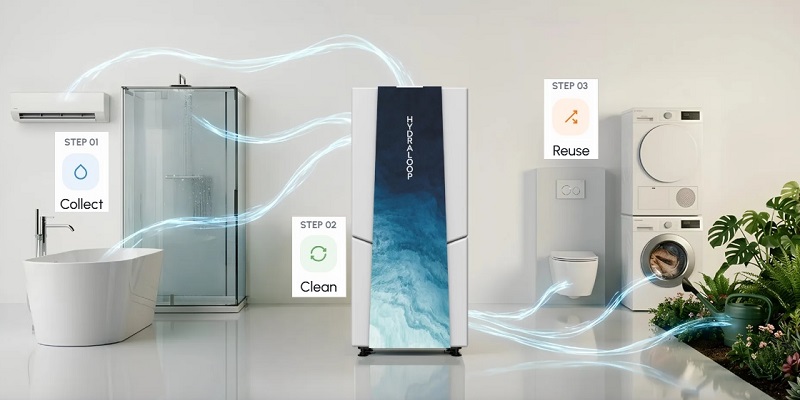
3 Key Steps of a robust Graywater System as illustrated by Hydraloop
Image courtesy of Hydraloop
While residential systems focus on simple filtration for irrigation, industrial data centers use intensive, multi-stage membrane purification to treat wastewater for high-pressure cooling systems. This industrial-grade, onsite membrane technology is increasingly filtering down to the residential market, enabling advanced, in-home recycling systems that can reduce water footprints by up to 45%.
The scale of the blackwater opportunity is also significant: according to EPA estimates, toilet flushing alone accounts for 24–30% of all indoor household water use—water that advanced residential recycling systems can now intercept, treat, and route right back to that same toilet. Combined, graywater and toilet reuse together address roughly 75–85% of all indoor household water consumption, making whole-home water recycling one of the highest-leverage resilience upgrades available to homeowners today.
A Note on Spelling: Why We Use “Graywater”
You’ll encounter this term spelled four different ways—”graywater,” “gray water,” “grey water,” and “greywater”—when researching systems, contractors, and products; they refer to the same thing. For this guide, we follow the professional and regulatory standard used in the US: graywater, one unhyphenated word. The EPA and most state regulatory bodies, including the California Plumbing Code, use “graywater” as a single word. It also mirrors its counterpart blackwater, establishing both as distinct technical classifications of wastewater, not casual color descriptions of the liquid itself.
Core Benefits: Why Graywater Matters
Implementing a graywater system offers deep, practical value that extends far beyond broad environmental altruism. For property owners and building professionals, this infrastructure pivot highlights a major opportunistic advantage:
- Landscape Resilience: Provides a reliable, constant, and drought-proof irrigation source that keeps high-value landscapes thriving even during mandatory municipal outdoor watering bans.
- Asset and Equity Protection: Safeguards thousands of dollars invested in mature trees, prize shrubs, and specimen plants from catastrophic, dry-season die-offs.
- Lower Utility Bills: Cuts overall household potable water consumption by 30% to 40% when utilizing advanced membrane systems to safely loop water into indoor toilets and laundry machines, directly dodging expensive, tiered drought surcharges.
- Infrastructure Independence: Insulates your property from the escalating strains placed on local municipal grids by heavy industrial competitors and failing snowpacks.
- Market Differentiation: Gives custom builders, architects, and real estate professionals a distinct, high-performance sustainability credential that drives premium asset valuations.
What Can Graywater Actually Water?
A common point of confusion is which plants can safely receive graywater. The answer depends heavily on whether you are routing raw, unfiltered water via gravity, or using an advanced membrane treatment system.
For unfiltered, gravity-fed systems, follow this strict safety breakdown:
🟢 Approved (The Best Targets)
- Ornamental Trees and Shrubs: Deep-rooted varieties thrive on consistent, high-volume subsurface flows.
- Fruit Trees: Citrus and stone fruits benefit if water stays strictly at the root zone.
- Large Perennials: Woodier species like rosemary handle laundry-to-landscape water exceptionally well.
🟡 Use With Caution
- Lawns: Overhead spraying is illegal due to pathogen inhalation risks. Lawns require sub-turf drip lines.
- Sub-Surface Drip Lines: Raw graywater lint and hair easily clog standard irrigation emitters. Special wide-aperture lines are mandatory.
- Acid-Loving Plants: Blueberries and azaleas struggle over time because laundry water is slightly alkaline.
🔴 Avoid Entirely
- Edible Root Vegetables: Potatoes and carrots directly touch the soil and must never contact graywater.
- Leafy Greens: Spinach and lettuce carry high splash-contamination risks from untreated water.
💡 The Multi-Stage Exception
If your property utilizes an advanced Membrane Bioreactor (MBR) system, these biological and botanical restrictions largely disappear. Because MBR systems filter out pathogens, lint, and chemical residues, the recycled water can safely run through standard automated drip systems, irrigate turf lawns, and water a broader variety of landscape features without clogging or health hazards.
Navigating the Regulatory Landscape
The regulatory framework for residential water reuse varies dramatically across the country. In many U.S. regions, basic Laundry-to-Landscape (L2L) setups are exempt from formal building permits if they adhere to strict health and safety standards, making them an accessible weekend project.
California’s tiered model demonstrates this baseline, carefully distinguishing between no-permit washer-pump systems and permit-required modifications involving structural household drainage pipes. While state frameworks create these legal pathways, local municipal codes, county health departments, or homeowners associations can impose much stricter regulations.
A History of Tiered Frameworks
California first legalized residential graywater in 1994, with a landmark regulatory overhaul in 2009, establishing the exact tiered blueprint that many water-stressed states follow today. Under Chapter 15 of the California Plumbing Code (CPC), the state officially codifies the boundaries between simple, homeowner-driven laundry setups and complex, engineered whole-house loops.
The Permit-Free Exception
Under state law, a standard L2L setup can be installed without filing plans, paying fees, or waiting for an inspector. To maintain this exempt status, the installation must satisfy strict performance mandates:
- Subsurface Discharge: Water must drain entirely under a two-inch cover of mulch, rock, or soil—never as an open pool or surface spray.
- Diverter Valve: The setup must include an accessible, clearly labeled three-way valve to immediately route water back to the sewer line if needed.>
- No External Pressurization: The system must rely strictly on the washing machine’s internal discharge pump. Adding an external pump or holding tank instantly voids the permit exemption.
Permit-Required Systems
Any system that taps into your home’s permanent drainage plumbing—such as permanently cutting into the waste lines of showers, bathtubs, or bathroom sinks—requires formal architectural plans, hydraulic calculations, local building department permits, and site inspections.
The Municipal “Gotcha”
Always remember that local cities and county health boards retain final veto power. They have the authority to layer additional restrictions, mandate backflow preventers, or completely ban graywater use regardless of broad state-level permissions. Always verify rules with your local building office before starting any installation.
“Is Graywater Right for Me?” A Decision Framework
Before investing in hardware or drafting plans, evaluate your property across five critical dimensions to determine your optimal setup:
- Landscape Alignment: High-value trees, large shrubs, and dense perennial beds are the ultimate targets. If your landscape is strictly raised vegetable beds, a basic graywater system provides little utility. However, if you have a sprawling turf lawn, an advanced membrane system can keep it green year-round.
- Topography and Elevation: Gravity is your cheapest asset. If the yard slopes gently downhill from the house, a low-maintenance, gravity-fed system is ideal. If the landscape slopes uphill, you must budget for a pressurized pump or an indoor MBR unit to push water against gravity.
- The Yield-to-Demand Ratio: Match your indoor household output to outdoor irrigation needs. A family of four typically generates 50 to 150 gallons of graywater per day from showers, sinks, and laundry. This is enough to sustain a modest orchard, but it can easily oversaturate a compact courtyard.
- The Real Estate Footprint: Basic systems require zero indoor space because water immediately exits the home. Advanced, multi-stage filtration units like Hydraloop or Ecovie require a dedicated interior footprint. Builders and architects must allocate garage, basement, or utility room clearance for the treatment tanks.
- The DIY vs. Professional Technical Threshold: Tapping a washing machine discharge hose is an accessible weekend DIY project. Conversely, cutting into structural waste stacks or intercepting upper-story shower lines requires a licensed, green-certified plumbing professional.
Common Types of Systems and Financial Realities
Residential graywater hardware solutions scale directly with mechanical complexity, automation, and treatment capabilities.
Before You Invest: The Bucket Test
The simplest graywater strategy requires no permits, no plumbing, and no hardware whatsoever—just a bucket. Two common household applications illustrate the point:
The Shower Bucket: Place a bucket in the shower to catch the cold water while you wait for it to warm up. That collected water can go directly to outdoor plants or garden beds—clean, legal in every US state, and universally classified as graywater.
The Kitchen Bucket: A bucket placed in the kitchen sink while rinsing fruits and vegetables during food prep collects some of the cleanest incidental household water imaginable—and many homeowners instinctively redirect it to garden beds. Technically, kitchen sink water is classified as blackwater under most US plumbing codes—including California’s—due to the broader category of food particles, fats, and oils that can pass through that drain. Produce-rinse water sits at the safest end of that spectrum, but the classification is blanket rather than use-specific. For ornamental trees and shrubs with subsurface application, the practical risk profile is very low. That said, confirm your local requirements before adopting this practice, and avoid any water that has contacted raw meat, poultry, or fish entirely.
Both approaches cost nothing, waste nothing, and give any homeowner an immediate, tactile sense of how much usable water disappears down the drain every day. Once you’ve watched a five-gallon bucket fill in a single session, the case for a more permanent system tends to make itself.
Consider it a way to get your feet wet.
3 Primary Tiers of Systems
Expected costs and mechanical structures break down into three distinct market tiers:
1. Laundry-to-Landscape (L2L)
How It Works: Directs water from your washing machine by utilizing the washer’s internal drain pump to push water out through a dedicated multi-outlet distribution line.
DIY Financial Reality: $200–$500 for a DIY project using off-the-shelf retail components.
Pro Financial Reality: $1,000–$2,500 for a licensed installer.

Laundry-to-Landscape graywater diverter connection
Image courtesy of Greywater Corps
2. Branched Drain Systems
How it works: Intercepts plumbing waste lines from showers, tubs, or bathroom sinks using pure gravity to guide water through sloped pipes that split into underground mulch basins. Requires no pumps or electricity.
DIY Financial Reality: $500–$1,500 for DIY materials (highly dependent on crawlspace or basement plumbing access).
Pro Financial Reality: $2,500–$5,000 for a professional retrofit.
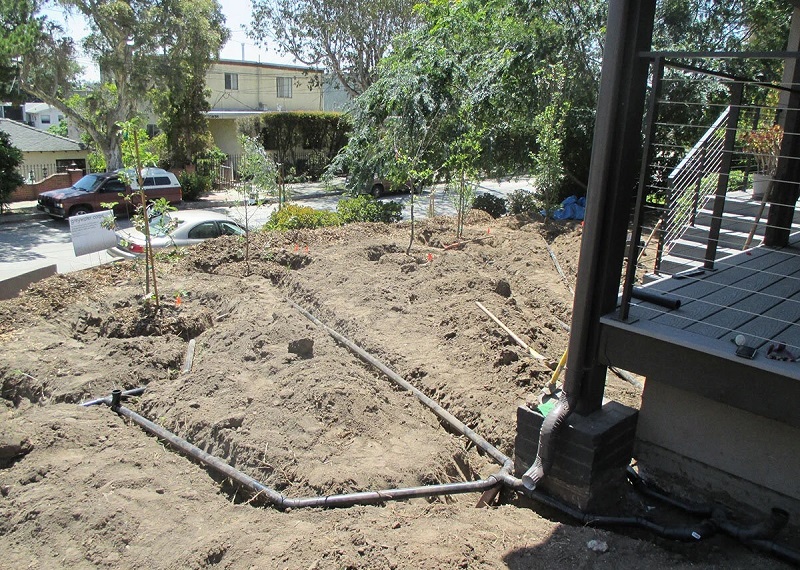
Branched drain installation in the front yard of a home
Image courtesy of Greywater Corps
3. Automated Pump & Advanced Filtration Systems
How It Works: Collects water from multiple household fixtures into an underground or indoor surge tank, then runs it through advanced membrane filtration—the same core technology used in industrial water reuse facilities—to treat water to near-potable standards. Unlike gravity systems, membrane-filtered water can be safely stored beyond 24 hours, pumped through automated drip-irrigation lines without clogging emitters, or routed back inside the home to flush toilets.
Unlike off-the-shelf L2L components, advanced membrane systems are procured through certified contractor and dealer networks—homeowners work with a licensed plumber, septic engineer, or green-certified contractor who coordinates directly with the manufacturer to size and install the system to local code. For architects and builders, both BioMicrobics and Ecovie maintain dedicated residential pipelines and can be integrated directly into custom home project specifications.
Pro Financial Reality: $8,000–$18,000+ for fully engineered, professionally installed systems.
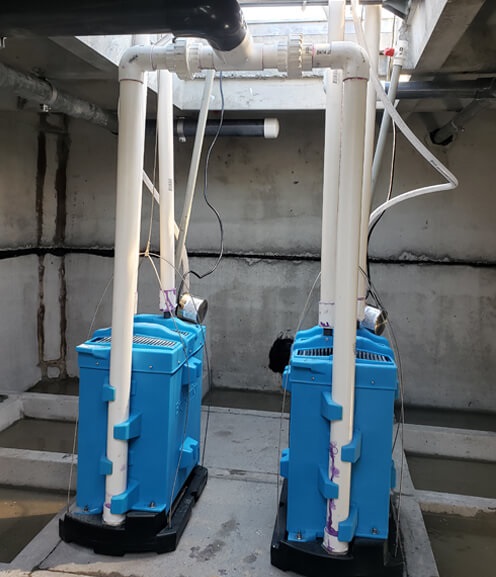
BioMicrobics BioBarrier residential installation—submerged ultrafiltration membrane technology, scaled for single-family home use.
Image courtesy of BioMicrobics
Innovative Solutions & Component Sourcing
Homeowners looking to implement a graywater infrastructure pivot can choose between high-end, turnkey architectural appliances or highly customizable, component-level DIY setups.
System-Level Architectural Appliances
The most sophisticated residential graywater appliances bring industrial-grade membrane bioreactor (MBR) and ultrafiltration technology—the same systems data centers and heavy industries use to scrub and recycle wastewater in closed-loop cooling towers—down to the scale of a standard household appliance.

Rendering of a Hydra H300 graywater recycling system installed in a large laundry room
Image courtesy of Hydraloop
Three prominent brands lead this premium market tier:
- Hydraloop: A sleek, award-winning indoor recycling appliance that purifies graywater using a multi-stage biological and UV treatment process—entirely eliminating disposable filters or harsh chemical additives—and recycles it back into the home for toilet flushing and washing machine inputs. Hydraloop holds prestigious NSF/ANSI 350 certification (the gold standard for residential water reuse), verifying fresh water demand reductions of 40% to 45%.
- BioMicrobics BioBarrier: A rugged, sub-surface or basement system engineered around submerged ultrafiltration membranes operating directly inside a centralized treatment tank. This unit miniaturizes industrial-scale MBR architecture to pull a 99.9% contaminant-free stream from household bathing and laundry lines.
- Ecovie Aqualoop: This setup scales Moving-Bed Bioreactor (MBBR) technology down to single-family home modules. By pairing a fluidized biological bed with independent ultrafiltration membranes, it allows for safe, long-term treated water storage and whole-home reuse.
- Flotender: A robust, professional-grade outdoor option that specializes in automated multi-zone irrigation. It acts as a specialized distribution processor, utilizing specialized commercial components like Netafim drip lines to distribute water evenly across complex yard layouts without manual valve flipping.

On the Horizon: The Hydraloop Upfall Shower—currently available in Europe with international rollout planned for mid-2026—delivers a full spa-shower experience while cutting water and energy use by up to 80% through real-time recirculation and UV-C purification. A category worth watching.
Image courtesy of Hydraloop
DIY Component Sourcing & Storefront Essentials
For homeowners building a direct Laundry-to-Landscape (L2L) or a gravity-fed branched drain loop, the fundamental mechanical components are highly accessible via local plumbing suppliers and specialized online storefronts:
- 3-Way Diverter Valves: The critical control center of any basic setup. These manual or electronic valves allow you to bypass your irrigation field instantly and redirect water back to the municipal sewer stack during winter freezes or when running harsh household bleach loads.
- Aqua2use Filtration Kits: A premier brand for physical sediment removal, engineered by Matala Water Technology. These systems utilize durable, multi-stage progressive filtration blocks that drop directly into surge tanks to mechanically screen out heavy hair, lint, and other impurities before water enters your landscape lines.
- Distribution Materials: Standard 1-inch and 1.5-inch PVC piping, dual-rotator flow splitters, inline mesh sediment filters, and specialized wide-orifice subsurface emitter tubing designed specifically to distribute raw water beneath mulch basins without clogging.
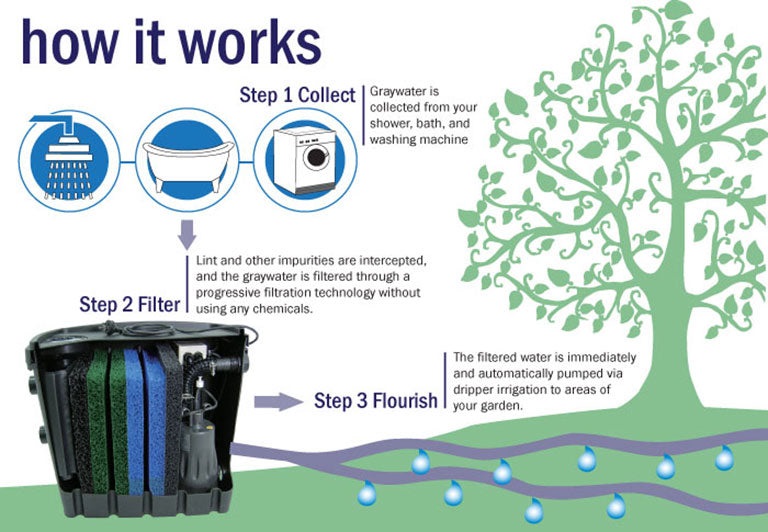
How the Aqua2use graywater filter works
Image courtesy of Aqua2use
Maintenance, Upkeep, and Frequently Asked Questions
Graywater systems are not completely “set-and-forget.” They require basic, ongoing operational discipline to remain hygienic and clog-free:
Four Rules of Operational Care
- The 24-Hour Rule: Untreated graywater contains organic nutrients and bacteria. It must be discharged and filtered through soil within 24 hours. Storing graywater any longer allows bacteria to multiply, creating severe septic odors.
- Routine Filter Cleans: Homeowners must regularly clean out lint traps, hair strainers, or mesh filters to ensure lines do not clog and cause plumbing backups. Neglecting filters causes field clogs and indoor plumbing backups.
- Seasonal Diverter Management: Flip your 3-way valve during heavy winter rains. Sending water to the municipal sewer prevents yard pooling. Always divert water when running harsh chemical loads.
- System Lifespan: High-quality, gravity-fed PVC lines have no moving parts and can last 20 to 30+ years. Automated pump configurations and smart mechanical valves are more complex and generally require component replacement every 5 to 10 years.
Homeowner Safety & Upkeep FAQ
Is graywater safe?
Yes, when managed properly. Graywater must always be discharged entirely beneath a thick layer of wood mulch or soil. It must never be allowed to pool on top of the ground, spray through sprinklers, or run off your property lines.
Does it smell?
Not if installed correctly. Graywater only smells if it is stored in a tank for more than 24 hours or if it pools on the surface. Subsurface discharge into mulch beds ensures the water breaks down cleanly and odor-free.
What soaps are landscape-safe?
Switch to liquid, plant-based, biodegradable detergents that are entirely free of boron, salt, and chlorine. Powdered detergents often contain high levels of sodium, which will damage your soil structure over time.
Will it attract pests?
No. Because the water is discharged completely underground into mulch basins, there is no standing surface water to attract mosquitoes, flies, or rodents.
What happens if I sell my home?
Permitted graywater systems add verified structural value and must be disclosed during real estate transactions like any other plumbing asset. Conversely, unpermitted plumbing modifications create major title and inspection liabilities during escrow. Sticking to state compliance codes protects property equity.
Does the 24-hour rule apply to all systems?
No. This rule only applies to untreated, gravity-fed setups. Advanced certified filtration systems—like Hydraloop, BioMicrobics, and Ecovie—treat water to near-potable standards. This process destroys the pathogens that cause odors and drive the 24-hour limit for untreated setups. Advanced systems allow treated water to be stored in sealed tanks for extended periods and pumped on demand.
Where the Industry Is Heading: Recent Trends
Residential water management and infrastructure are evolving rapidly, shifting graywater from a niche interest into mainstream home building:
- Smart Home Tech Integration: Modern automated graywater valves now feature built-in IoT flow meters and Wi-Fi connectivity, allowing homeowners to monitor exactly how many gallons they save in real time directly via smartphone apps.
- National Code Modernization: Both the Uniform Plumbing Code (UPC) and International Plumbing Code (IPC) have overhauled their water reuse frameworks. These updates standardize permitting for advanced interior treatment systems, making adoption vastly easier nationwide.
- Net-Zero and Dual-Plumbing Construction: Innovative home builders are increasingly installing dual-wastewater plumbing loops during initial structural framing. Designing code-compliant drainage separations from day one completely eliminates the prohibitive cost of future plumbing retrofits.
- Community-Scale Deployments: Leading brands like Hydraloop exemplify this new construction shift. Because in-home shower-to-toilet recycling requires separate dedicated drainage plumbing loops, forward-thinking master-planned developers are increasingly deploying these systems across entire water-scarce neighborhoods to bypass strict municipal water allocation limits.
Getting Started: Implementation Checklist
If you are ready to secure your property’s landscape and insulate your investment from municipal restrictions, use this step-by-step framework to launch your project:
📋 Phase 1: Diagnostic Assessment
- ✅ Verify Jurisdictional Policy: Call your building department to check Laundry-to-Landscape permit exemptions.
- ✅ Audit Drainage Elevation: Confirm targeted planting beds sit downhill from your drainage pipes.
- ✅ Map Landscape Targets: Count permanent trees and shrubs to locate subsurface mulch basins.
- ✅ Calculate Daily Yield: Multiply household members by 30 gallons to estimate daily output.
📋 Phase 2: Execution Pathways
For Basic DIY Laundry-to-Landscape Setups:
- ✅ Swap Household Soaps: Switch immediately to liquid, boron-free, plant-based detergents.
- ✅ Procure Diversion Hardware: Order a high-quality 3-way diverter valve and PVC fittings.
- ✅ Dig Subsurface Basins: Excavate dedicated trench lines filled with deep wood mulch.
For Advanced Whole-Home Membrane Recycling:
- ✅ Allocate Mechanical Space: Dedicate garage or utility room footprint for filtration tanks.
- ✅ Contact Certified Dealers: Reach out to authorized manufacturer networks for equipment sizing.
- ✅ Hire Licensed Plumbers: Retain green-certified contractors to draft dual-plumbing blueprints and install the system.
The Bigger Picture: Your Home as a Water-Resilient System
A graywater system is far more than a simple plumbing upgrade. It marks another fundamental evolution in the capabilities of high-performance homes.

The most forward-thinking homes being designed and built today are not just shelters; they are multifunctional systems that generate, conserve, and cycle their own resources:
- Solar Panels with Battery Storage: Capture, store, and deploy localized energy independent of the grid.
- Rainwater Harvesting: Collects and preserves clean atmospheric precipitation for landscape and household use.
- Graywater Infrastructure: Closes the loop on indoor waste streams, turning a daily liability into a drought-proof landscape asset.
- Biochar-Amended Soil: Supercharges the receiving end of your graywater system—improving soil structure, water retention, and nutrient cycling so that every recycled gallon works harder and goes further. (Learn more about biochar’s many benefits)
This is the natural evolution of the modern home—from passive consumer of municipal infrastructure to an active, resilient participant in its own resource management. In a period when water supplies are being strained by drought, population growth, and the insatiable cooling demands of a data-center economy, the homeowners who act first will be the ones who worry least tomorrow.
Graywater Resources
- The Grey Water Project: A prominent non-profit organization focused heavily on public outreach, localized water conservation initiatives, and educational school curricula to promote safe residential water reuse.
- Greywater Action: The premier national educational collective for home-scale water reuse. This hub offers comprehensive online classes, a searchable database of plant-safe detergents, and extensive case studies on gravity-fed layouts.
- Greywater Corps: A Los Angeles-based company specializing in graywater and rainwater design, installation and education.
- Oasis Design: Curated by Art Ludwig, the mechanical innovator who originally pioneered and open-sourced the “Laundry-to-Landscape” and “Branched Drain” plumbing layouts. This site serves as the ultimate archive for detailed hydraulic charts, flow-splitter schematics, and plumbing code history.
- San Francisco Graywater Design Manual: Published by the San Francisco Public Utilities Commission, this blueprint is widely considered the gold-standard municipal reference guide in the United States. It provides clear, highly visual step-by-step instructions for calculating household water yields, mapping plumbing slopes, and sizing mulch basins.
- Water Recycling Systems (WRS): A highly experienced, California-based residential water-recycling contractor specializing in advanced, permitted integrations. Their platform features great technical case studies on routing treated graywater directly into residential automated irrigation networks and indoor toilet-flushing lines.
Additional Recommended Water & Resilience Reading
- What is Smart Irrigation?
- Biochar: How to Make Your Home More Resilient with This Ancient Soil Secret
- How to Manage the Rising Costs of Homeownership
- Permeable Paving: Sustainable Benefits That Will Make Your Home Beautiful
- Why Your Next Home Should Be Built Like a Computer
- Tankless Water Heaters: On-Demand Energy Efficiency for the Home
- A Simple Guide to Choosing a Water Softener System
- How to Choose a Water Leak Detection System for Your Home
- Related Topics: Water | Resilience | Lawn Care | Utilities | Green Solutions
| Purgula is reader-supported. When you click on links to other sites from our website, we may earn affiliate commissions, at no cost to you. If you find our content to be helpful, this is an easy way for you to support our mission. Thanks! Learn more. |