
Last updated on May 5, 2026
Each year, behind the doors of some of the country’s most beautiful homes, something remarkable happens:
spaces are reimagined, problems are solved creatively, and design ideas move from concept to reality.
Entering its 61st year, The Pasadena Showcase House (PSH) stands as one of the premier showcase events in the country. This year’s edition at Baldwin Oaks Estate is no exception. More than just a stunning display of style, PSH 2026 offers a rare opportunity to see how top designers tackle real-world renovation challenges—transforming outdated layouts, navigating structural limits, and breathing new life into an older historic home.
For homeowners planning their own renovations or design refreshes, showcase houses like PSH serve as living laboratories for your imagination. They reveal practical solutions to tricky spaces—awkward floor plans, limited natural light, or historic preservation constraints—while demonstrating how to balance ambition with budget and building codes. Instead of relying solely on photos or inspiration boards, visitors can experience these ideas in person, gaining a much clearer sense of scale, flow, and what actually works.
Beyond inspiration, showcase homes also support meaningful charitable causes, turning each ticket into a philanthropic contribution that extends far beyond design. As the primary fundraiser for Pasadena Showcase House for the Arts, PSH turns design appreciation into direct support for music programs, scholarships, and arts education across Southern California. The result is a space where creativity and community intersect—where you can meet designers, explore their work up close, and begin building connections with professionals who understand both the art and the realities of renovation.
Whether you’re planning a full-scale remodel or simply gathering ideas, attending a Showcase House can fundamentally change how you think about your home. It’s not just about beautiful imagery—it’s about experiencing what’s truly possible.
What follows is what we learned about this year’s Pasadena Showcase House—Baldwin Oaks Estate, a 1907 shingle-style two-story home in Arcadia, California—and how these insights can be applied to design challenges encountered in homes of all sizes, shapes, and styles. Keep in mind that this is just a subset of this marvelous home, so we encourage you to take an in-person tour!
Details on spaces not covered here can be found in the 2026 PSH digital program.
Pasadena Showcase House 2026: Baldwin Oaks Estate
- About Baldwin Oaks Estate
- Pygmalion Transformations
- Architectural Challenges
- Rooms That Tell a Story
- Elevated Functionality
- The Entertainment Room: Layered Hospitality
- Design Secrets & Hidden Details of PSH 2026
- About the Pasadena Showcase House of the Arts
Also see:
- 5 Spectacular Rooms from the 2025 Pasadena Showcase House
- Timeless Hardscaping Inspiration From the 2025 Pasadena Showcase House
- A Design Recap of The 2024 Pasadena Showcase House
- Design Inspiration from the 2024 Pasadena Showcase House of Design
- Pasadena Showcase House 2024: A Tudor Kitchen Comes To Life
- More Recommended Reading
- Related Topics: Design Events | Architecture | Inspiration | Indoor-Outdoor Living | Restoration
About Baldwin Oaks Estate
The Diamond Princess’s Crown Jewel
Built in 1907 as “Twin Oaks” during the height of the American Arts & Crafts movement, Baldwin Oaks Estate is an 8,065 square foot shingle-style residence on nearly two acres of mature oaks, pines, camphor, and palms in Arcadia, California.

Watercolor painting by Lynn Van Dam Cooper of Baldwin Oaks Estate, the 61st Pasadena Showcase House, Arcadia, California
Image courtesy of the Pasadena Showcase House of Design and Lynn Van Dam Cooper
The two-story home features a circular driveway, wraparound porch, hand-finished oak paneling, massive beams, a grand central staircase, five expansive bedrooms (several with fireplaces and private baths), and generously proportioned living spaces, including a grand living room, library, family room, dining room, and entertainment spaces. These impressive attributes define a residence that has quietly witnessed nearly 120 years of Southern California life. Despite shrinking boundaries due to surrounding subdivisions, the property itself has remained largely unaltered.
The original architect remains unknown, though period accounts have long speculated a possible connection to the Greene & Greene office. The property was purchased in 1909 by Clara Baldwin Stocker (1847–1929) and her husband Harold Stocker, becoming her personal crown jewel on land once part of her father’s vast ranch.

Up close view of the front entrance to Baldwin Oaks Estate, the 61st Pasadena Showcase House of Design, in Arcadia, California
The real story belongs to Clara, eldest daughter of pioneering magnate Elias “Lucky” Baldwin—the man who literally shaped Arcadia—from whom she inherited both fortune and flair. Known locally as the “Diamond Princess,” she was glamorous, charismatic, and unapologetically lavish. She draped herself in diamonds, hosted legendary multi-day parties that drew celebrities, athletes, and the social elite, and even received Arcadia’s very first liquor license. Those unforgettable soirées—echoing with music, laughter, and clinking glasses under the California sun—still remain part of local folklore.
In this year’s PSH, designers have leaned deeply into that provenance. From the grand living room to the intimate nooks and garden rooms, every space draws inspiration from Clara’s larger-than-life personality and the home’s Golden Age roots:
honest craftsmanship, warm oak tones, deep-set windows, and a sense of effortless social prestige.
The result is a fresh yet respectful reimagining that honors the original bones while layering in modern artistry, texture, and narrative depth.
When you step through the front door, you’re not just touring a showcase house—you’re experiencing a living chapter of California history. A place where the Diamond Princess once held court, where the walls still seem to remember the music and laughter, and where every unveiling detail makes you want to learn more.
Baldwin Oaks Estate is available to tour from April 19 – May 17, 2026
Hours of Public Tours:
- Monday: Media Invite Only
- Tuesday, Wednesday, Thursday: 9:30AM – 5:00 AM
- Friday: 9:30AM – 6:30PM
- Saturday, Sunday: 9:30AM – 5:00PM
For event information visit: pasadenashowcase.org
Tickets can be purchase online at tickets.pasadenashowcase.org
or by calling 626-606-1600 (6AM-6PM seven days a week)
Pygmalion Transformations
During the PSH Empty House Party—held in late January just prior to the commencement of house-wide renovations—we took care to observe closely the condition of each space in its original, gutted state. This year, we devoted particular attention to the bathrooms, as they appeared to require the most extensive renovations.
The empty house offers attendees a unique opportunity to view the home in its raw, unfinished form—essentially a coarse, blank canvas for the designers tasked with its transformation. From irregularly placed crossbeams to outdated knob-and-tube electrical wiring, the challenges are both visible and substantial. For this reason, the designers undertaking the most arduous makeovers might aptly be described as architectural ‘Henry Higginses’—Pygmalion specialists who see past the rough, unpolished character of an old, “stubborn” home, with laser focus on the dormant sophistication waiting to emerge.
From our perspective as homeowners, the most impressive makeover triumphs were achieved by three designers, each of whom reimagined distinctly different bathrooms or powder rooms, transforming them into spaces that are both highly functional and aesthetically refined.
The Hidden Powder Room at the Grand Entry
Designed by Iryna Helmy Interiors
Tucked discreetly to the left of the grand entry of the historic Baldwin Oaks Estate, the Hidden Powder Room by Iryna Helmy Interiors transforms a modest utilitarian space into an intimate jewel-box experience. Designed to complement the grandeur of the home’s opulent gardens with mature trees that surround the property. The remodeled room offers a moment of surprise and discovery, as it provides both a functional necessity and a memorable design moment for guests entering the residence.

View of the elegant Hidden Powder Room designed by Iryna Helmy Interiors in Baldwin Oaks Estate, 61st Pasadena Showcase House
Image courtesy of the Pasadena Showcase House and Iryna Helmy Interiors
With Phillip Jeffries wallpaper in green and gold and a Made Goods vanity with a tree trunk design, Helmy gives visitors a transition from the stately openness of the foyer into a more personal and enveloping environment, reinforcing the sense that even the smallest rooms deserve the same artistry as the larger spaces.

Tree trunk sink in the Hidden Powder Room designed by Iryna Helmy Interiors in Baldwin Oaks Estate, the 61st Pasadena Showcase House
Image courtesy of the Pasadena Showcase House and Iryna Helmy Interiors
The powder room’s hidden quality heightens its sense of intrigue, encouraging guests to step beyond expectation into a carefully composed interior narrative. The resulting design reflects the philosophy that small spaces offer powerful opportunities for creative expression and memorable experiences.
In a home defined by craftsmanship, detail, and layered history, the powder room becomes an intimate counterpoint to the sweeping architectural gestures of the grand entry. It is conceived as a moment of pause—an experiential retreat where design detail becomes immersive and personal.
The Fireplace En Suite Bathroom
Designed by Jill Romine Interior Design
We spent time with Jill Romine, founder of Jill Romine Interior Design—a bicoastal firm with offices in NYC and LA—during the Empty House Party, gaining insight into her vision for the Fireplace En Suite Bathroom. The room’s generous proportions (16′ x 9′) provided an expansive canvas, particularly for the extensive tilework required in both the large shower (54″ x 54″) and flooring.

View of the Shropshire bathtub and Godiva Calacatta marble backsplash, in the Fireplace En Suite designed by Jill Romine Interiors in Baldwin Oaks Estate, the 61st Pasadena Showcase House
Image courtesy of the Pasadena Showcase House and Jill Romine Interiors
Romine navigated several design challenges within the space (see the Architectural Challenges section of this article), yet her persistence and creative problem-solving makes her an ideal collaborator for homeowners seeking a designer capable of thoughtful innovation under pressure.
The finished space reflects Romine’s narrative-driven approach, transforming a traditional architectural feature into both the emotional and visual focal point of a private retreat. Her work demonstrates how contemporary storytelling and historic architecture can be brought together in refined harmony.
Rich tile and stone selections—including Fireclay Tile’s Chaparral Gloss and Tempest Gloss, expertly fabricated and installed by Pierre Royal—lend the room an intimate, inviting character.
A freestanding clawfoot Shropshire tub by Victoria + Albert (House of Rohl) pays homage to the Victorian era, complemented by a vintage-inspired pendant light overhead. Stacked sconces provide layered illumination, while the walls, finished in Dunn-Edwards French Press Coffee, create a warm, enclosing backdrop.
Godiva Calacatta marble, used for both the tub backsplash and vanity, introduces a subtle sense of luxury that completes the design.
Le Petite En Suite
Designed by Rhonda Angell Interior Design
Le Petite En Suite is perhaps the most dramatic transformation at this year’s Pasadena Showcase House of Design 2026. Rhonda Angell reimagined the once-drab, poorly laid-out bathroom by relocating a massive shower stall that blocked a west-facing window overlooking the verdant foothill grounds of San Gabriel Valley.

View of the elegant, resituated walk-in shower in the Petite En Suite
Image courtesy of the Pasadena Showcase House and Rhonda Angell Interior Design
The shift of the shower stall to the opposite wall allowed elegant swirling marble—used on both the shower walls and flooring—to reflect light alongside gold toned House of Rohl fixtures. A custom vanity, repurposed from a 1920s Michigan dresser—from Angell’s home state—adds vintage character in keeping with the home’s Craftsman style. Though Angell completely gutted the room to the studs, she replicated the aesthetic spirit of the original crown moulding, paneling, and wainscoting to maintain the room’s historic charm—with the latter custom designed by Angell.
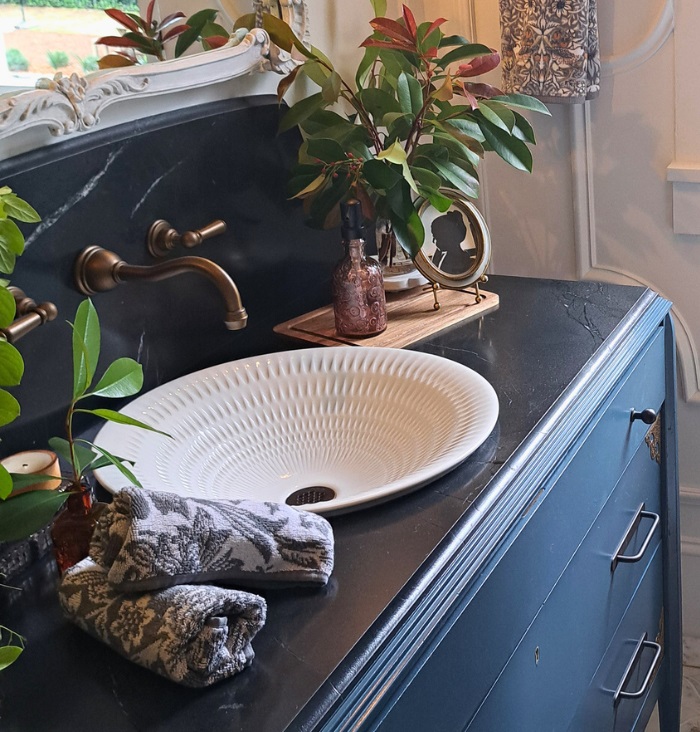
A small framed photo of Angell’s sister rests atop of the masterfully repurposed Michigan dresser serving as the colorful vanity in the Petite En Suite
Light personal touches, such as a small black and white photo of her then four or five year-old sister—taken by their mother—adds a poignant element that syncs with the room’s warmth and comfort.
The space now proudly entices visitors inward, its window thrown open to frame the living sights and gentle sounds of the surrounding lush landscape.

View of the entrance to Le Petite En Suite from the Magnolia Room, designed by Cordrey Collection, with both designs meshing seamlessly without any foreknowledge of the other’s design plans
Architectural Challenges
Designing within the Pasadena Showcase House presents a unique set of challenges that go far beyond aesthetics. Each space carries the weight of its original infrastructure and architectural history, often revealing limitations that must be thoughtfully addressed rather than simply concealed. Designers are frequently asked to work within existing conditions that were never intended for contemporary use—awkward layouts, outdated systems, and structural quirks that require both ingenuity and restraint.
At the same time, scale can become its own obstacle.
Many rooms are unusually large, demanding strategies to introduce warmth, proportion, and a sense of human intimacy without diminishing their inherent grandeur. In these expansive settings, the challenge lies not in making a space feel bigger, but in making it feel lived-in, inviting, and emotionally grounded.
Here we explore how designers navigated these layered constraints—balancing preservation with reinvention, and transforming architectural challenges into opportunities for creativity. Through problem-solving, collaboration, and a deep sensitivity to context, they demonstrate how limitations can ultimately become the foundation for the most compelling design outcomes.
The Bloom Lounge
Designed by The Art of Room Design
Baldwin Oaks Estates was known for wild decadent soirees when the Mistress of the House, Clara Baldwin Stocker, held its keys. Imagine the scale of rooms designed for entertaining guests, during that era and you understand the issues that today’s designers must resolve.
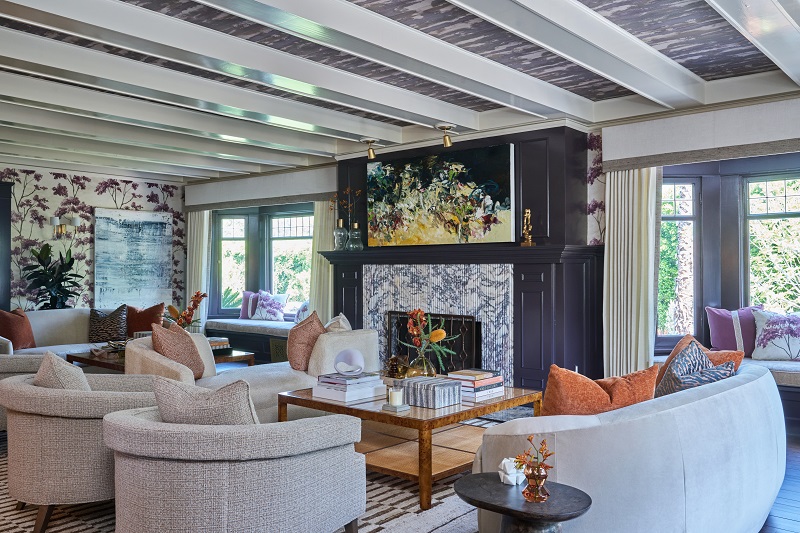
View of the center area of the expansive Bloom Lounge expertly appointed and designed by The Art of Room Design
Image courtesty of the Pasadena Showcase House and The Art of Room Design
Maria Videla-Juniel and Cheryl Hardy of The Art of Room Design are no strangers to large foreboding spaces. We have seen their work at several PSH rooms, and they are adept at introducing intimacy, warmth and proportion to vast canvases. The Bloom Lounge is an excellent example of the duo’s creativity and expertise with proportion, using color, furniture and art to deflect impersonal vastness in an open space.
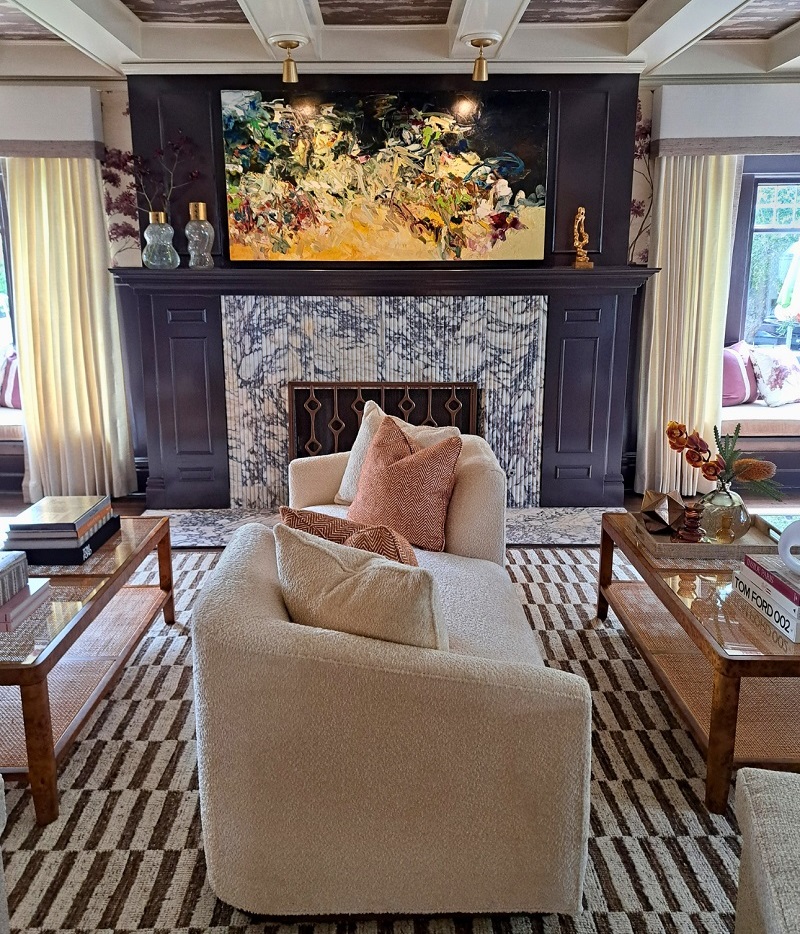
View of the highly versatile bouclé tête-à-tête sofa that connects both sides of the enormous living room, that is placed directly in front of the statement fireplace and painting, by Harry Moody
Dunn Edwards French Press Coffee was chosen to reduce the scale of the room to make it more inviting and intimate. Furniture choices—such as the bouclé tête-à-tête sofa strategically situated in the center of the room—surreptitiously create conversation areas for large or small groups of guests. These design choices are masterful ways to make the room functional and attractive on a human scale.

Sleek, low-profile sofa bench placed in front of the large front-of-the-house window with two bolster pillows in burnt orange, the accent color of the living room
The Fireplace En Suite
Designed by Jill Romine Interior Design
As we mentioned, The Fireplace En Suite had a number of challenges due to constraints in the existing architectural infrastructure, combined with specific preferences of the homeowner. These obstacles required Romine to go through four design iterations in order to reach a successful outcome:
- Romine’s First Design Change was required due to the need for a structural engineer, a cost not part of the budget. Floor joists and wall mechanicals were also not compliant with the original design.
- Design Option Two required that the standalone tub be moved further away from the toilet, which was basically within arm’s reach.
- Design Three incorporated the homeowner’s preferences for the vanity design, including placement for the mirrors and sconces.
- The Final Design (number four) is what you see when visiting the completed Fireplace En Suite Bathroom—an homage to the Arts & Crafts era with quiet contemporary elements that blend seamlessly.
Rooms That Tell a Story
In the most compelling interiors, a room is never just a composition of materials, furnishings, and light—it is a narrative unfolding in three dimensions. Designers working in historic settings such as Baldwin Oaks are not simply decorating; they are translating memory into atmosphere, and architecture into story.
Every house begins with an inherited voice. The period in which it was built leaves its imprint—whether through the symmetry of its façade, the craftsmanship of its millwork, or the way rooms were originally intended to be used. A 1900s estate, for example, may still carry the quiet formality of its era, suggesting parlors for receiving guests and dining rooms designed for ritual rather than routine. In contrast, later alterations and renovations introduce new chapters, sometimes in tension with the original, sometimes in harmony with it. The designer’s task is not to erase these layers, but to read them, respect them, and decide how they continue the story forward.
Equally influential are the imagined lives of those who came before. Even when names are lost to time, traces remain: a worn threshold where footsteps once gathered, a sunlit corner that suggests morning rituals, or a grand staircase that once echoed with evening arrivals. Designers often respond to these subtle cues by building a narrative bridge between past and present—allowing the home to feel inhabited not only by its current moment, but by a continuum of lives and uses. In showcase projects, like the Pasadena Showcase House of Design, where rooms are reinterpreted by multiple designers, this sense of layered authorship becomes even more pronounced, each space a chapter rewritten yet still aware of the original manuscript.

The Grand Staircase of Baldwin Oaks with a newly added runner that seamlessly connects the Entry to the Upstairs Foyer, with vibrant patterns, softened with muted colors. Designed by Blue Brick Design
Then there is the personal mythology of the designer—the quiet, often whimsical imprint of lived experience. A childhood memory of a coastal garden might reappear as a palette of weathered blues and sandy neutrals. A fascination with travel might surface in an unexpected juxtaposition of materials or a vignette that feels collected rather than composed. These details, subtle or bold, are where personality enters the architecture of storytelling. They transform a room from an exercise in style into something more intimate: a reflection of how the designer sees the world.
Ultimately, the art of storytelling in interior design is an act of translation. It converts history into atmosphere, biography into detail, and architecture into emotion. And in the most successful projects, the viewer does not simply observe the design—they enter the story, and find themselves part of it.
Here are three stellar examples of storytelling through design encountered at this year’s Pasadena Showcase House:
Entry and Upstairs Foyer
Designed by Blue Brick Design
In The Entry and Upstairs Foyer of the 61st PSH, design becomes a form of storytelling—one that honors the grandeur of California’s Golden Age while quietly reinterpreting it for contemporary life.
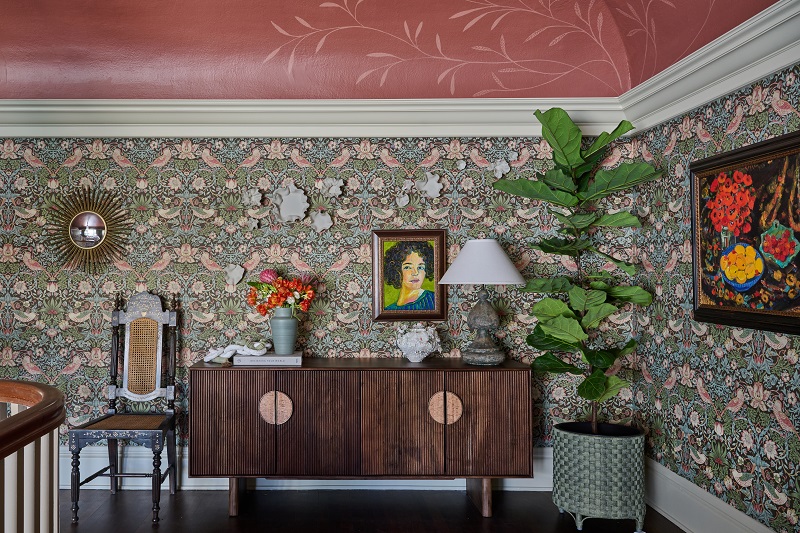
View of the Upstairs Foyer designed by Lara Hovanessian of Blue Brick Design
Image courtesy of the Pasadena Showcase House and Blue Brick Design
Designed by Lara Hovanessian of Blue Brick Design, these transitional spaces are far more than passageways; they are the opening chapters of the home’s narrative. Through carefully considered furnishings, layered wallpaper, nuanced paint palettes, and a thoughtfully curated selection of art, Hovanessian establishes a dialogue between past and present. Each choice contributes to a sense of personality and charm, transforming historically significant architecture into something intimate and lived-in.
Within these spaces, scale is not softened so much as translated. Grand proportions are balanced with moments of human detail: a console styled with collected objects, a chair placed as if momentarily abandoned, a vignette that invites pause and curiosity.

View of the Grand Staircase and Entry designed by Blue Brick Design
Image courtesy of Pasadena Showcase House and Blue Brick Design
The wallpaper pattern, Morris & Co. Strawberry Thief in Chocolate/Slate and Dunn Edwards Elusive Morel paint tone were selected not merely for decoration, but for atmosphere—shaping light, guiding movement, and creating rhythm as one moves from entry to upper landing.
Art plays a central role, acting as both anchor and counterpoint. Works drawn from varied sources are placed to create visual conversations that echo the home’s layered history. Antique and vintage-inspired furnishings—including two benches designed by Hovanessian—further reinforce this sense of continuity, referencing the craftsmanship and ornamentation of the original era without becoming derivative.
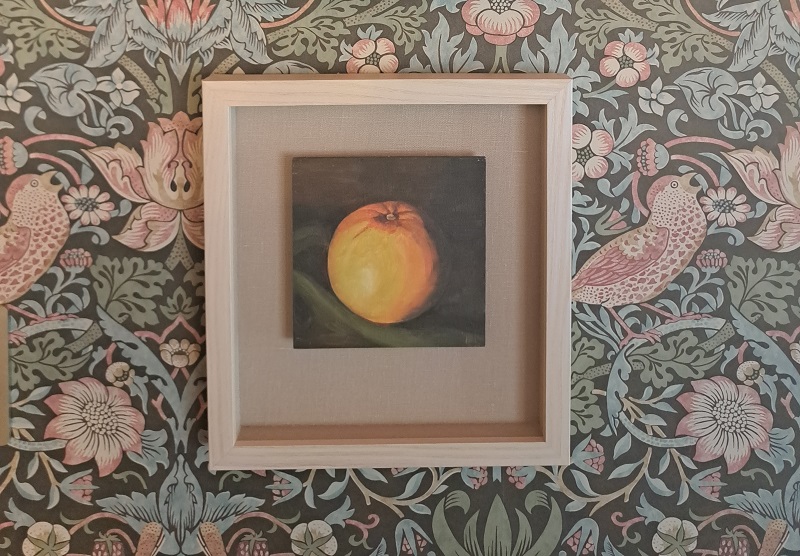
Up close view of a small print and wall paper in the Upstairs Foyer designed by Lara Hovanessian
The result is an entry experience that unfolds like a sequence of scenes. The Entry introduces the story with confidence and warmth, while the Upstairs Foyer offers a quieter, more reflective continuation. Together, they demonstrate how design can transform circulation spaces into moments of meaning—where history is not only preserved, but reimagined through atmosphere, artistry, and an updated narrative.
The Enchantment Nook
Designed by Hattas Studios
The Enchantment Nook, created by Hattas Studios, stands as a quiet but powerful expression of storytelling through color, lighting, technology and tactile details.

Shimmering lights, and a projector-powered moon, watch over the cozy Enchantment Nook, designed by Hattas Studios for Baldwin Oaks Estate, the 61st Pasadena Showcase Houe
A former hallway closet, the Enchantment Nook reads less like a simple architectural alcove and more like a chapter in a visual novel—one where paint, murals, bespoke furniture with texture become language. Tucked within the larger expanse of the home, the nook offers a moment of pause:
a reflective corner that invites the visitor to linger, to notice, and to feel the layered personality embedded within its finishes.
Storytelling begins with paint, the most immediate emotional cue in the room. This is the only space at PSH 2026 that used ALL 36 PAINT COLORS from the Dunn Edwards finalized PSH 2026 palette. Rather than functioning as a neutral backdrop, the paint becomes atmospheric—suggesting depth, mood, and a sense of quiet discovery.
Across the showcase tradition, murals and decorative surfaces often introduce movement or natural imagery to balance the strong architectural framework of historic homes. Hattas Studios has mastered the art of storytelling in every mural they paint, whether it is a simple accent wall to give a room a bit of whimsy, or more detailed ceiling work, such as their mural in the Formal Dining Room of PSH 2024.
In The Enchantment Nook, this philosophy translates into surfaces that feel layered and dimensional rather than static. Whether through patterned paper, painterly effects, or tactile finishes, the walls establish a sense of intimacy that counters the grand scale often found elsewhere in the estate. The viewer experiences the nook as a personal refuge—a miniature world embedded within a much larger narrative.
Thus, the genius of the Enchantment Nook lies in its scale.
In a house exceeding 8,000 square feet and filled with dramatic architectural gestures, the nook offers a human-sized pause—a respite or shift from spectacle to introspection. The larger home celebrates lavish entertaining, echoing the legendary gatherings hosted by Clara Baldwin Stocker, whose lifestyle made the estate a center of social life in Arcadia’s early years.
Yet the nook whispers rather than announces. It reminds visitors that storytelling in design is not always about bold statements; sometimes it is about creating a place where the imagination can rest. Through the interplay of paint, escape-room technology, lighting, and Hollywood-inspired magic, the designers created more than decoration—they created atmosphere, memory, and mood.
The Enchantment Nook, is a reminder that even the most overlooked spaces can become vessels for imagination. What was once an ordinary hallway closet—functional but forgettable—has been transformed into a tiny stage for storytelling, drawing inspiration from beloved fairy tales and the sense of wonder they evoke. Instead of feeling confined, the space becomes cocoon-like, a hidden refuge where imagination can quietly unfold.
Texture deepens the illusion. Subtle wall treatments introduce dimension, suggesting bark, moss, or weathered stone—surfaces one might encounter in an enchanted woodland. Rather than leaving the walls flat and anonymous, these tactile layers give the nook a sense of age and story, as if it has existed far longer than the hallway that surrounds it.

A large comfortable green fur chair to soak in the immersive storytelling of the Enchantment Nook designed by Hattas Studios for the 61st Pasadena Showcase House
The furniture—formerly a leather and wood accent chair, now custom painted and upholstered in green fur—scaled thoughtfully to the modest proportions of the former closet, reinforces the fairy-tale narrative. A single seat or whimsical accent piece evokes the idea of a resting place for travelers between chapters—a momentary pause in the forest before the next adventure begins.
The chair’s presence also humanizes the space, transforming it from storage to sanctuary.
Perhaps the most poetic gesture comes from the use of dried plants. Arranged to mimic the forest, as these natural elements introduce fragility and memory—like botanical specimens gathered on a journey through mythical woods. Their muted tones soften the drama of the artistically busy walls while reinforcing the woodland theme that anchors the fairy-tale narrative.
Together, paint, furniture, texture, and dried botanicals give personality to what was once a purely utilitarian closet. In the hands of Hattas Studios, the Enchantment Nook becomes proof that storytelling in design is not dependent on square footage. Sometimes the most magical transformations occur in the smallest, most unexpected places—where imagination is allowed to take root and flourish.

Vestibule and Family Room Powder Room
Designed by Rebecca J Hansen Design Studio
With layered materials and motifs, the Vestibule and Family Room Powder Room, by Rebecca Hansen, is deceptively small in scale, yet conceptually rich. These transitional and intimate spaces are precisely where storytelling through materials becomes most concentrated:
every surface must carry narrative weight.
In our experience in reviewing Hansen’s projects, she explicitly builds interiors on contrast:
modern vs. vintage; structured vs. organic.
Her work is described as layered, tactile, and narrative-driven, often blending: natural materials such as terracotta stone with interesting overlays, artisanal elements and historic references.

Vestibule and Powder Room designed by Rebecca J Hansen Design Studio for Baldwin Oaks Estate, the 61st Pasadena Showcase House
Image courtesy of the Pasadena Showcase House and Rebecca J Hansen Design Studio
Elevated Functionality
In a historic home like Baldwin Oaks Estate, true design excellence lies in elevating everyday functionality without sacrificing beauty. This year’s Pasadena Showcase House features two standout spaces that masterfully transform often-overlooked service areas into highly efficient, multifunctional rooms that enhance daily life.
From a hardworking mudroom that gracefully manages the flow of an active household to a bright, inspiring laundry and craft room that supports both chores and creativity, these designs prove that practicality and elegance can coexist beautifully. Thoughtful storage, durable materials, and flexible layouts turn routine necessities into refined, productive experiences—demonstrating how smart renovation can meaningfully improve how we live in our homes.
Laundry and Craft Room
Designed by Arterberry Cooke Architecture
The Laundry and Craft Room at the 2026 PSH, designed by Arterberry Cooke Architecture, reimagines a traditionally mundane space as a bright, inspiring environment that blends productivity with creativity.

View of the bright and cheerful Laundry and Craft Room, designed by Arterberry Cooke Architecture
Recognizing the room’s generous windows—described as having the finest views of the home—the designers focused on elevating the everyday laundry experience through thoughtful planning and attention to natural light. The layout supports multiple functions, allowing routine household tasks to coexist with creative pursuits, such as sewing, crafting, painting or project work. Dedicated work surfaces, organized storage, and clearly defined zones ensure that tools and materials remain accessible, yet orderly, reinforcing the room’s role as a highly functional workspace.
View this post on Instagram
Material selections reinforce both durability and visual appeal. Hardworking surfaces—quartzite counters—were chosen to withstand moisture, frequent use, and the demands of laundering, while refined finishes lend the room a polished character that aligns with the elegance of the historic estate. Cabinetry and built-in storage elements maximize efficiency, transforming the once-overlooked service area into an organized hub of activity.

A place for respite to focus on creative aspirations in the reimagined the Laundry and Craft Room by Arterberry Cooke Architecture
Inspired by the legacy of the American Arts and Crafts era, the designers approached the space with the goal of creating an artistic and uplifting environment. The result is a Laundry and Craft Room that transcends its utilitarian roots: a light-filled, purposeful workspace that celebrates craftsmanship, encourages creativity, and supports the practical rhythms of modern life within the storied setting of Baldwin Oaks Estate.
Mud Room
Designed by Gex Designs
The Mud Room at the PSH 2026, designed by Gex Designs, exemplifies how a thoughtful renovation can elevate a purely utilitarian space into an organized and visually appealing transition zone well-suited for modern living. At the Empty House Party, Noelle Gex Djokovich—the room’s designer—explained how important this small space is to the entire household, given its proximity to the garage and other active outdoor areas, such as the garden. In daily life, this room serves as the primary entrance to home, so the area needs to be well thought out in order to deliver convenient functionality.
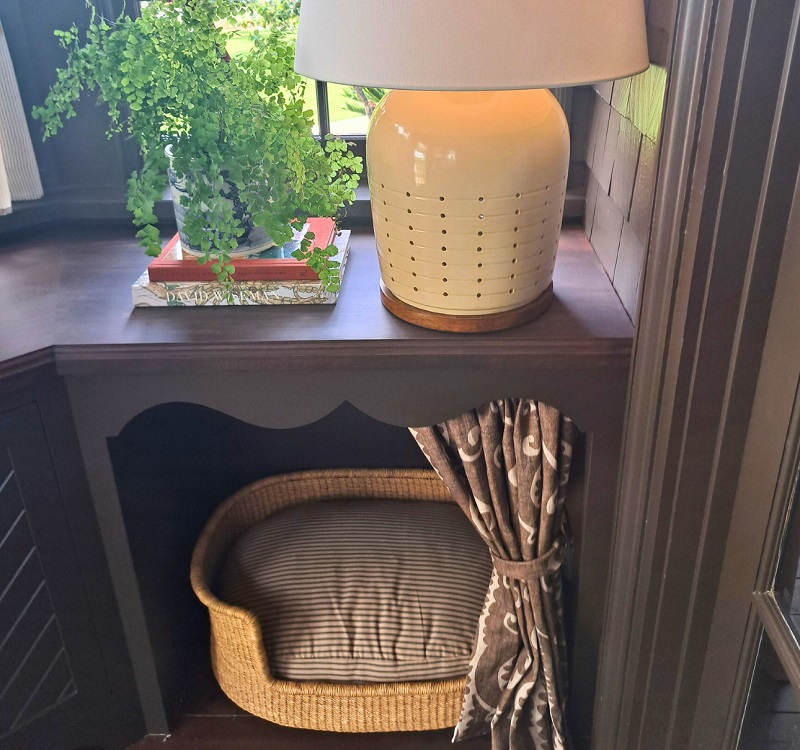
A discrete pet bed in the sunny Mud Room designed by Gex Designs for Baldwin Oaks Estate, the 61st Pasadena Showcase House
Custom cabinetry anchors the design, incorporating tailored storage solutions—including a discreet hideaway for a dog or cat bed—that streamline daily routines while preserving the home’s traditional character. Built-in shelving and a custom corner bench provide dedicated zones for shoe removal and the storage of outdoor essentials, helping to contain clutter before it reaches the main living areas.
Durable surfaces and easy-to-maintain materials reinforce the room’s role as a hardworking entry point, capable of withstanding the wear and tear of an active household without sacrificing style.

Gardening boots are conveniently located to go “play in the dirt” at a moment’s notice.
Functionality was a central goal of the renovation. By improving circulation and introducing purposeful storage, the redesigned space now supports the rhythms of contemporary life—whether returning from the garden, outdoor activities, or daily errands—while maintaining the elegance expected in a historic estate setting. The result is a mudroom that feels purposeful rather than incidental: a practical yet polished gateway that anchors the home’s service wing and enhances the overall livability of this storied residence.
The Entertainment Room: Layered Hospitality
Designed by Studio Joshua
Studio Joshua created the Entertainment Room that feels equal parts sophisticated salon, game room, speakeasy and curated gallery—an environment designed to encourage conversation, laid back competition, and lingering evenings among friends. The space is defined by a confident layering of rich materials, sculptural furnishings, and tactile surfaces that transform entertainment into an immersive experience.

The dark chocolate 11 Ravens billiards table viewable in the background.
At the heart of the room, a dramatic custom billiards table from 11 Ravens anchors the social zone in dark chocolate–stained oak. Nearby, a custom turntable console and bar cart by Earl Home add a distinctly analog charm with hidden modern capabilities, inviting guests to gather around music and craft cocktails with equal enthusiasm. An extra-plush mohair rug introduces softness underfoot, encouraging a relaxed, lounge-like rhythm to the room that balances the harder architectural elements.
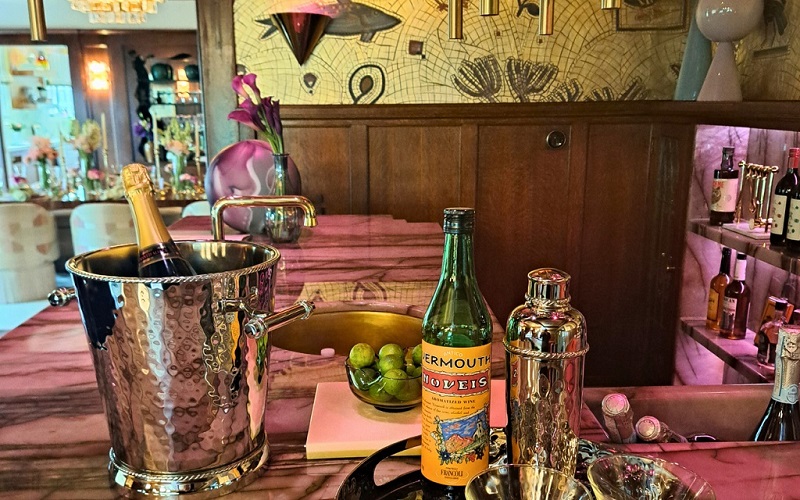
The pink tone of the quartzite is accentuated with the corresponding setting of the Philips Hue lighting system.
Materiality plays a central role in the room’s drama. Stunning stone surfaces in rose hues from Elements Room by Pacific Shore Stones feature Cosmopolitan quartzite slabs sourced from Brazil, whose natural veining lends both durability and unparalleled artistry to the bar area. These richly patterned surfaces pair with unlacquered brass fixtures and hardware that will patinate over time, reinforcing the sense that the room is meant to evolve through use and memory, rather than remain static.

Calico Wallpaper’s custom Mosaic mural in the Tarnish colorway is viewable around the bar of the Entertainment Room
Walls and ceiling surfaces further deepen the room’s narrative. Studio Joshua installed Calico Wallpaper’s custom Mosaic mural in the Tarnish colorway—designed by Francesca Dimattio—that serves as an atmospheric wrap that radiates around the space. This large-scale, non-repeating mural print delivers a rich, textured metallic patina with subtle variations in tone, evoking aged bronze and ancient mosaics. The effect perfectly complements the room’s moody, speakeasy-inspired lounge vibe inspired by Clara Baldwin Stocker’s glamorous legacy. Upholstered wall paneling and seating wrapped in performance velvet add a tactile richness, while asymmetric linen drapery softens architectural lines and introduces movement. Together, these layered textures create a sense of intimacy that offsets the room’s grand entertaining purpose.

View of the fabric-based chandelier, custom furniture pieces and custom music console in the Entertainment Room
Lighting acts as both illumination and sculpture. Fixtures designed by Jason Koharik and fabric-based chandeliers add dimension overhead, casting layered shadows that heighten the room’s theatrical tone. Brass and glass shelving introduces a museum-like presentation for collectibles and barware, while curated glass objects and antique vessels provide glints of reflected light that enchantingly animate the space after dark.
Made possible by a stellar cadre of partners, the resultant feeling of the Entertainment Room proves the effectiveness of Studio Joshua’s approach to design:
“I don’t work in a vacuum. I always work with collaborators who balance my strengths and weaknesses.”
— Joshua Praught, Founder and Principal Designer, Studio Joshua
Ultimately, Studio Joshua’s Entertainment Room succeeds because it treats hospitality as an art form. Every detail supports one clear idea:
that entertaining should feel facile, tactile, and deeply personal.
The result is a room that doesn’t merely host guests—it invites them to participate in a comfortable yet engaging experience of texture, sound, light, and social ritual. If the ghost of Clara Baldwin were to visit her former home, this is surely the room where she would linger longest—marveling at its many-splendored delights.
Design Secrets & Hidden Details of PSH 2026
Stories Behind the “Stories”
When touring showcase homes, whether historic or newly built modern homes, we always try to uncover secrets of the home—stories behind the “stories”. These discoveries typically consist of lesser-known facts about a home that, when discovered, make the results feel even more miraculous and interesting. “Secrets of a home” can consist of one or more the following criteria:
- Happy Accidents
- Hidden or Personal Sources of Inspiration or Tribute
- Magical Design Tricks
- Obscure Historical Notes
- Overlooked Features
- Paranormal Experiences
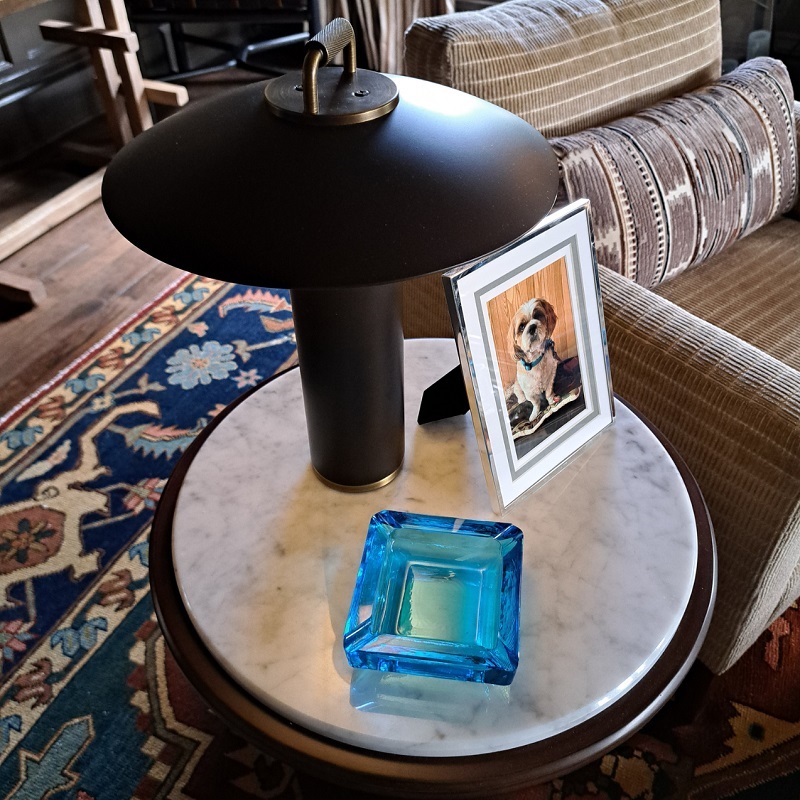
One of several prints of Barnaby in the Minkwood Library, a tribute by James Hernandez to his beloved dog
Here are some of our favorite insider insights and lesser-known details about Baldwin Oaks Estate that you’re unlikely to hear on a standard tour:
- PSH 2026 is the first time that the historic Baldwin Oaks Estate has been made available to the public to tour.
- At least one hidden safe resides in one of the many window benches. Which one? You’ll have to ask each designer to find out!
- The Minkwood Library, James Hernandez included several touching portraits of his beloved dog Barnaby as a heartfelt personal tribute—adding an emotional layer to the room’s comforting design.
- In the Entry and Upstairs Foyer, a key goal of the painstakingly curated artwork by Lara Hovanessian was to project an appearance of having been collected over many years
- PSH 2026 marked the fourth consecutive year that The Art of Room Design showcased art by Harry Moody, displayed above the fireplace in the Bloom Lounge
- Designer Maria Videla-Juniel has now participated in 13 consecutive Pasadena Showcase Houses, first starting in 2004
- Burnt Orange is the accent color used in the Bloom Lounge
- The fluted Calcutta Viola marble on the fireplace in the Bloom Lounge is definitely on trend, according to our recent attendance of Coverings 2026—North America’s largest Tile & Stone tradeshow
- Look up in the Bloom Lounge to see the subtle rice paper on the ceiling
- Take Note of the Windows: according to Maria Videla-Juniel, every designer treated the large bench-framed bay windows differently, located in eight separate rooms
- Feel the Speakeasy Vibes: Intimate Prohibition-era “aesthetics” can be felt in several spaces: Entertainment Room; The “Vault” in the Family Parlor; The Minkwood Library; The “Refreshment Station” in the Lady’s Lounge
- The wooden bases of two matching lamps in the Minkwood Library are from the bow of an old ship sourced in Phuket, Thailand
- The only room in the entire PSH 2026 to use every color of Dunn Edwards palette was The Enchantment Nook by Hattas Studios
- The Minkwood Library only used three colors: Blue, Brown and Black
- Arcadia became synonymous with horse racing when Clara’s father, Lucky Baldwin, built the first Santa Anita Racetrack in 1904
- Both Shingle and Craftsman architecture fall under the American Arts & Crafts movement, which was inspired by the English Arts & Crafts movement, and emphasized natural materials and open layouts.
- Window seats in many of the rooms were installed for optimal appreciation of the surrounding natural world, including views of trees throughout the property and mountain views to the north.
- Around 1970, the inventor Richard Knerr, who co-founded the Wham-O toy company in South Pasadena in 1948, purchased the home. The company is best known for marketing and creating many popular toys, such as the Frisbee and the Hula Hoop. Knerr installed the large flagpole located in the front of the house.
- The pool, located on the west-side of the home, was added in the 1960’s.
- Baldwin Oaks Estate was originally known as Twin Oaks, going by that name for many decades, likely until recent years. No specific year or event marks a formal rename to Baldwin Oaks Estate.
- Lucky Baldwin made a concerted effort to save native oak trees as his land was developed, with several of them still standing on the property of PSH 2026.
- The residence showcases hallmark features of the American Arts & Craft era: cedar shingles draped across the exterior; a roofline with multiple intersecting gables; expansive porches meant for storytelling and conversation; and the use of local stone that grounds the home in the landscape of early California.
- The PSH 2026 Dunn Edwards Palette started with 40 colors in October 2025, and then evolved downward to 26 colors in the end. Colors that were not being used were removed.
- The process for selecting the official PSH palette started in September 2025
- Joshua Praught’s favorite Philips Hue preset lighting color for the Entertainment Room is the Honolulu Scene
- The booster pillows in the Entertainment Room are made from repurposed fabric from a vintage Japanese obi
- The Enchantment Room incorporated “Escape Room Technology” to incorporate the interactive storytelling capabilities, including the image of the moon being from a backscreen projector.
- The Entertainment Room is considered to be the most historic space of the home.
- The small black and white silhouette of a young girl on display on the vanity of the Le Petite En Suite is the sister of the room’s designer Rhonda Angell. The photo was taken by their mother, Cinnamon Landman, when her daughter was just four or five years old.
About the Pasadena Showcase House for the Arts
The Heart Behind the Houses
Pasadena Showcase House for the Arts is a passionate all-volunteer nonprofit dedicated to enriching Southern California communities through music and the arts since 1948. For 61 years, their signature event—the Pasadena Showcase House of Design—has transformed a historic home each spring into a living gallery of talent, creativity, and inspiration. This one-of-a-kind annual fundraiser is their primary source of support, allowing them to present music programs, award substantial Gifts & Grants, and fuel arts education across the region.
To date, the organization has contributed over $27 million to nonprofit music education organizations, reimagined 60 homes, welcomed 26,000+ visitors each season, and awarded more than 1,000 gifts and grants to schools, music programs, scholarships for young musicians, and nonprofit arts organizations—from the Los Angeles Philharmonic to local marching bands, jazz ensembles, and music therapy initiatives.
Pasadena Showcase also supports the study and appreciation of music among young people with its four philanthropic initiatives:
- Gifts & Grants which distributes $1 million annually on average to local music and arts nonprofits
- The Music Mobile which has introduced orchestral instruments to more than 125,000 third grade students
- The Instrumental Competition which has awarded more than $700,000 in monetary prizes for exceptionally talented young musicians
- The Youth Concert which has brought nearly 260,000 fourth graders to Walt Disney Concert Hall to experience live performances by the LA Phil
When you visit the Showcase House, you’re not just touring beautiful rooms—you’re directly supporting the next generation of artists and musicians who will shape California’s cultural future. It’s design with purpose, history with heart, and a tradition that continues to shine brighter every year!
Recommended Reading
- The New American Home 2026: Innovation Meets Philanthropy
- The New American Home 2025: Artistic Craftsmanship that Wows
- The New American Home 2024: Indoor-Outdoor Transformable Warmth
- 5 Reasons Victorian Homes Are Still So Popular
- New Technologies to Restore Time-Ravaged Older & Historic Homes
- What to Consider When Purchasing an Older or Historic Home
- 5 Simple Tips to Improve Your Home’s Curb Appeal
- Related Topics: Design Events | Architecture | Inspiration | Indoor-Outdoor Living | Restoration
| Purgula is reader-supported. When you click on links to other sites from our website, we may earn affiliate commissions, at no cost to you. If you find our content to be helpful, this is an easy way for you to support our mission. Thanks! Learn more. |