

We came away from FutureScape USA 2026 with enough material that one article couldn’t hold it all. The session we thought mattered most this year—Michael Bernier’s case for landscape as social infrastructure, and how it connects to our earlier coverage of The Granary in Milton, Delaware—got its own full treatment: Beyond Decoration: What Landscape Can Do for a Community. If you haven’t read it yet, start there.
This piece covers everything else that stood out: a session on water quality that reframes the entire “water crisis equals fewer plants” conversation; a market opportunity talk on sustainable landcare with numbers that surprised us; and a handful of unique products from the show floor we think are genuinely worth a homeowner’s attention.
Table of Contents
- Waterwise Design: Plants Aren’t the Problem
- The Business Case for Sustainable Landcare
- Products from FutureScape 2026 We Like
- What We Think Matters Most
Also see:
- Beyond Decoration: What Landscape Can Do for a Community
- Biochar: Is the Soil Beneath Your Home an Asset or a Liability?
- Graywater Systems: A Primer for Homeowners
- More Landscaping Articles
- Related Topics: Landscaping | Home Wellness | Water | Resilience
Waterwise Design: Plants Aren’t the Problem
Though we’ve written extensively about related topics—water systems, fire resilience, native plants, and curb appeal—we expected to learn a lot from the Waterwise by Design: Rethinking Gardens for the Future Climate session. We weren’t disappointed.

Waterwise Design session at FutureScape USA 2026
From left to right: Stephanie Bartron, Dr. Ashkan Nochian, Kevin Hauschel, Stephen Rivard, and Edward Brown, moderator
Garden designer Stephanie Bartron, joined by Dr. Ashkan Nochian (Landoos), Kevin Hauschel (Rainmaker.Earth), and Stephen Rivard (Soake Pools) opened this session with a line she returned to again and again:
The reflex to solve a water crisis by removing plants gets the diagnosis backwards.
Her alternative isn’t “zeroscaping”—gravel and a single cactus—it’s treating the whole lot as a working watershed: capturing stormwater and graywater on-site, building soil that holds more water, and grouping plants by actual moisture need instead of watering everything on the same schedule.
Hauschel’s counterintuitive argument was simple:
low-quality water doesn’t just fail to help plants; it can degrade soil and force you to use even more water, not less, by starving root zones of oxygen.
His fix starts with testing—a comprehensive chemical audit can run up to $2,000, while Hauschel cited a useful baseline test at around $120. Most homeowners skip it entirely. Bartron’s small, vivid aside stuck with us too: petrichor, the distinct smell of rain hitting dry ground, smells essentially the same everywhere on Earth—a reminder of just how consistent water-soil chemistry really is, regardless of climate.
Thoughts on Fire-Resilient Landscapes
One of the session’s most compelling arguments turned conventional fire-safety wisdom on its head, addressing a persistent misperception in fire-prone regions in the process. The panel challenged the reflex of clear-cutting native landscapes in response to rising insurance anxieties. The panel’s evidence pointed the other way—lush, hydrated, well-maintained landscapes can shield a home, whereas dry, barren ground offers little defense, including providing dry dead fuel to fires.
In Altadena, California, hydrated native plants with intact canopies survived; succulents—the “obvious” fire-safe choice—burned, releasing their stored water rapidly under heat, while ivy on the ground (versus on a fence) held its water and didn’t burn. Chaparral was framed as fire protection, not fire risk. For context: chaparral’s flammability depends heavily on how hydrated it is—dry, cured chaparral burns readily, but green, hydrated chaparral is far less prone to ignition, and clear-cutting it often does more harm than good, since the bare ground that results tends to invite highly flammable invasive grasses rather than staying bare.
It’s also worth noting that lightly irrigated, living vegetation doesn’t just resist ignition better than dry vegetation—it can actively help a home by absorbing or “catching” hot embers that would otherwise blow straight toward it, rather than sending them ricocheting off bare, hardscaped ground. Landscape architect Cassy Aoyagi has given this exact scenario a memorable name: “ember bowling alleys“—the wide-open, gravel-cleared lanes that some drought responses and fire-clearance methods create, which give windblown embers a straight, unobstructed path to roll right toward a home, instead of getting caught and extinguished along the way.
The mechanism, per Dr. Nochian, is plant health and spacing—grouping flammable, high-resin species into separated islands—not wholesale removal. Hauschel backed up that point with a concrete example, with the kind of confidence that comes from a fix that’s genuinely straightforward: on a vegetation-management project in Marin County, California, roughly 90% of the work was simply removing flammable invasive plants, not native vegetation—since invasive species tend to thrive precisely when native plants are weakened or stressed to begin with. Clear out the invasives, and the healthier native landscape does most of the remaining work on its own. Water features fit a similar logic at any scale: a full pool, a plunge pool, or a smaller soaking pool can all serve as hardscaping barriers, as well as an on-property water reservoir that firefighters and homeowners can draw from during an emergency.
Thoughts on Artificial Turf
On the topic of artificial turf, the panel politely landed on a situational rather than a “not ever” recommendation: turf surfaces can reach 150°F at midday; they eventually wear down and end up in a landfill; and—since turf doesn’t let water soak into the ground the way soil does—it contributes to the same stormwater runoff problem the rest of the session was trying to solve. The panel didn’t shy away from the challenges of maintaining natural grass, but impressive advancements are being made. Hauschel pointed to the San Francisco Giants’ grass baseball field, which hasn’t needed resodding in five years, as proof that natural-grass resilience is more solvable than people assume.
The Business Case for Sustainable Landcare
If the Waterwise Design session made the ecological case for rethinking landscaping, Kathleen Hallal’s session—“The Business Case for Sustainable Landcare: Better Soil, Smarter Water, Better Choices, Better Business”—made the financial one. Hallal, VP of Landcare and Municipalities at FireHawk Bioherbicide (one of the products we highlight below), pitched sustainable practices to a room of landscaping professionals not as an idealistic upgrade, but as a higher-value service homeowners are already requesting.
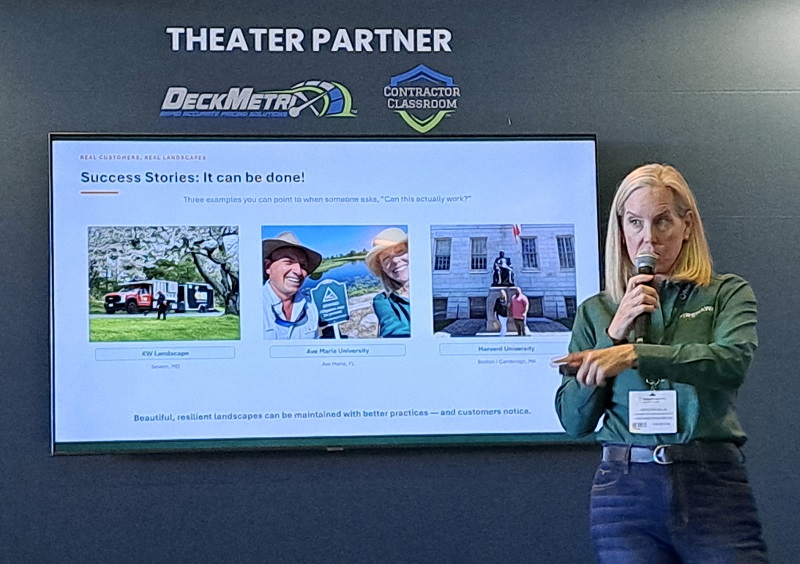
Kathleen Hallal presenting “The Business Case for Sustainable Landcare” at FutureScape USA 2026
The numbers support that argument. Demand for native, drought-tolerant plants climbed from 67% of clients in 2021 to 79% in 2024. Homeowners are willing to pay roughly $18 more per month to reduce spray applications, and up to $24 more per month for non-chemical pest and weed control—with a rough sell-in threshold of just $3.50 more per home per month making sustainable landcare an easy addition rather than a hard sell. One HOA near Fort Myers, Florida had every homeowner agree to collectively fund the community’s transition to FireHawk. This isn’t a fringe preference; it’s a market that’s already funding the shift.
Part of the urgency comes from outside the yard entirely: Hallal pointed to the financial exposure surrounding glyphosate litigation (e.g. Roundup-like products), citing $11.3 billion in provisions and liabilities as of December 31, 2025, along with a proposed nationwide class settlement of up to $7.25 billion still subject to the court process. That backdrop is pushing landscaping pros to have credible, non-chemical answers ready before customers start asking.
The rest of Hallal’s talk echoed a theme we’d already run into during the Waterwise Design session: soil is the whole game. Her line—”you don’t need to be a soil scientist, you need to stop treating soil like inert dirt”—could have come straight out of that earlier session, where soil-water quality was framed as the actual lever behind water conservation, not plant removal.
Hallal shared practical advice that saving water starts below the sprinkler head, and it comes down to two tracks that only work when addressed in tandem:
1. Irrigation
- Fix leaks
- Reduce overspray
- Adjust seasonally
- Use drip/smart controls where appropriate
2. Soil
- Reduce compaction
- Build appropriate organic matter
- Aerate when needed
- Keep soil covered
She’d add a third piece to that list, too: right plant, right place—choosing species suited to a spot’s actual conditions rather than fighting them with extra water. In short, healthy soil paired with the right plants in the right places simply needs less water to begin with, which is really the whole argument in one sentence.
She also pointed to plant guilds—compatible plants grouped to do each other’s work, the way a fruit tree can be surrounded by companions that handle its feeding, pest control, and pollination instead of leaving all of that to the homeowner. It’s the same underlying idea behind the Three Sisters method we’ve written about before—corn, beans, and squash grown together so each one does a job the others need. Hallal’s framing for pros applies just as well to homeowners: sell yourself the easier 10-year decision, not just the prettier 10-minute one.
We saw the biochar version of this same intuition firsthand at the Earthstock Regenerative Summit with Michael Wittman of Blue Sky Biochar—read our full take here. Wittman was also at FutureScape this year presenting similar material; we didn’t cover that session separately since it closely tracked what he’d shared at Earthstock.
Products from FutureScape 2026 We Like
Aquor
Aquor is reinventing outdoor water access with modern, quick-connect hydrants and water valves for homes, gardens, RVs, boats, and commercial settings. The result of an MBA project, the company stands out as a smart, polished alternative to the familiar—and often frustrating—outdoor spigot or “hose bib”: its low-profile systems are designed to make connecting a hose fast and simple, while automatically stopping water flow when disconnected. The sleek aesthetic made us wonder, “Why has no one thought of this before?”
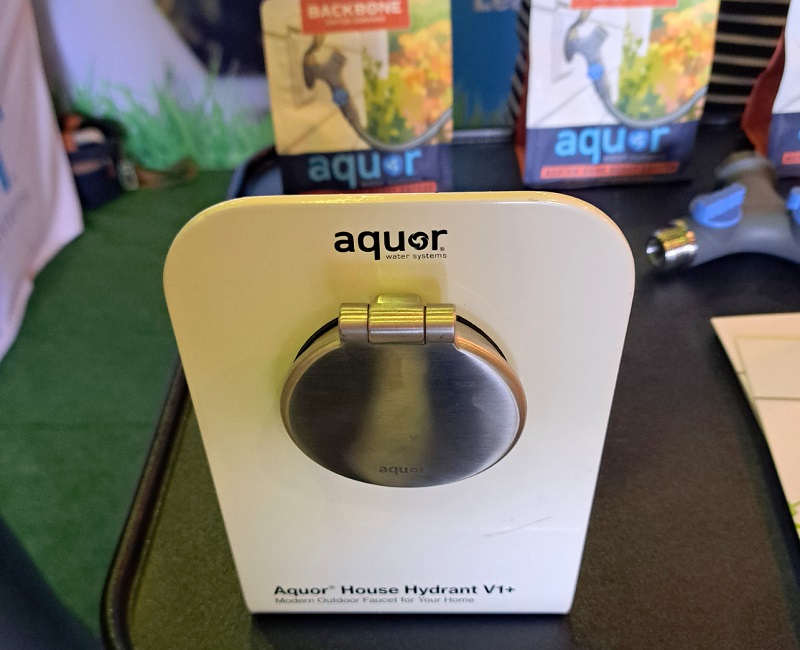
Aquor’s sleak looking House Hydrant V1+ at FutureScape USA 2026
What is especially compelling is the focus on the problems traditional faucets commonly create: dripping, leaks, awkward hose threading, and exposure to freezing conditions. Aquor’s house hydrants are marketed as leak-free, maintenance-free, and frost-free, pairing durable construction with a clean, architectural appearance. That clean, low-profile design also does double duty for curb appeal—swapping out a rusted or dripping hose bib for a sleek, flush-mounted hydrant is a small change that can meaningfully upgrade how a home’s exterior reads to a buyer or guest, without any structural renovation. For homeowners, that can mean less wasted water, greater ease during every day watering and washing tasks, and an outdoor fixture that looks as thoughtfully designed as the rest of the home.
In short, Aquor turns an overlooked utility into a more convenient, durable, and water-conscious part of a well-appointed property.

Additional Aquor products on display at FutureScape USA 2026
Feelds
Feelds is a Belgian manufacturer of premium artificial grass designed for landscaping, leisure, and sports applications. The company’s products convey a thoughtful, design-forward option for creating green, inviting spaces where natural grass may be difficult to maintain—whether that is a residential garden, rooftop, patio, play area, or commercial landscape.
The biggest benefit of Feelds’ artificial turf is the promise of a consistently polished lawn-like appearance without the routine demands of mowing, watering, reseeding, or dealing with muddy patches. Its products are developed for both indoor and outdoor use, allowing homeowners and landscape professionals to create durable, usable green areas that remain visually appealing through changing seasons.
Feelds also offers versatility beyond a typical backyard lawn. With product lines intended for leisure, landscaping, and sport, the company can help transform underused areas into comfortable spaces for relaxing, entertaining, playing, or training. For anyone seeking the look and feel of a lush landscape with less day-to-day upkeep, Feelds presents a practical, premium-feeling solution.
Festávolo
Festávolo is a distinctive outdoor-living brand that rethinks the traditional barbecue by building a premium gas grill directly into an elegant dining table. Discovering the company for the first time, its central idea feels refreshingly simple: rather than having one person stand apart at the grill while everyone else gathers around the table, Festávolo brings the cooking into the shared dining experience—so the host can stay seated and everyone can take part.

Festávolo’s largest table on display at FutureScape USA 2026
The company’s grill tables combine modern outdoor furniture styling with integrated gas-grilling technology. Its collections—including Forte, Primo, and Rocca—come in multiple sizes, with configurations designed to accommodate intimate meals or larger get-togethers. The modular concept also extends to coordinated seating, planters, shelving, pizza ovens, and grilling accessories, helping create a cohesive patio or garden setting.
From a buyer’s perspective, the benefits go beyond appearance. Festávolo emphasizes quick gas grilling, convenient cleaning, durable materials, and an integrated layout that keeps the social energy of a meal intact. With natural-gas connection options for some installations, homeowners may also avoid the inconvenience of moving and replacing propane tanks. It is an especially appealing solution for anyone who values memorable outdoor entertaining, functional design, and a more inclusive way to cook with family and friends of all ages.
FireHawk Bioherbicide
FireHawk Bioherbicide is a practical, plant-derived alternative for people who want fast, effective control of unwanted weeds without relying on glyphosate (“Round Up”). The product line includes ready-to-use sprays and concentrated formulas, designed for gardeners, landscape professionals, nurseries, farms, and vegetation-management applications. Its active ingredient is nonanoic acid, and it works as a broad-spectrum, non-selective contact herbicide—meaning it acts on the foliage it touches, including many grasses, broadleaf weeds, mosses, and similar unwanted vegetation.

Glyphosate-Free logo proudly on display in the FireHawk Herbicide booth at FutureScape USA 2026
What makes FireHawk especially appealing is its combination of speed and convenience. It is formulated to provide visible burn-down of actively growing weeds quickly, comes in both no-mix and mix-with-water formats, and can be applied with standard spray equipment. Because it is non-selective, users should apply it carefully around desirable plants; however, that same broad activity makes it a useful tool for clearing weeds along paths, in landscape beds, around gardens, and in other targeted areas. For someone seeking an efficient, glyphosate-free weed-control option with a more naturally derived profile, FireHawk Bioherbicide offers a compelling and versatile solution.
Illuminated Trees
Illuminated Trees stands out as a creative provider of striking, low-maintenance decorative lighting solutions. The company’s pre-lit, faux grove of Ginkgos, Oaks, and Maples, to name a few, bring the warmth and visual appeal of natural foliage into spaces where real plants may be impractical, adding an inviting focal point to homes, events, hospitality venues, retail environments, and outdoor displays.

Close up view of a colorful tree on display at FutureScape USA 2026 by Illuminated Trees
What makes these products especially appealing is their ability to combine atmosphere with convenience: these dazzling arbors can create a memorable ambience instantly, operate efficiently with LED lighting, require far less upkeep than living décor, and provide a reusable design feature for seasonal or year-round use. For anyone looking to make a space feel more elegant, welcoming, and visually distinctive, Illuminated Trees offers an imaginative alternative to conventional lighting and décor.
LumiLev
LumiLev takes a genuinely clever angle on a problem most homeowners never think about: outdoor landscape lighting fixtures get damaged constantly, usually by the very landscaping crews hired to maintain the property around them. The inventor’s impetus was personal—his own landscaping crew kept breaking or damaging clients’ outdoor fixtures, leaving him footing the bill for replacements—and it took four years to turn that frustration into a finished product.
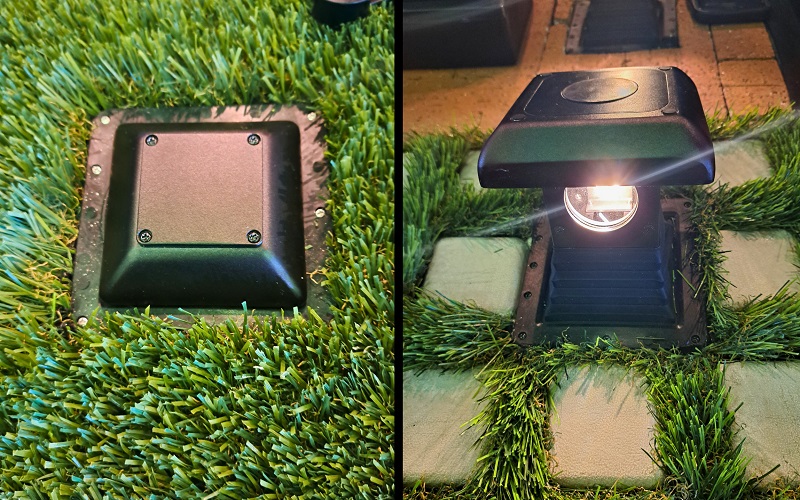
LumiLev’s landscaping lights displayed in the closed and opened positions at FutureScape USA 2026
LumiLev’s solution is a retractable fixture that sits flush with the ground, wall, or path by day—invisible, and out of the way of mowers, trimmers, and foot traffic—then rises into place at night via a sealed telescoping mechanism, casting a warm, architectural light exactly where it’s needed. The system is IP68-sealed for durability across climates and fully app-controlled, with scheduling, dimming, and scene presets handling everything from dusk onward.
What makes LumiLev especially compelling is that solving the damage problem and improving the aesthetic turned out to be the same design decision: a fixture that disappears when it’s not needed is also a fixture that can’t get run over by a mower or clipped by a trimmer. For homeowners tired of replacing cracked or knocked-over landscape lights every season—and for the landscaping crews who’d rather not be the ones explaining what happened—LumiLev offers a rare case where durability and design elegance point in exactly the same direction. It’s yet another inspiring example of an innovative product born out of someone’s day-to-day, real-world experience in the trades—a pattern we keep running into at shows like this one.
Rainmaker.Earth
Rainmaker.Earth takes direct aim at a problem this whole recap keeps circling back to: water quality, not just water volume, determines whether irrigation actually works. The company’s pitch—”helps you get more from every drop”—is a natural extension of Kevin Hauschel’s own argument in the Waterwise session above, where he’s VP of Sales and Business Development: that low-quality water can quietly sabotage even a well-designed landscape by degrading soil rather than feeding it.
What makes Rainmaker.Earth’s approach compelling is its focus on the water-soil relationship rather than water quantity alone. The company markets its technology as decompacting soils to support deeper rooting, breaking down salts and bicarbonates present in both water and soil, and improving water infiltration and nutrient uptake—addressing the underlying chemistry that determines whether a gallon of water actually reaches a plant’s roots or gets wasted fighting degraded ground. Its reach extends well past residential yards, too, with stated applications in row-crop and vineyard agriculture, golf course and turf management, ecosystem remediation, professional sports fields and stadiums, and municipal and commercial landscapes, alongside residential irrigation.
In short, Rainmaker.Earth treats water quality as a measurable, improvable input rather than a fixed condition landscapers just have to work around—making every irrigation cycle more effective, not just more frequent.
Soake Pools
Soake Pools creates beautifully designed, space-saving plunge pools that bring the enjoyment of a swimming pool and the comfort of a hot tub into one compact backyard feature. The appeal is immediate: these prebuilt, precast-concrete pools are positioned as a sophisticated alternative to a large conventional pool, offering a refined outdoor experience without requiring an oversized footprint or months of disruptive construction.
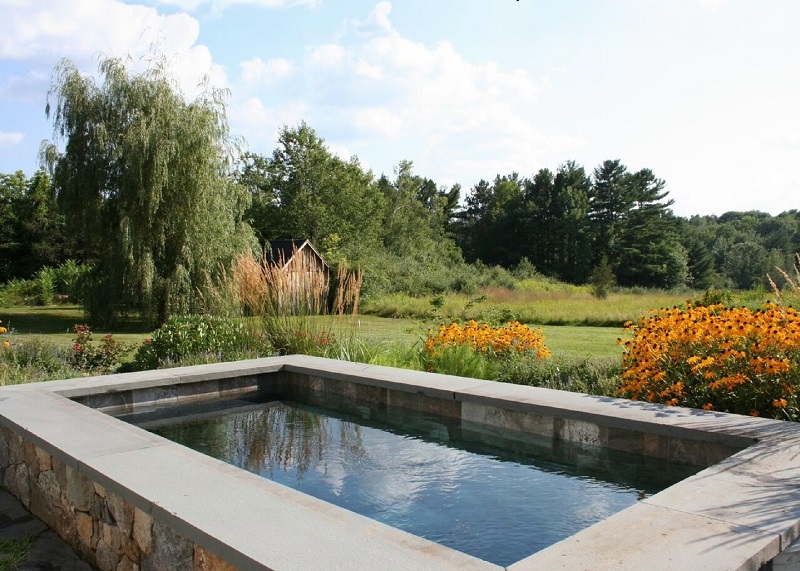
A Soake Pools plunge pool in a serene rural setting
Image courtesy of Soake Pools
What makes Soake Pools particularly compelling is their versatility. The pools can provide a refreshing place to cool down in summer, then be heated for warm-water relaxation and hydrotherapy in colder months—helping turn a backyard into a usable, year-round wellness retreat. Their smaller size can also mean substantially lower water use than a traditional large pool, while leaving more room for landscaping, entertaining, and everyday outdoor living.
Nearly all of Soake’s plunge pools run on a saltwater system rather than traditional chlorine, with the exception of their dedicated Cold Plunge model, which features an Advanced Oxidation Process sanitation system and a water chiller. For the remaining lineup, the water passes through a chlorine generator that converts salt into a low level of natural chlorine. The company describes the resulting water as noticeably gentler on skin than ocean salt water. It’s worth being precise about what that means, though: saltwater pools are sometimes marketed as “chemical-free,” but they aren’t—the salt is still being converted into chlorine, just through a different process than adding it directly. The trade-offs run like this: in Soake’s favor, saltwater tends to feel softer on skin and eyes and carries less of the sharp chlorine smell, with less day-to-day chemical dosing; on the other side, salt systems still require their own upkeep—monitoring salinity and periodically servicing the generator cell—and can be more corrosive over time to certain metal pool hardware and nearby fixtures than a standard chlorine system.

A Soake Pools plunge pool being lowered into the ground at an installation site
Image courtesy of Soake Pools
For homeowners drawn to wellness, convenience, and thoughtful design, Soake Pools offers an inviting balance of luxury and practicality: a personal place for low-impact exercise, muscle recovery, quiet relaxation, family time, or simply elevating the look and feel of an outdoor space. Be sure to browse their project gallery to see an impressive array of styles and installations.
What We Think Matters Most
Step back from the individual sessions, and a single thread runs through nearly everything we saw at FutureScape this year:
Both landscaping professionals and homeowners are developing a genuinely more sophisticated intuition about the ground they live on.
Water quality, soil biology, native and drought-tolerant plants, symbiotic planting—these used to be niche, almost fringe topics. Now they’re showing up in mainstream buyer behavior, alongside a related and growing desire to grow at least some of one’s own food, both for health reasons and for a measure of self-sufficiency, and a broader appreciation for the wellness benefits of simply spending time outdoors around living, biophilic spaces.
There’s a wrinkle in that “used to be niche” framing worth sitting with, though. Toward the end of her talk, Hallal made a point that stuck with us more than almost anything else we heard at FutureScape: much of what she was teaching a room full of working professionals wasn’t new information at all—older-generation landscapers, as she described them, already knew and understood most of it. What reads today as an emerging trend may really be a rediscovery. It’s not hard to imagine our own grandparents, or their parents before them, already understanding many of these same concepts—reading soil by feel, planting natives because that’s simply what grew there, growing food out of necessity rather than as a lifestyle choice. Somewhere along the way, though, pressures for convenience and cost-efficient solutions likely pulled us away from retaining that knowledge, trading it for faster, cheaper fixes that didn’t require understanding the ground underneath them. If that’s right, the shift underway isn’t new knowledge finding its way into the mainstream. It’s old knowledge finding its way back.
Bernier’s session made the case for landscape as social infrastructure. Waterwise Design made the case that soil and water quality—not plant removal—are the real levers of resilience. Hallal made the business case that homeowners are already willing to pay for these changes. Three different rooms, three different audiences, converging on the same underlying shift: it’s less a single trend than a whole cluster of them, all pointing the same direction. Homeowners aren’t waiting for the industry to tell them what matters underground.
Additional Landscaping Articles
- Landscaping Upgrades That Add the Most Value to Your Home
- How to Design a Beautiful Self-Sustaining Permaculture Backyard
- FutureScape USA 2025: Inspiring Landscaping Trends We Encountered
- 5 Landscaping Mistakes That Could Decrease Your Home’s Value
- How to Improve Buyer Perceptions with Your Outdoor Spaces
- Water Features for an Innovative Modern Home
- Related Topics: Landscaping | Home Wellness | Water | Resilience
| Purgula is reader-supported. When you click on links to other sites from our website, we may earn affiliate commissions, at no cost to you. If you find our content to be helpful, this is an easy way for you to support our mission. Thanks! Learn more. |