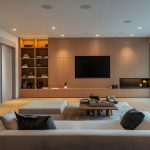

Lighting has traditionally been something we control. We walk into a room, flip a switch. We turn a dimmer down when the evening begins. We close the blinds when afternoon sun becomes too bright. We turn off the lights when we leave. But increasingly, residential lighting can do more of that thinking and reacting for us.
Adaptive environmental sensors allow lighting systems to respond to what is happening around them—whether a room is occupied, how much daylight is coming through the windows, what time it is, or, in more sophisticated systems, other environmental conditions.
The result isn’t necessarily a home filled with lights that constantly change on their own. In fact, the best adaptive lighting will be less noticeable than that.
The goal is simpler:
Give the home enough information to make better lighting decisions.
That can mean turning lights on when someone enters a dark hallway, reducing artificial light when sunlight is already doing the job, or creating different lighting conditions for morning, afternoon, and evening. For homeowners, the technology is becoming easier to understand and use—and increasingly important to discuss with designers, electricians, lighting professionals, and smart-home integrators.
This article introduces adaptive environmental sensors in residential lighting, exploring how they empower homes to automatically make smarter, more seamless lighting decisions based on occupancy, natural daylight, and the time of day.
Table of Contents
- What Is an Environmental Sensor for Lighting?
- Why Does Residential Lighting Need Sensors?
- Four Types of Sensors Homeowners Should Know
- From Smart Lighting to Adaptive Lighting
- Advanced Possibilities: Combining Sensors
- Adaptive Lighting Shouldn’t Mean Constantly Changing Lighting
- Adaptive Sensors and the Layers of Light
- How Adaptive Sensors Can Work Room by Room
- What Homeowners Should Ask Before Installing Adaptive Lighting
- Why Adaptive Lighting Is Also a Design Decision
- The Future of Residential Lighting: Less “Smart,” More “Responsive”
Also see:
What Is an Environmental Sensor for Lighting?
An environmental sensor is essentially an input device. It observes a specific change in its environment and sends that data to a lighting control system. The system then decides what, if anything, to do with that information.
Think of the process as a simple chain reaction:
Sensor → Information → Control → Lighting Response
Here are two common ways this plays out in a home:
- Daylight Sensor: Room is flooded with sun → Control system reduces output → Electric lights dim
- Occupancy Sensor: Someone enters a dark hallway → Control system detects movement → Hallway lights turn on
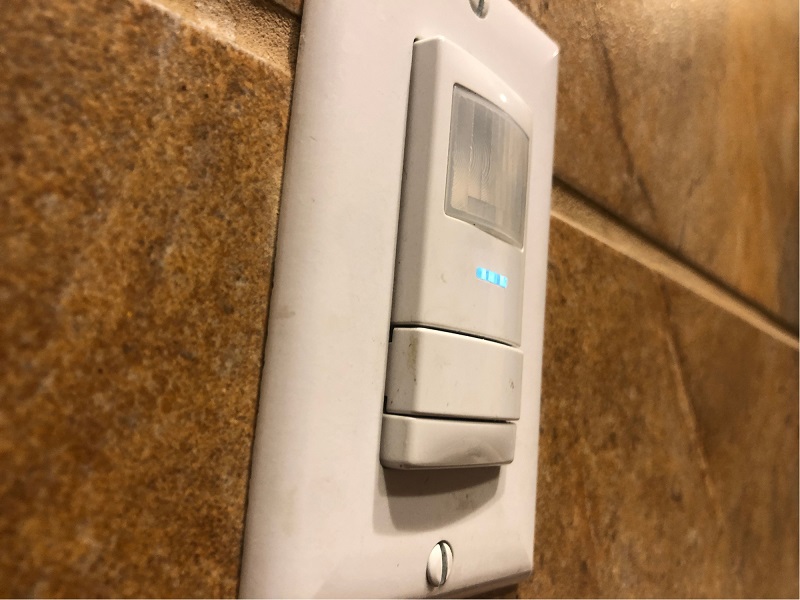
A wall-mounted passive infrared (PIR) occupancy sensor switch with a digital status indicator, acting as the eyes and ears of a room’s lighting network.
This distinction matters because the sensor itself doesn’t actually control the light. Instead, it acts as the data provider. In a sophisticated system, sensors feed information to a centralized controller, which applies programmed rules to switches, dimmers, fixtures, automated shades, and other connected devices. According to the U.S. Department of Energy’s Better Buildings Solution Center, light sensors measure available light to signal a control system, while occupancy sensors strictly detect whether a space is actively being used, as outlined in their Exterior Lighting Control Guidance report.
In other words:
The sensor acts as the home’s eyes and ears, while the lighting-control system serves as the brain making the final decisions.
Why Does Residential Lighting Need Sensors?
The natural environment inside and outside a home is constantly changing. Sunlight entering a bedroom at 8 a.m. bears little resemblance to the harsh glare of noon. A living room bustling with a family of four at 7 p.m. is entirely different from that same space sitting empty at 11 p.m.
Yet conventional lighting systems treat these fluid situations exactly the same way. A ceiling fixture is either on or off. A lamp is either plugged in or unplugged. A manual dimmer simply stays wherever someone last left it.
Adaptive controls introduce a dynamic alternative:
Lighting that aligns with shifting environmental conditions, rather than relying entirely on human intervention.
By allowing a home to respond to its environment, adaptive lighting directly optimizes several key areas:
Daily Living & Comfort
- Convenience: Hands-free illumination activates the moment someone enters a space.
- Visual Comfort: Artificial light levels automatically balance against changing daylight.
- Ambiance: Illumination gradually transitions from crisp daytime utility to a softer evening glow.
Efficiency & Utility
- Energy Savings: Power usage drops automatically when rooms are empty or sufficiently lit by the sun.
- Consistency: Spaces maintain predictable, comfortable lighting patterns throughout the day and night.
- Accessibility: Automated paths eliminate the need to fumble for physical switches in the dark or with full hands.
The defining concept here is being adaptive. The objective isn’t automation for its own sake, but designing a lighting environment that meshes with how a home is actually inhabited.
Four Types of Sensors Homeowners Should Know
You don’t need to understand every proprietary sensor technology on the market to have a productive conversation with a lighting professional. Focusing on these four primary categories provides a solid baseline for planning your system:
- Occupancy and Motion Sensors
- Daylight Sensors
- Time and Schedule-Based Inputs
- Other Environmental Sensors
1. Occupancy and Motion Sensors
As the most familiar form of adaptive hardware, motion-based sensors detect physical activity to tell a lighting system that a space is actively being used. Depending on how the system is programmed, lights can automatically switch on, maintain a specific brightness level, dim, or shut off completely once a room is vacant.
Manufacturers like Lutron offer residential sensors that distinguish between two critical behaviors:
- Occupancy Sensing (Auto-On/Auto-Off): Lights turn on automatically when you enter a room and turn off after you leave. Best for: hallways, closets, laundry rooms, and garages.
- Vacancy Sensing (Manual-On/Auto-Off): You turn the lights on yourself using a physical switch. If you forget to turn them off when leaving, the sensor handles it for you. Best for: bathrooms, bedrooms, and spaces with plenty of windows.
The Department of Energy reports that vacancy sensing frequently saves more energy than automatic-on hardware because it prevents lights from turning on unnecessarily when natural daylight is already sufficient.
Placement Considerations: Motion sensing is highly dependent on design. For instance, Passive Infrared (PIR) sensors detect moving heat sources, meaning improper placement near heating vents, shifting airflow, or even large pets can cause false triggers or leave you sitting in the dark.
2. Daylight Sensors
If occupancy sensors track presence, daylight sensors evaluate environment. Often called photosensors or photocells, these devices measure available natural light to signal the system to scale back artificial illumination.
Consider a kitchen with large, south-facing windows:
- 10:00 AM: The sun floods the space. The adaptive system scales back the electric fixtures to a bare minimum.
- 4:00 PM: As shadows lengthen, the system gradually scales the electric light back up to keep the ambient baseline perfectly steady.
This shifts the entire paradigm of home lighting. Instead of treating daylight and lightbulbs as competing elements, an adaptive system treats them as a single, unified environment. As noted in our Homeowner’s Guide to Lighting, great lighting isn’t about maximum brightness; it is about balancing ambient layers and controlling glare.
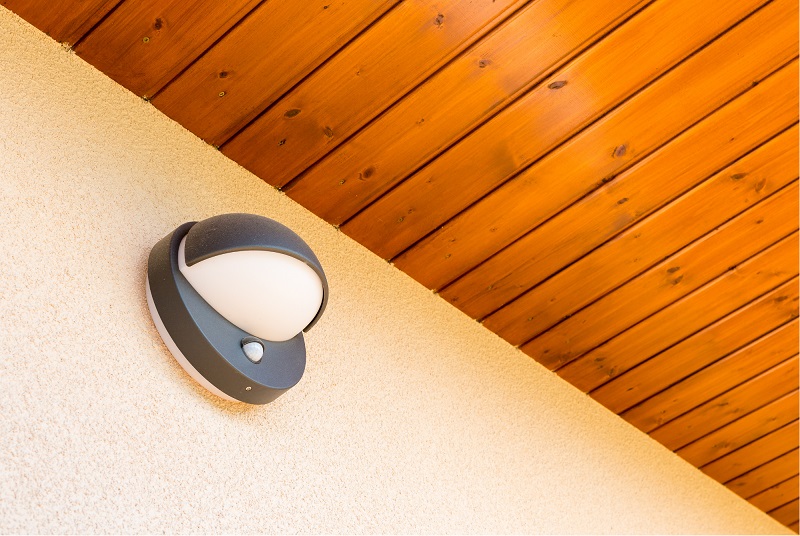
An exterior architectural luminaire featuring an integrated sensor node to automatically balance fixture illumination against natural ambient daylight.
3. Time and Schedule-Based Inputs
Not all environmental data requires physical hardware inside the room—time itself is a powerful input. A smart lighting controller can track:
- Exact daily sunrise and sunset times based on local geography
- The day of the week
- The household’s predictable wake-up and wind-down routines
While a physical sensor responds to what is currently happening, a schedule responds to what is expected to happen. The most capable systems deploy both simultaneously. For example, a Lutron system can use scheduling rules to ensure that if a motion sensor triggers a hallway light at 2:00 AM, it only turns on at a soft 10% brightness rather than blinding you.

• An elegant living room utilizing an evening schedule to transition decorative fixtures into low-level, warm lifestyle scenes.
4. Other Environmental Sensors
Here’s where the idea of adaptive environmental sensing becomes broader than conventional “smart lighting.”
True “responsive” lighting expands beyond simple smart switches by tying into a broader ecosystem of home automation. Controllers can aggregate ambient data points from around the house, including:
- Window shade positions and outdoor ambient light
- Temperature, humidity, and indoor air quality indices
- Smart security contacts (knowing if a door or window is open)
The System in Action: Imagine entering your bedroom at 8:00 PM. The system evaluates the context: it is evening, the room is occupied, outdoor light is low, and the motorized window shades are drawn closed. Instead of firing up a bright overhead ceiling fixture, it automatically activates a low-level, warm accent scene tailored for relaxation.
The technology isn’t necessarily doing anything amazing—
It is simply executing a better, more thoughtful decision because it has access to better information.
From Smart Lighting to Adaptive Lighting
While they sound similar, there is a fundamental difference between “smart” and “adaptive” lighting systems. Understanding this distinction marks a major evolution in modern residential lighting design.
- Smart Lighting focuses on input control. It gives you new, connected ways to operate your lights—such as a smartphone app, a voice assistant, or manual presets. The human still has to initiate the change.
- Adaptive Lighting focuses on environmental response. The lighting automatically modifies its own behavior based on real-time data from its surroundings.
To see how this distinction plays out in real life, consider how the two systems handle the exact same living room:
| System Type | The Mechanism | The Real-World Action |
|---|---|---|
| Smart Lighting | Requires a human command | You tell a voice assistant, “Set the living room lights to 50 percent.” |
| Adaptive Lighting | Evaluates the context automatically | The system determines: “It is 7:30 PM, the space is occupied, daylight has faded, and the evening scene should seamlessly transition to 50 percent.” |
With an adaptive installation, the homeowner is completely liberated from giving commands. The technology recedes into the background, quietly making the home more comfortable by intelligently responding to the context of your day.
Advanced Possibilities: Combining Sensors
While a single standalone sensor is highly useful, the true magic of adaptive lighting happens when multiple sensors pool their data. When sensors work together, a system moves beyond simple binary triggers and begins executing sophisticated environmental strategies.
Consider how a modern home office benefits from this collective intelligence. Instead of a basic motion detector blindly flashing the lights to 100% whenever you walk through the door, an integrated, multi-sensor system cross-references several data points simultaneously:
- Occupancy Sensor: Confirms you have walked into the room.
- Daylight Sensor: Measures that a bright afternoon sun is pouring through the window.
- Astronomical Clock: Notes that it is 2:00 PM on a Tuesday.
- Historical Logic: Recognizes that this hour is typically dedicated to focused screen work.
The Resulting Response: Instead of overpowering the room with electric glare, the system smoothly dims the overhead fixtures and only activates a subtle, glare-free task light over your desk. It maintains the exact aesthetic balance a professional designer intended, dynamically adjusting in real-time as clouds pass over the sun or evening sets in.
By combining inputs, adaptive environmental sensing ceases to be a mere convenience feature—it becomes a powerful tool that actively protects the comfort, mood, and visual design of your home.
Adaptive Lighting Shouldn’t Mean Constantly Changing Lighting
This is perhaps the most critical takeaway for any homeowner considering this technology:
A poorly designed adaptive lighting system can quickly become a daily annoyance.
Nobody wants a light fixture that noticeably fluctuates in brightness every single time a cloud passes overhead, nor do they want an ambient scene shattered because the family pet wandered across the floor.
The highest form of residential automation is always the one you barely notice.
A successful installation operates within highly stable boundaries to preserve the basic architectural character of a room. For instance, a daylight sensor should never cause a lightbulb to visibly step up and down every few seconds. Instead, an experienced programmer configures the system to make incredibly gradual, imperceptible adjustments over an extended period.
Likewise, an occupancy trigger shouldn’t simply blast every light in a room to full capacity. Truly intelligent systems rely on context-dependent logic to determine the appropriate response:
- In a Bathroom: The sensor triggers crisp, bright illumination during morning routines, but switches to a soft, low-level guide light if activated at 2:00 AM.
- In a Hallway: Late-night activation triggers a gentle, low-level pathway glow rather than standard daytime brightness.
- In a Closet: The hardware activates functional task lighting automatically while you are inside, then silently douses it the moment you walk out.
Ultimately, the true intelligence of a responsive home does not reside within the physical sensor itself—it lives entirely within the carefully crafted rules that govern how those sensors behave.
Adaptive Sensors and the Layers of Light
Responsive technology does not replace foundational design principles; instead, it elevates them. As explored in our comprehensive Homeowner’s Guide to Lighting, a beautifully lit room relies on layering three primary types of illumination: ambient, task, and accent.
Rather than overriding these layers, adaptive sensors allow you to orchestrate them with incredible precision.
Here is how different lighting layers interact dynamically with adaptive controls:
| Lighting Layer | Primary Purpose | How Sensors Automate It | Real-World Application |
|---|---|---|---|
| Ambient | Overall room illumination. | Scales down automatically as natural daylight increases. | Keeping a living room perfectly illuminated all afternoon. |
| Task | Focused, functional light | Activates instantly when an occupant is detected in a specific zone. | Illuminating a kitchen island or a dedicated home workshop. |
| Accent | Highlighting architecture/art | Activates and transitions according to an astronomical schedule. | Illuminating artwork softly from sunset until midnight. |
| Decorative | Visual interest & style | Participates primarily in pre-programmed evening lifestyle scenes. | Dimming chandeliers and pendants to a warm glow at dinner. |
| Pathway / Night | Safe navigation | Triggers low-level, glare-free guide paths only during late-night hours. | Safely lighting a path from the bed to the bathroom. |
This multi-layered approach makes a residential lighting system vastly more flexible without requiring you to install a single additional fixture.
This underscores a vital design truth:
Better control does not mean adding more lighting. It simply means extracting significantly more utility and beauty from the lighting you already have.
How Adaptive Sensors Can Work Room by Room
The technology becomes easier to understand when you stop thinking about sensors as gadgets and start thinking about what each room needs.
Our guide to Lighting Your Home, Room by Room takes a similar approach, looking at lighting according to the activities, surfaces, proportions, and visual requirements of individual spaces.
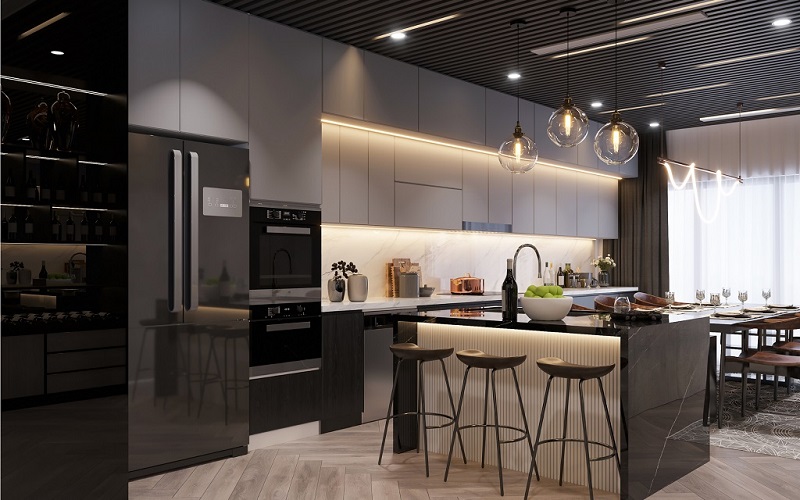
A modern kitchen layout highlighting localized under-cabinet task lighting layers that adapt independently from ambient overhead fixtures.
Kitchen
- A kitchen may benefit from daylight sensing combined with occupancy detection.
- During the day, natural light can reduce the need for ambient electric lighting. Under-cabinet task lighting can remain available when needed.
Bathroom
- Occupancy sensing is particularly convenient here.
- A more sophisticated system might also use time-of-day settings so that late-night illumination is considerably softer than morning task lighting.
Hallway
- Motion sensing can provide automatic illumination without requiring a switch at every end of the passage.
- At night, the system might use a lower brightness level.
Closet
- This is one of the simplest and most compelling applications.
- Open the door, enter the space, or trigger the sensor—and the lights come on. Leave, and they turn off automatically.
Living Room
- This is where adaptive lighting can become more sophisticated.
- Rather than automatically turning everything on, sensors and schedules might help establish different scenes for daytime, evening entertaining, watching television, reading, or late-night movement.
Bedroom
- Automation needs to be handled more carefully here.
- Automatic-on lighting can be useful when entering a dark bedroom, but unwanted activation in the middle of the night can be disruptive. Time-based scenes and low-level nighttime illumination may be more appropriate than simply turning on all the lights.
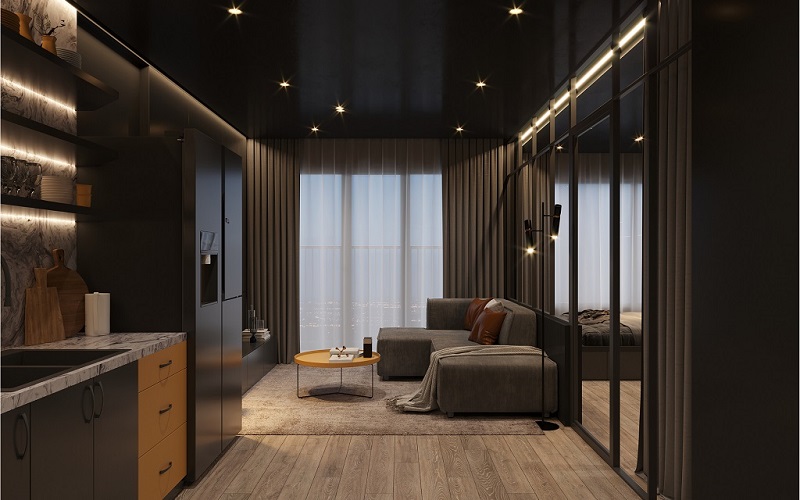
Integrated low-level ceiling details in a contemporary bedroom, providing safe navigation without causing disruptive midnight glare.
What Homeowners Should Ask Before Installing Adaptive Lighting
You don’t need to become a lighting-controls expert before beginning a project. But a few questions can make a conversation with your designer, electrician, or lighting professional much more productive.
1. What are we trying to automate?
Don’t start with the sensor. Start with the problem. Is the goal convenience? Energy savings? Better nighttime lighting? Daylight integration? Accessibility? A more sophisticated whole-home lighting experience?
2. What should happen when the room is occupied?
Should lights turn on automatically—or should the occupant turn them on manually? That’s the difference between occupancy and vacancy strategies.
3. What should happen when daylight changes?
Should artificial lighting simply turn off when there is enough daylight? Or should it gradually adjust to maintain a more consistent level?
4. What should happen at night?
Nighttime lighting often deserves its own strategy. A hallway that needs bright illumination at 8 a.m. may need only a small amount of low-level light at 2 a.m.
5. What happens when the automation gets it wrong?
Every automated system needs a manual override. You should always be able to turn something on, turn something off, dim it, or otherwise take control when circumstances don’t match the programmed assumptions.
6. Will the sensors work with the lighting equipment?
This is particularly important with LED lighting. As discussed in A Homeowner’s Guide to Lighting, LED fixtures and lamps have drivers and control requirements that can affect dimming performance. Compatibility among the sensor, control, dimmer, driver, and fixture should be established before installation—not after something starts flickering or buzzing.
Adaptive Lighting Is Also a Design Decision
It’s tempting to think of sensors as an electrical or smart-home issue. But they’re increasingly part of lighting design itself.
- Where should a sensor be located?
- What should it see?
- Which fixtures should it control?
- Should it control the entire room or only one lighting layer?
- How quickly should the lighting respond?
- What happens when sunlight changes?
- What happens when someone is sitting perfectly still?
- What happens when a room is occupied by one person rather than a whole family?
These are design questions as much as technical ones. The sensor may be a small piece of hardware, but its placement and programming can affect how an entire room feels.
The Future of Residential Lighting: Less “Smart,” More “Responsive”
The most significant development in modern residential lighting isn’t the ability to dim a lightbulb from a smartphone app—that is a problem we have already solved. The far more compelling frontier is whether lighting can become truly responsive to the home itself.
A genuinely responsive lighting system operates on pure context. It tracks when natural daylight begins to shift, notices when someone steps into a quiet hallway, understands when the evening is winding down, and recognizes the exact moment a room sits empty.
As integrated systems continue to evolve, they will aggregate these environmental signals to manage your home with less and less manual intervention. This doesn’t mean your light fixtures are becoming autonomous works of artificial intelligence. It simply means your home has access to better context—and better context invariably produces better lifestyle decisions.
For homeowners planning a build or renovation, the practical takeaway is straightforward:
Don’t just ask which smart lights you should buy. Ask what you want your lighting to know.
Before your next meeting with an architect, designer, or electrician, consider how you want your home to track:
- Presence: Exactly where people are moving throughout the day.
- Daylight: How much natural light is already flooding the architecture.
- Time: The progression of hours and your household’s personal routines.
- Utility: What specific task or activity a room is being used for at any given moment.
- Atmosphere: How the space should ultimately feel right now.
Once these contextual questions become the foundation of your lighting design conversation, adaptive sensors stop looking like high-tech novelties. Instead, they become what they were always meant to be: an indispensable design tool for creating a home that intelligently responds to the people living inside it.
Related Lighting Articles
- Neuroaesthetics: Designing Homes That Feel as Good as They Look
- Hospitality Trends Transforming Today’s Homes
- 4 Easy Home Improvements That Only Take a Day
- 10 Practical Home Upgrades for Vibrant Aging in Place
- How to Add Character to Your Home with Outdoor Lighting
- Is Uplighting or Downlighting Better for Your Property?
- How to Deal With Glare on a Waterfront Property
- Related Topics: Lighting | Wellness | Curb Appeal | Indoor-Outdoor Living
| Purgula is reader-supported. When you click on links to other sites from our website, we may earn affiliate commissions, at no cost to you. If you find our content to be helpful, this is an easy way for you to support our mission. Thanks! Learn more. |