

America builds roughly one million new homes a year—and very few of them are designed around the question of whether their residents will actually get to know each other. In an era when loneliness has been declared a public health crisis, one developer in coastal Delaware is betting that the way we build neighborhoods is part of the cure.
The Granary is a 451-acre master-planned community emerging in Milton, Delaware, by Convergence Communities. Rooted in a vision of “conscious community-building,” the project is being designed to cultivate the way people live, connect, and thrive.
Conceived and founded by developer Colby Cox, The Granary’s community ethos is built on Cox’s central conviction that human connection shapes emotional and social well-being more than any other element of how we live. Planned with over 10 phases unfolding across approximately 15 years, the development will eventually bring together 1,350 residences, 60,000 square feet of commercial space, 110 acres of preserved open space, 55 acres of parks, and a robust amenity program centered on everyday wellness, belonging, and meaningful human interaction.
Envisioned as a seamless, organic extension of the town of Milton, The Granary will weave together parks, trails, gathering spaces, and immersive landscapes that invite both residents and the broader community into a more connected way of living. An unstated goal of the project is to eliminate any semblance of an “Us vs. Them” mentality, as thousands of transplants become new residents of Milton—a town founded over 260 years ago—in coming years.
In this article, we’ll share what excites us about this particular development, and other related communities, and what prospective buyers should understand before signing on to a community built as much around a philosophy as a suite of amenities or floor plans.
Table of Contents
- The Granary: From Bali to Delaware
- The Built Infrastructure of Isolation
- Dark Sky Principles
- How The Granary Compares to Similar Communities
- The Granary Mindset: Alignment Over Demographics
- What The Granary Gets Right
- Where Philosophy Meets Reality: The Buyer’s Due Diligence
- What Would Make The Granary Great
- Resource Links
Also see:
- The Forever Home Myth: Why Adaptability is More Important than Endless Love
- The New American Home 2026: Innovation Meets Philanthropy
- The Future of Homebuilding Arrives in Pacific Palisades: Cover Delivers First Fire Rebuild
- More Recommended Housing Articles
- Related Topics: Home Buying | Community | Home Wellness | Aging in Place | Multigenerational
The Granary: From Bali to Delaware
When Purgula asked Colby Cox, founder and developer of The Granary, about the inspiration behind the project, he reflected on a 2024 trip to Bali. While Cox hesitated to label the excursion as a “seminal moment” for The Granary, the trip undeniably shaped his vision.
He and his wife had traveled to Indonesia to renew their wedding vows after 20 years of marriage, an experience that deepened his appreciation for the local culture. Struck by the profound contentment of the people he met, Cox began asking locals how they maintained such a positive disposition—a quality he felt was increasingly missing in modern American life. One Balinese hotel worker encapsulated their approach to happiness in three simple pillars: a connection to nature, a connection to others, and a connection to God and self.
Inspired, Cox brought these principles home as the philosophical seeds for his master-planned community in Milton, Delaware. He adapted the third tenet into a more secular framing of “connection to self,” further explaining this introspective principle as the need to pursue “life’s big questions.” “I’ve always had a strong belief that human connection was an important component of human happiness,” Cox noted.

Illustration of Diamond Park at The Granary, Milton, Delaware
Ultimately, it is a long way from a quiet conversation on a Balinese patio to a 451-acre development in Delaware. Bridging that immense distance is exactly the challenge The Granary sets out to meet.
The Built Infrastructure of Isolation
To understand the architecture of The Granary, one must become familiar with systemic failures of the conventional American suburb. Over the past half-century, suburban master-planning has largely optimized for privacy and vehicular convenience over human connection.
Cul-de-sacs intentionally choke off pedestrian through-traffic, transforming streets into quiet but sterile, empty corridors. Zoning laws isolate residential pockets from retail and civic life, forcing a total reliance on automobiles. When daily interaction requires getting behind the wheel, third places where community life once happened spontaneously—the corner cafe, the neighborhood park, the town square—disappear entirely. A byproduct of car-dependent design is a quiet epidemic of loneliness.
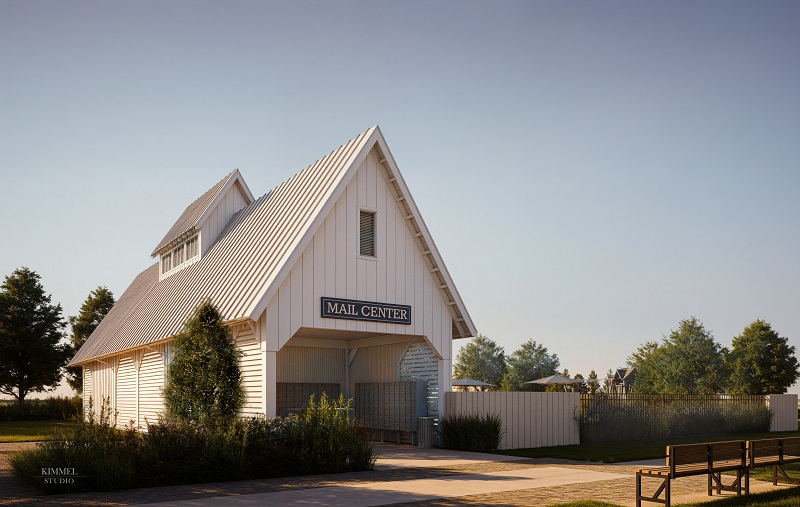
View of the Mail Center – a Phase 1 amenity for The Granary.
Rendering by Kimmel Studio
The Granary is structured as an explicit rejection of this privacy-first blueprint, replacing it with a proximity-first infrastructure. Rather than hiding behind gates and expansive, exclusionary setbacks, the layout utilizes narrow, connected street networks explicitly patterned to calm vehicular traffic and encourage walking.
Inside that framework sidewalks and integrated trail loops do not merely exist for recreation; they function as a continuous pedestrian highway that channels foot traffic past front porches and community gardens. By embedding public squares, open pavilions, and pocket parks within a short walk of every doorstep, the layout facilitates regular, organic opportunities for daily encounters—allowing neighbors to establish relationships naturally over time.
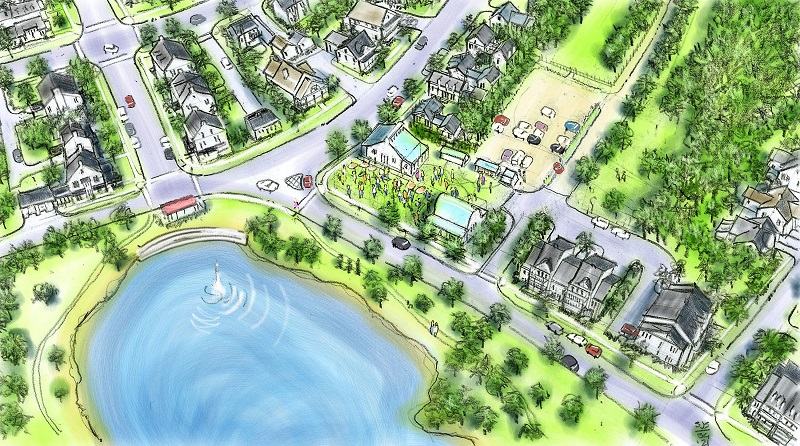
Color illustration of the Farmers Market at The Granary
Image courtesy of The Granary and Convergence Communities
Yet, deploying this ambitious social experiment carries immense regional consequences. The project is slated to essentially double the population of Milton, a historic Delaware town whose roots reach back 260 years. While a development of this magnitude aims to solve existing societal challenges, it also risks creating new ones, threatening to strain local infrastructure, dilute civic identity, and overwhelm the small-scale charm that defines the area. Whether a 451-acre community can truly alleviate the isolation of modern suburban life—while simultaneously absorbing the weight of a doubling town—depends entirely on how closely the physical layout honors its philosophical blueprint.

The Granary Community Map – All Phases
Image courtesy of The Granary and Convergence Communities
Dark Sky Principles
A key community wellness design element of The Granary is incorporating Dark Sky Principles.

The Granary entrance at Lavinia Street at night.
Rendering by Kimmel Studio
Modern residential developments rarely account for the invisible footprint of light pollution, which disrupts local ecosystems, inflates energy consumption, and severs our ancestral connection to the night sky. To counteract this, dark sky design principles prioritize preserving the natural nighttime environment through targeted outdoor lighting. By mandating shielded fixtures that direct light downward, setting lower overall illumination thresholds, and using warm-colored lights, communities can significantly minimize the artificial glare and light trespass that bleeds into surrounding homes. In an era where only a fraction of the global population can experience true darkness, these guidelines offer a proven framework for protecting local nocturnal wildlife while fostering healthier human circadian rhythms.
The Granary is adopting these standards as an aspirational blueprint for its master plan. The development intends to replace harsh, high-intensity commercial streetlights with low-intensity, warm-color LED alternatives and pedestrian-scaled pathway lighting. While there are roughly 270 formally certified Dark Sky places worldwide, whether The Granary will pursue formal certification remains to be seen—but the design intent is clear.
This approach is backed by the project’s macro-design: expansive open green spaces, deep agricultural buffers, and protected trail networks act as natural defense barriers against sky glow. By combining strict fixture specifications with intentional zoning, the layout prevents light from spilling into the neighboring Delaware wetlands and adjacent homes.
For future residents, this architectural restraint translates directly into a calmer, more restorative living environment. Eliminating intrusive light spill through bedroom windows naturally supports deeper sleep patterns, while reduced glare makes navigating neighborhood trails at night safer and more intuitive. By deliberately keeping the ground dark, The Granary opens up the horizon, granting its community an uncompromised, shared view of Sussex County’s coastal night skies.
Also see:
How The Granary Compares to Similar Communities
Dark Sky principles are one vivid expression of a broader design philosophy that has been quietly reshaping American residential development. The Granary is not the first development to sell a philosophy alongside a floor plan. Over the past two decades, a handful of communities have pioneered this model with enough of a track record to offer prospective buyers genuine points of comparison. Evaluating The Granary against its peers reveals something important: its vision is neither wholly original nor merely derivative. The proximity-first design and explicit social philosophy build on an established and growing movement—but the specific combination of Dark Sky principles, agricultural roots, and deliberate integration with an existing historic town gives it a character worth taking seriously on its own terms.
- Serenbe: Chattahoochee Hills, Georgia
- Willowsford: Loudoun County, Virginia
- Babcock Ranch: Fort Myers, Florida
- Amblebrook at Gettysburg: Gettysburg, Pennsylvania
Serenbe: Chattahoochee Hills, Georgia
Established 2004
The most direct and well-known parallel to The Granary is Serenbe, widely regarded as the gold standard of wellness-oriented master-planned communities in America. Located 30 miles southwest of Atlanta, Serenbe is an award-winning biophilic community spanning 1,700 acres, ultimately designed to house 1,700 homes. Like The Granary, it centers on a philosophical vision rather than square footage and amenities alone—one rooted in the relationship between people, nature, and the rhythms of daily life. Miles of trails connect European-inspired homes to a working organic farm, an outdoor performance venue, community gardens, and a range of wellness facilities that make healthy living feel incidental rather than effortful. Serenbe places 70% of its land into conservation and agricultural preservation, using the remaining 30% for walkable clusters of neighborhoods and shared amenities.
As the earliest and most mature expression of this community model, Serenbe is the most useful measuring stick for The Granary. The honest question prospective buyers should sit with is whether The Granary’s “three harmonies” framework represents a genuine evolution of Serenbe’s biophilic model or whether it is largely the same concept with a fresh coat of branding. After two decades, Serenbe has earned its philosophy through demonstrated execution. The Granary has yet to make that case.
Willowsford: Loudoun County, Virginia
Established 2012
For Mid-Atlantic buyers, the closest meaningful geographic comparison is Willowsford, a 4,125-acre master-planned community in Loudoun County, Virginia, approximately 25 miles from Washington, D.C. Like The Granary, Willowsford is built around the idea that daily life should be lived in proximity to nature, neighbors, and locally grown food. Its centerpiece is a working farm that cultivates more than 200 varieties of produce for residents, supported by 45 miles of multi-surface trails, two community centers with teaching kitchens, resort-quality pool complexes, and more than 2,000 acres of permanently designated open space.
What distinguishes Willowsford structurally—and what makes it particularly instructive for Granary buyers—is the Willowsford Conservancy, a standalone nonprofit organization separate from the HOA that manages all open space, farmland, and natural systems within the community. This institutional separation ensures that land stewardship accountability exists independently of the homeowners association, insulating conservation commitments from the financial pressures and governance disputes that can erode HOA priorities over time. Prospective Granary buyers should ask directly whether any equivalent independent stewardship structure is planned for its 110 acres of preserved open space and 55 acres of parks—and if not, what governance mechanism ensures those commitments are honored across 10 phases and 15 years of development.
Also see:
Babcock Ranch: Fort Myers, Florida
Established 2018
Babcock Ranch offers a different and perhaps more instructive kind of comparison—not because it resembles The Granary philosophically, but because it demonstrates what a long, phased master-planned build-out actually looks like at mid-execution. America’s first entirely solar-powered town, Babcock Ranch is powered by an 870-acre solar field and is planned for approximately 20,000 residences and 6 million square feet of commercial space. It first welcomed residents in 2018 and has since grown to house more than 15,000 people, ranking among the top ten best-selling master-planned communities in the country for three consecutive years.
Its organizing vision—resilience and sustainability rather than human connection—is a meaningful contrast to The Granary’s social philosophy. Where Cox asks residents to invest in a shared civic experiment, Babcock Ranch asks them to invest in infrastructure: solar panels, stormwater systems, elevated foundations, and fiber connectivity. That distinction matters when evaluating which kind of promise is easier to keep over a 15-year build-out. Tangible infrastructure either exists or it doesn’t. A social philosophy depends on whether the right people show up and stay. Babcock Ranch’s success is a testament to what committed, well-capitalized execution of a clear infrastructure vision can deliver. It also serves as a reminder that “wellness community” can mean vastly different things depending on who is building and what they have chosen to prioritize.
Amblebrook at Gettysburg: Gettysburg, Pennsylvania
Established 2020
No comparison of wellness-oriented master-planned communities would be complete without acknowledging the remarkable innovation happening within the 55+ active adult segment. Amblebrook at Gettysburg in Pennsylvania stands out as one of the most compelling examples—a community that has taken the wellness philosophy and applied it with exceptional specificity to the needs of older adults seeking active, connected, and purposeful living. For solo agers, downsizers, and empty nesters drawn to The Granary’s vision, Amblebrook offers a useful reference point: a community where the alignment between philosophy and execution has already been demonstrated at scale for a demographic that has the most to gain from getting this choice right.
Taken together, these communities confirm that The Granary is entering a real and growing market with genuine precedents—not forging entirely new ground. That is not a criticism. It means the model has been tested, refined, and validated by buyers willing to pay a premium for it. What remains to be seen is whether Convergence Communities can execute across a 15-year, 10-phase timeline with the consistency that separates a visionary development from an ambitious one that ran out of steam. The communities above suggest it is possible. They also suggest it is harder than the marketing materials make it look.
The Granary Mindset: Alignment Over Demographics
The ideal resident of The Granary is defined not by their age or occupation, but by their appetite for proximity. While typical master-planned communities cater to buyers seeking a predictable real estate asset or a place to withdraw into quiet anonymity, this development requires a fundamental willingness to participate in a shared civic experiment.

Photo of an enclosed porch by DRB Homes in The Granary, Milton, Delaware
Image courtesy of The Granary and Convergence Communities
The target resident is someone who recognizes that the casual friction of daily encounters—passing neighbors on narrow sidewalks, sharing a community garden plot, or gathering at a public square—is a prerequisite for authentic connection. Whether a young family, a remote professional, or a retiree, the unifying thread is a deliberate preference for active engagement over the isolationist privacy of the traditional American suburb. It attracts those who see environmental stewardship, wellness, and a slower pace of living not as marketing buzzwords, but as natural daily practices.
This ethos is deeply rooted in the local landscape. Founder Colby Cox is a fourth-generation Miltonian whose maternal family, the Drapers, has shaped the region’s agricultural, philanthropic, and civic identity for generations. The project is less an attempt to manufacture a trendy lifestyle brand and more an effort to scale the historical, close-knit dynamics of deep-rooted Milton to a new generation of residents and families.

Dune model home by DRB Homes at The Granary
Image courtesy of DRB Homes
Consequently, The Granary is explicitly the wrong fit for a specific type of buyer. If your primary residential goal is total seclusion in an environment where you can completely ignore your neighbors, the essence of this community will likely feel intrusive. Navigating a neighborhood designed around continuous pedestrian highways, shared green spaces, and intentional proximity demands a baseline level of social openness. For those who prioritize personal autonomy and privacy above all else, a traditional suburban lot or a gated enclave will offer a better-suited living arrangement.
What The Granary Gets Right
Not every ambitious residential development deserves the label ‘visionary.’ But when a project’s design philosophy converges with major trends reshaping how Americans think about health, community, and the built environment, it warrants serious attention. What we find compelling about The Granary is precisely this convergence—between Colby Cox’s stated vision and the core residential values Purgula has been documenting and advocating for across years of independent coverage.
- Community-Based Wellness & Resilience
- The Multi-Generational “Forever Community”
- Material Integrity, Craft, and Legacy
- Seamless Indoor-Outdoor Living
- Innovative Resource Management
1. Community-Based Wellness & Resilience
In our analysis of how 55+ active adult communities are reinventing wellness, we noted a profound cultural shift in which modern homeowners and communities are rewriting the rules of aging, demanding environments that prioritize continuous activity, independence, and holistic health over clinical isolation. The Granary’s proximity-first layout explicitly honors this trend. By weaving together walkable neighborhood trails, central public squares, and integrated green spaces, the physical footprint acts as a built-in preventative health measure.
Furthermore, true community resilience is built on the strength of neighborly bonds. As we explored in our feature on the growing movement of Repair Cafés, a deeply connected community doesn’t just make a neighborhood more enjoyable; it creates an organic, real-world support system that makes everyday life safer, richer, and far more adaptable. The Granary’s emphasis on communal friction points aligns perfectly with this ethos, providing the necessary “third places” where civic resilience can take root.
Also see:
2. The Multi-Generational “Forever Community”
Many developers build for a transient buyer, but our research into the myth of the static forever home underscores that true longevity requires architectural flexibility. A home only becomes a multigenerational sanctuary if it can adapt to its residents’ changing physical needs over time. We champion design choices that support vibrant aging-in-place—such as zero-step entries, intuitive floor plans, and highly accessible flex layouts—without sacrificing aesthetic beauty. The Granary’s focus on long-term residential wellness suggests an alignment with this philosophy, building spaces intended to be lived in for decades rather than outgrown in a few years.
Whether The Granary’s homebuilders deliver on these specific features remains a question that prospective buyers should raise directly. However, we are confident that growing numbers of elderly homeowners—solo agers, downsizers, and empty nesters—will find communities like The Granary to be strong fits for their lifestyle needs.
3. Material Integrity, Craft, and Legacy
There is a growing global reverence for craftsmanship and the layered storytelling embedded within architecture with purpose. In our coverage of the 2026 Pasadena Showcase House of Design at the historic Baldwin Oaks Estate, we highlighted a critical cultural awakening: a distinct return to craft, material integrity, and a respect for architectural heritage. This celebration of authenticity is exactly what we appreciate about The Granary’s approach to its integration with the town of Milton. By incorporating thoughtful, respectful planning, the development pays sincere homage to Milton’s historic and agricultural roots.
We also see a kindred spirit in Cox’s known passion for microbreweries and his deep belief that they are strong community builders. This interest parallels a broader cultural revival we have been observing: a renewed collective desire to understand how things are made, to honor highly skilled crafts and trades, and to preserve deep-rooted traditions. Much like a carefully crafted microbrew brings people together over shared space and tangible, hand-made quality, a neighborhood built around common interests—be it gardening, walking, birding, exercise, fixing things, or wide-ranging cultural pursuits—can transform an ordinary subdivision into a vibrant, enduring community where residents truly look after each other.
4. Seamless Indoor-Outdoor Living
The future of healthy residential design relies heavily on the seamless integration of interior spaces with the natural world outside. As documented in our design guides on balancing interior and exterior design and our deep dives into vanguard spaces like the 2026 New American Home and La Cova, a home’s footprint should naturally flow into its surroundings. The Granary leverages this dynamic on a neighborhood scale, treating its preserved countryside character, pocket parks, and dark skies as a literal extension of the resident’s living room. We subscribe to the belief that biophilic design is indeed a foundational key to human health and happiness.

Photo of kitchen and living room with ample natural light of the St. John model by DRB Homes at The Granary
Image courtesy of The Granary and Convergence Communities
5. Innovative Resource Management
Finally, modern community design cannot ignore the physical realities of natural threats and responsbile resource management. We have long advocated for the integration of proactive, defensive infrastructure—such as residential microgrid technology for localized energy independence, and sophisticated fire management strategies to protect individual properties, communities and ecosystems.
Crucially, this forward-looking framework must extend to how a community interacts with water. As we detailed in our guide on water features for an innovative modern home, intelligent water design must look past purely cosmetic features to focus on smart conservation, advanced stormwater management, and localized water-saving infrastructure. By treating water as a finite, precious asset to be integrated sustainably into the surrounding terrain—and combining these metrics with its dark-sky lighting initiatives—The Granary positions itself as a model for how a 21st-century development can responsibly co-exist with its local environment.
Also see:
Where Philosophy Meets Reality: The Buyer’s Due Diligence
While the design vision of The Granary aligns with vanguard wellness and community principles, prospective buyers must remember that purchasing into a master-planned community is as much a legal and financial partnership as it is a lifestyle choice.

Phase 1 Community map of The Granary
Image courtesy of The Granary and Convergence Communities
An ambitious 451-acre layout relies entirely on a complex infrastructure of Homeowners Associations (HOAs) and specialized local tax districts. Our extensive coverage of how to manage the true costs of homeownership and the critical need to avoid buying more home than you can afford underscores that long-term affordability is driven by ongoing, mandatory fees rather than the initial sale price.
The social cohesion promised by a proximity-first development requires intense structural governance. As we analyzed in our deep dive into the future of HOAs, modern associations are shifting from mere aesthetic regulators to complex mini-governments managing millions in assets and infrastructure. This reality demands that buyers exercise rigorous HOA due diligence before closing and carefully map out the hidden features that can fluctuate a home’s intangible value.
To bridge the gap between architectural idealism and hard financial reality, every serious buyer considering The Granary must seek definitive answers to the following questions—and of all of them, none warrants more careful scrutiny than the Special 30-Year Tax District, a funding mechanism that will shape carrying costs long after the mortgage is paid.
- Financial Governance & Special Taxation
- Regional Tax & Utility Due Diligence (A Relocation Checklist)
- Community Integration vs. Private Sanctuary
- Legal Protections & Local Advocacy
Financial Governance & Special Taxation
- What are the precise mechanics of the special 30-year tax district? Buyers should verify if the annual assessment—originally projected to be $2,000 for single-family detached homes and $1,600 for single-family attached homes—is a flat rate across all property types or if it scales based on square footage or lot size.
- Is there a legal mechanism or inflation clause that allows this special tax rate to change over the 30-year lifecycle?
- Can this 30-year tax obligation be paid off upfront at closing, and if so, what is the exact formula used to calculate that lump-sum amortization?
- How are the foundational HOA fees calculated, what is the projected escalation path as the phases expand, and how are the community’s reserve funds managed?
- Will the community feature revenue-generating assets—such as performance venues, event rentals, cafés, or retail spaces—and will that revenue offset resident HOA dues or flow back to the developer?
Regional Tax & Utility Due Diligence (A Relocation Checklist)
- How does the local property tax assessment process work, and are there localized exemption or abatement programs? For buyers moving across state lines, navigating the property tax debate is critical; you must understand how often the county reassesses home values, whether school district taxes are billed separately, and if the state offers senior or primary-residence homestead protections that alter your long-term carrying costs.
- What is the structural framework of the local utility delivery system? Relocating to a new region requires researching a neighborhood’s core utility FAQs—including whether water, sewer, and trash are municipal or privately managed, if the community utilizes centralized bulk-rate contracts for internet and power, and how specialized green infrastructure (like localized microgrids or advanced stormwater systems) shifts day-to-day utility billing compared to traditional public utilities.
Community Integration vs. Private Sanctuary
- What specific restrictions exist regarding enhanced individual privacy? In a development built around shared sightlines and pedestrian interaction, buyers must know if they are legally barred from installing fences, privacy hedges, dense screening trees, or retaining walls.
- Which exact amenities are strictly reserved for Granary residents, and which public squares, trails, and parks will remain completely open to the greater Milton population?
- What contractual benefits or fee incentives will early-phase buyers receive to offset the disruption, dust, and noise of living through years of subsequent construction phases?
Legal Protections & Local Advocacy
- Does the target state offer robust statutory protections or ombudsman programs that grant extra rights to homeowners operating within an HOA? Our baseline advice for homeowners living in an HOA community shows that state-level legal frameworks vary wildly in how they protect buyers from predatory assessments or arbitrary rule changes.
Because an HOA agreement is a legally binding contract that supersedes standard property rights, we strongly recommend that prospective buyers hire an independent homeowner advocate or real estate attorney to review the covenants, conditions, and restrictions (CC&Rs) before signing. Demanding clarity on these critical questions will help ensure that your investment serves your life rather than constrains it.
What Would Make The Granary Great
The Granary arrives at a meaningful cultural moment, and Colby Cox deserves genuine credit for addressing challenging questions than most developers are willing to ask. What follows is offered in that spirit—not as criticism, but constructive feedback that may separate a good development from an enduring one.
- Foster Community Through Shared Interests, Not Forced Obligation
- Maintain a Feedback Loop for the Community
- Establish an Independent Stewardship Entity for Natural Spaces
- Provide Plain-Spoken Financial Transparency on the Special 30-Year Tax
- Define What Success Looks Like and Share Publicly
- Address the Milton Integration Question With Action, Not Aspiration
1. Foster Community Through Shared Interests, Not Forced Obligation
Of all the recommendations in this section, this one is the most fundamental—and the most delicate to execute well.
Cox uses the word “programming” to describe the organized events and activities that will animate The Granary’s shared spaces. Programming, done right, is one of the most powerful community-building tools available to a developer. Amblebrook at Gettysburg stands as perhaps the finest current example: a relentless, imaginative calendar of activities—fitness classes, lectures, craft workshops, gardening clubs, live music, cultural events, volunteer opportunities—that gives residents dozens of genuine reasons to leave their homes and encounter their neighbors without ever feeling that participation is expected or monitored. Their approach to involvement is not just doing things you already enjoy, but enjoying the adventure of trying new things, as well.
The Amblebrook community doesn’t ask you to connect—it simply makes connection irresistible.
That distinction—between invitation and obligation—is everything.
The risk Cox faces is that a development built so explicitly around a social philosophy can inadvertently tip from inspiration into pressure. When community is the stated mission of a place, residents who prefer a quieter, more private mode of living can begin to feel like they are failing the neighborhood simply by staying home. That feeling—subtle, rarely articulated, but deeply corrosive—is the fastest way to undermine the authentic connection Cox is trying to establish. Manufactured warmth is not warmth. Curated belonging is not belonging.
The antidote is abundance and choice.
Offer so many different kinds of programming—across interests, schedules, ages, and temperaments—that every resident can find their own natural point of entry without anyone noticing or caring whether their neighbor found a different one. A birding walk at dawn and a microbrewery tasting on a Friday evening are both community events. So is a quiet morning in the community garden and a multigenerational technology workshop where a teenager teaches an eighty-year-old how to video call their grandchildren across the country.
This last point deserves particular emphasis. One of the most underutilized opportunities in master-planned community design is deliberate multigenerational programming—not just activities that happen to attract mixed ages, but experiences specifically designed around the exchange of knowledge, skill, and perspective across generations. Elders carry wisdom, lived experience, and institutional memory that younger residents genuinely need. Younger residents carry energy, technological fluency, and fresh perspective that older residents genuinely benefit from. A community that creates structured opportunities for that exchange—mentorship programs, intergenerational project teams, shared skill workshops—builds something far more durable than a neighborhood. It builds a flourishing culture. Launching a recurring Repair Café would be an invaluable early community program to launch that would not only get new residents involved, but also serve as collaborative bridge to members of the greater Milton community.
The Granary has the physical infrastructure to support all of this. The question is whether its programming philosophy will be expansive and humble enough to let residents define and evolve community on their own terms rather than the vision of the developer.
2. Maintain a Feedback Loop for the Community
Cox’s passion for his vision is one of The Granary’s greatest assets in its early phases—and one of its greatest long-term risks. The communities that endure are not the ones that execute a founding vision perfectly. They are the ones that listen carefully to what residents actually experience and adapt accordingly.
We would encourage Cox and Convergence Communities to build a formal, transparent resident feedback mechanism into The Granary’s governance structure from day one—something distinct from HOA meetings and complaint processes, designed specifically to capture what is working, what isn’t, and what residents wish existed. The most valuable insights will come from people who chose to live there and discovered something unexpected, both good and bad. Treating that intelligence as a strategic asset rather than a public relations inconvenience would distinguish The Granary from the vast majority of developments that confuse resident satisfaction surveys with genuine accountability.
The willingness to evolve—to hold the founding vision loosely enough that reality can improve it—is the mark of a developer building for generations rather than for a groundbreaking ceremony.
3. Establish an Independent Stewardship Entity for Natural Spaces
The Granary’s 110 acres of preserved open space and 55 acres of parks are central to its identity and its promise to buyers. But promises embedded in marketing materials are only as durable as the institutions designed to keep them.
We recommend that Convergence Communities establish an independent land stewardship entity—modeled on the Willowsford Conservancy in Virginia—to manage The Granary’s natural systems separately from the HOA. A standalone nonprofit with its own governance, funding mechanism, and conservation mandate would insulate the community’s environmental commitments from the financial pressures, leadership changes, and governance disputes that inevitably affect HOAs over a 15-year build-out. It would also provide residents with a transparent, accountable institution whose sole purpose is protecting the land they were promised—not balancing that protection against competing budget priorities.
This is not a radical suggestion. It is increasingly considered best practice among serious long-term conservation-oriented developments. Adopting it early would signal that The Granary’s environmental commitments are structural rather than aspirational.
4. Provide Plain-Spoken Financial Transparency on the Special 30-Year Tax
The special 30-year tax district is the single financial detail most likely to determine whether The Granary attracts the right buyers or the wrong ones. Buyers who understand it fully and choose The Granary anyway become committed, informed residents. Buyers who discover its implications after closing may become resentful ones.
Cox and Convergence Communities have an opportunity to distinguish themselves by getting ahead of this entirely. A proactive, plain-language explanation of the tax mechanics—how the assessment is calculated, whether it scales with property size, what inflation provisions exist, whether it can be retired early, and how it interacts with Delaware’s broader property tax structure—published openly and prominently before buyers reach the due diligence stage, would build exactly the kind of trust a community built around human connection needs to establish early. Transparency here is not just good ethics—it is good community design.
5. Define What Success Looks Like and Share Publicly
A development with a 15-year timeline and a social philosophy at its core owes its buyers more than a vision board. It owes them a definition of success.
We would encourage Cox to publicly commit to specific, measurable outcomes that The Granary will use to evaluate whether it is achieving its mission—not just sales velocity and construction milestones, but genuine community health metrics. Resident retention rates. Participation in community programming over time. Conservation benchmarks for the preserved open space. Relationships formed between new Granary residents and the existing Milton community. These are harder to measure than square footage, but they are exactly what Cox has staked his development’s identity on. Naming them publicly creates accountability. It also gives future residents something concrete to hold the developer to—and something to feel genuinely proud of when the numbers are good.
6. Address the Milton Integration Question With Action, Not Aspiration
The Granary will eventually double the population of a town whose roots reach back 260 years. That is not a footnote. It is a civic responsibility that deserves a response more substantive than open trails and public squares.

Welcome to Milton sign with a view of a town street
Image courtesy of The Oldfather Group
We would encourage Convergence Communities to develop and fund a specific Milton integration program—a deliberate, ongoing effort to build relationships between incoming Granary residents and the existing Milton community before, during, and after each development phase. This might include partnerships with local civic organizations, shared programming between Granary amenities and Milton’s existing cultural institutions, resident orientation experiences that introduce new arrivals to Milton’s history and character, and a standing community liaison role accountable to both sides of that relationship.
The difference between a development that enriches its host town and one that overwhelms it often comes down to whether the developer treated integration as a design problem worth solving or an inevitable outcome requiring no deliberate effort.
Cox’s own roots in Milton give him a credibility here that most developers could never claim.
Using that credibility actively—not just symbolically—may be the most important thing he does.

Drone view of the first model homes at The Granary, Milton, Delaware
Image courtesy of The Granary & Convergence Communities
The Granary is an ambitious, sincere, and genuinely interesting attempt to build something better than the American residential default. These suggestions are offered in the belief that it can succeed—and that the distance between a good development and a great one is usually the willingness to keep asking hard questions long after the groundbreaking champagne has been poured.
Resource Links
The following resources will help prospective buyers begin their direct research into The Granary and its available homes.
- The Granary Website
- The Granary FAQs
- The Granary Homes by DRB Homes
- The Granary Homes Area Map by DRB Homes
- The Granary Homes by D.R. Homes
- The Granary: A Vision Unveiled
- Colby Cox Interview by Spotlight Delaware
- Milton, Delaware Official Website
Additional Housing Articles
- Redefining Luxury: Resilience, Legacy, and the Future of the Modern Home
- La Cova: Where Wellness is the Future of Luxury Living
- Expert Tips for Designing a Beautiful & Resilient Coastal Home
- How to Make a Bathroom Accessible, Safe and Comfortable
- Future-Proof Secrets for a Master Bathroom in a New Build
- Related Topics: Home Buying | Community | Home Wellness | Aging in Place | Multigenerational
| Purgula is reader-supported. When you click on links to other sites from our website, we may earn affiliate commissions, at no cost to you. If you find our content to be helpful, this is an easy way for you to support our mission. Thanks! Learn more. |