

How the Housing Innovation Alliance’s national competition is creating a new collaborative R&D model for housing innovation—one that moves beyond ideas and into homes people can actually buy and afford to own.
Across the United States, homebuilders are confronting a reality that traditional approaches alone can no longer solve. Housing affordability has become a complex equation shaped not only by rising construction costs, but also by financing, insurance, energy use, maintenance, labor shortages, and increasingly complex building codes. Meeting that challenge requires more than incremental improvements—it requires a new model for innovation that brings together the people who design homes, build them, regulate them, finance them, and ultimately live in them.
The Housing Innovation Alliance (HIA) is pioneering that model by transforming research institutions into the homebuilding industry’s research and development partners. Through its Housing Innovation Challenge (HIC), universities are working alongside production builders, manufacturers, code officials, lenders, and public agencies to develop housing solutions that can move beyond future-forward classrooms and into real neighborhoods. Rather than rewarding visionary concepts alone, the competition requires every finalist to prove that their ideas can be built, sold, occupied, and measured.
In October 2027, the competition will culminate in Charlotte, North Carolina with the unveiling of ten completed demonstration homes that showcase innovative approaches to industrialized construction, affordability, resilience, and long-term homeownership by ten hybrid university-industry teams. More than a design showcase, these homes will serve as living laboratories—providing invaluable data, performance metrics, and real-world validation needed to accelerate the adoption of the next generation of attainable and resilient housing.
Purgula spoke with Bobby Vance, Co-Director of the Housing Innovation Challenge, to learn more about the HIC and to get his perspective on the future of home construction.
Table of Contents
- The Housing Innovation Challenge: A New Model for Innovation
- Why Builders Need an R&D Partner
- Beyond a Construction Competition
- Focus on the Full Cost of Homeownership
- Living Laboratories: Performance-Based Standards and Digital Twins
- The Common Thread: Industrialized Construction
- Lessons for the Future of Affordable Housing
Also see:
1. The Housing Innovation Challenge: A New Model for Innovation
For decades, America’s homebuilding industry has faced a familiar dilemma. Innovation happens slowly, housing costs continue to rise, and promising ideas often stall before reaching production. Universities generate research, builders deliver homes, manufacturers develop products and code officials regulate construction. Too often, each group works independently.
The Housing Innovation Alliance (HIA) is attempting to change that.
Rather than treating research institutions as isolated academic centers, HIA is positioning universities as the residential construction industry’s research and development arm—a place where new building systems, materials, construction processes, and housing models can be developed, tested, measured, and ultimately deployed at scale.

The result is the Housing Innovation Challenge (HIC), a multi-year initiative that will culminate in October 2027, when ten full-scale homes—designed, built, occupied, and measured—will be unveiled as working demonstrations of what the next generation of attainable housing could become.

Skyline of Charlotte, North Carolina, host of the inaugural 2027 Housing Innovation Challenge
Unlike traditional design competitions, success will not be judged solely on architectural creativity. The homes must actually work in the marketplace.
The Housing Innovation Challenge is frequently described as a construction competition, but its organizers argue that framing misses the point.
Bobby Vance, Co-Director of the Housing Innovation Challenge remarked:
“It is not just a construction challenge—it is an affordability challenge.”
That distinction changes everything.
Rather than focusing exclusively on reducing the initial purchase price, the competition evaluates homes through its H.O.M.E. Framework—a proprietary evaluation model developed by the Housing Innovation Challenge to capture the full cost of ownership across a home’s lifetime:
- H—Home Production Cost: land, labor, materials, and regulatory costs
- O—Occupancy Cost: financing, taxes, insurance, and fees
- M—Maintenance and Operation Cost: the recurring expense of keeping a home running over time
- E—Equity: the long-term value and wealth-building a home provides its owner
The objective is not simply cheaper housing, but homes that remain financially attainable throughout their life cycle, while still delivering value, resilience, and quality. As housing costs continue to outpace incomes across much of the country, lowering ownership costs may prove just as important as lowering construction costs.

Bobby Vance, registered Architect, Co-Director of the Housing Innovation Challenge, Assistant Professor of Building Design, Virginia Tech and Owner/Principal of Vance Design Company.
2. Why Builders Need an R&D Partner
HIC was born from HIA’s mission to be “the room where innovation meets action” and its long held belief in applied innovation. HIA drew inspiration from a few other events and competitions, as well, such as the Department of Energy’s Solar Decathlon (now called BuildingsNEXT), HIA’s own proprietary concept homes, and the creative thinking of forward-looking developers like Good Developments Group with their Gateway South project in St. Louis.
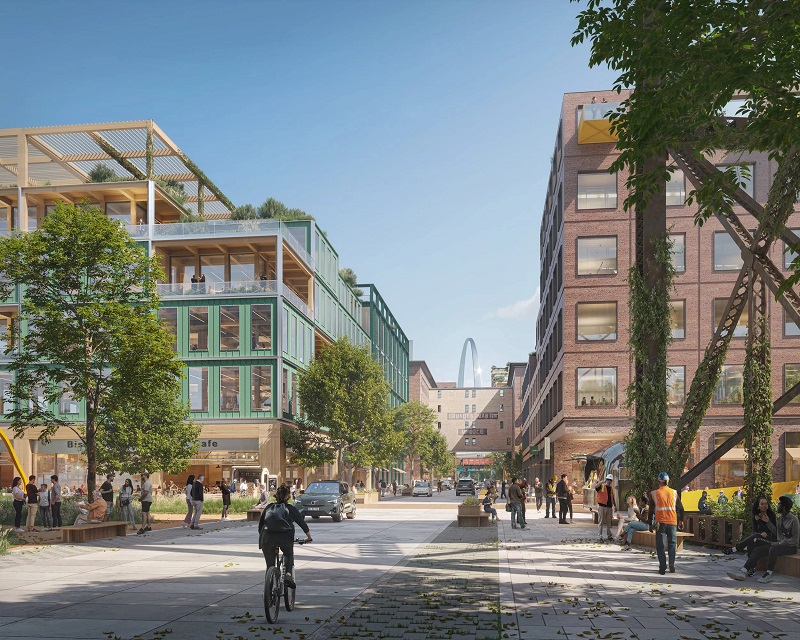
Rendering of the Gateway South Project in St. Louis
Image courtesy of Good Developments Group
HIA’s mission is built on three pillars, with their events, like HIC, serving as the connective tissue that ties it all together:
- Industry Intelligence and Research: the proprietary data and studies that show where the industry is actually headed
- Applied Innovation: turning that research and those relationships into real, built projects
- Startup Investment and Engagement: sourcing, vetting, and connecting HIA’s network to the most promising housing-tech startups

Attendees at HIA’s 2024 Innovation Summit
Image courtesy of the Housing Innovation Alliance
One of the competition’s most significant innovations is organizational rather than technological. Instead of universities developing concepts in isolation, HIC brings every stakeholder together from the beginning:
- Homebuilders
- Manufacturers
- Research universities
- Architects
- Engineers
- Mortgage professionals
- Code officials
- Public agencies
- Housing nonprofits

Partners of the Housing Innovation Challenge
This collaborative structure recognizes a fundamental reality:
successful innovation requires the participation of everyone who ultimately determines whether a new idea succeeds or fails.
Universities contribute research and experimentation, builders bring the practical knowledge of constructability, manufacturers provide pathways to scalable production, code officials identify regulatory hurdles, and financial institutions assess financing implications.
By engaging these stakeholders from the outset, the HIC identifies constraints early—while they can still be addressed—rather than discovering them after a prototype has already been completed. In doing so, the competition overcomes one of higher education’s longstanding challenges, where research often remains siloed within individual disciplines. Housing, however, is inherently interdisciplinary, requiring technical, regulatory, financial, and market expertise to transform promising concepts into homes that can be built, financed, sold, and lived in.
Then–Charlotte Mayor Vi Lyles described the city’s role in similar terms—not simply as a host, but as a participant with a stake in the outcome. As she put it, cities need to move beyond conversation and create opportunities to test new ideas in public view. That’s a notable shift for a public agency, which more typically sits on the regulatory side of a project like this rather than inside the room helping build it.
3. Beyond a Construction Competition
Innovation That Must Actually Be Built
Unlike many architectural design competitions that reward ambitious concepts which never move beyond the drawing board, the Housing Innovation Challenge has taken a fundamentally different approach:
Every finalist must construct a full-scale functional home.
That implementation requirement transforms the nature of innovation because, as Vance observed:
“It’s a different animal if you have to actually build the home.”
Thus, every design decision must withstand the practical realities of the marketplace:
- Can the home be permitted?
- Can it be financed?
- Can contractors build it efficiently?
- Will manufacturers supply the necessary components?
- Can homeowners maintain it affordably?
- Will buyers actually purchase it?
The challenge extends even further—each completed home must be sold to an actual homeowner, ensuring that every participant has a genuine financial and reputational stake in the outcome. These homes cannot simply look impressive in renderings or photographs; they must perform in the real world.
That emphasis on implementation also serves another critical purpose:
Reducing the risk of innovation.
Perhaps the competition’s greatest contribution is not a particular building technology, but its ability to de-risk new ideas before they enter the broader marketplace. Homebuilding is, by necessity, a conservative industry where mistakes are costly, and builders rarely reject innovation because they oppose change—they reject innovations that introduce uncertainty.
Competition organizers describe the program as “a giant de-risking exercise.” Rather than asking builders to gamble on unproven systems, the competition creates evidence. Completed homes become full-scale demonstrations where performance can be measured, costs documented, and lessons shared within the industry. By replacing assumptions with data, the program provides the metrics builders, lenders, manufacturers, and code officials need to make informed decisions. As competition leaders repeatedly emphasize, real-world performance—not marketing claims—is what ultimately persuades the industry to adopt new technologies, materials and methods.
Dennis Steigerwalt, President of the Housing Innovation Alliance, frames the stakes in similar terms. If the industry wants different results, he argues, it needs better ways to assess new ideas before they are asked to succeed at scale. The ten advancing teams, in his view, aren’t being recognized simply for creative concepts, but for work the rest of the industry can actually study, stress-test, and learn from.

Dennis Steigerwalt, President of the Housing Innovation Alliance
Image courtesy of the Housing Innovation Alliance
4. Focus on the Full Cost of Homeownership
The Housing Innovation Challenge asks a broader question than simply, How can we build a less expensive house?
Instead, it asks:
How can we lower the total cost of owning that house over decades?
That perspective is reshaping not only how homes are designed, but how they are assembled.
For generations, homes have been treated as single, unified structures, with every project designed as a largely unique object. The competition encourages a different way of thinking—one that views a home as a collection of interconnected systems, each with its own purpose, lifespan, and opportunity for innovation.
For instance, the foundation performs a different function than the exterior enclosure. The building envelope serves different requirements than the mechanical systems. Interior finishes change more frequently than structural components, while kitchens and bathrooms often share remarkably similar layouts regardless of the region where a home is built.
Recognizing those distinctions opens new possibilities for standardization where it creates efficiency, while preserving flexibility where homeowners value choice.
Concepts such as modular room assemblies, standardized bathroom and kitchen systems, and adaptable interior components illustrate how this approach could reduce construction costs while also simplifying maintenance, repairs, and future renovations. A home designed as an assembly of durable, replaceable components may ultimately prove less expensive to own over its lifetime than one optimized solely for the lowest initial construction cost.
Competition organizers often compare this layered approach to the automobile industry. Modern vehicles are built from highly standardized platforms that achieve significant manufacturing efficiencies, yet buyers can still customize finishes, technology packages, and features. Housing has the potential to follow a similar path, combining repeatable building systems with localized design and personalization rather than reinventing every home from the ground up.
Vance describes this distinction in terms of two competing models: a “construction system,” in which every element of a home is uniquely engineered and approved on a project-by-project basis, versus a “furniture system,” in which a home is treated as an assembly of pre-approved, interchangeable parts—not unlike a modular outdoor kitchen. Vance favors the furniture-system approach precisely because its components can be pre-approved once and reused widely, rather than re-litigated with every new project.
That thinking is already playing out in practice. In the wake of the Los Angeles wildfires, the affected municipalities have adopted pre-approved plan models that allow homeowners to select from a set of vetted designs—including ADUs—and personalize the details on top of an already-approved foundation. It’s an approach Vance points to as a template for how industrialized construction could scale nationally without requiring costly, time-consuming, case-by-case regulatory review for every home.
5. Living Laboratories: Performance-Based Standards and Digital Twins
The Housing Innovation Challenge recognizes that even the most promising technologies must navigate a complex ecosystem of building codes, permitting, and financing before they can become part of everyday construction.
To accelerate this transition, the initiative highlights a critical shift toward performance-based building standards. Traditional building codes prescribe exactly how a structure must be constructed. In contrast, performance-based standards evaluate whether a building achieves measurable outcomes for safety, durability, energy efficiency, and resilience, regardless of the methods used. This distinction allows builders to explore alternative, cost-saving solutions while maintaining strict public protections.
Once the construction phase of the competition concludes, the homes themselves become teaching tools. Builders, code officials, manufacturers, lenders, and policymakers will be able to walk through the completed structures, examine the construction methods firsthand, and evaluate real results—not renderings or marketing claims.
Digital Twins will serve double duty in this process—they function as a design tool before construction begins, and a field tool during the build itself. A collaboration between Meritage Homes, 84 Lumber, and MiTek in Greenville, South Carolina, highlighted at HIA’s 2025 Housing Innovation Summit, demonstrated both roles in practice:
The same virtual model that guided design decisions upfront was used to track construction in real time.
The true scientific value of the competition, however, begins after the homes are occupied, when that same digital twin becomes a tool for monitoring performance in real time. For homeowners, that digital twin becomes a lasting record of the house as it was actually built—useful for everything from planning a renovation to knowing whether a new sofa will fit through a doorway. It can also double as a built-in home inventory database: a running record of installed appliances, fixtures, and materials—brands, model numbers, ages, warranties, and finishes—that homeowners would otherwise have to assemble themselves for insurance documentation or claims.
Through long-term partnerships with participating universities, researchers will continuously collect data on energy consumption, material durability, maintenance requirements, and operational costs— the M in HIC’s H.O.M.E. framework. This ongoing evaluation transforms these structures from demonstration projects into living laboratories. By replacing theoretical claims with a growing body of real-world evidence, the program provides builders, manufacturers, insurers, and policymakers with the precise metrics they need to confidently adopt the future of housing.
Because every team’s digital twin captures data in the same consistent format, researchers can compare results across teams using entirely different construction technologies—turning individual case studies into a genuinely replicable body of evidence, rather than a collection of one-off success stories.
6. The Common Thread: Industrialized Construction
On May 20th, 2026, ten finalist teams were announced from a competitive field: 33 proposals submitted by 20 academic teams representing 23 universities nationwide.
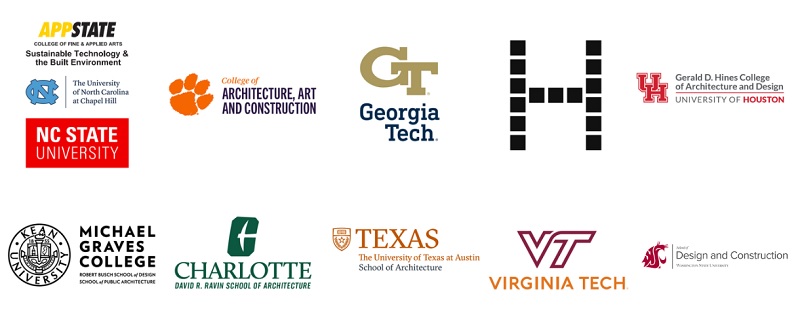
School logos of the 10 finalist teams selected for the inaugural 2027 Housing Innovation Challenge
The finalists include:
- Clemson—Core Connect: Connecting Modules. Connecting People.
- Georgia Tech—Lego Living
- Harvard—NeighborCore: A new typology for affordable, social living.
- University of Houston—Twin Stack
- Kean University—Porch Life Redefined: Scalable Passive Strategy
- University of North Carolina at Charlotte—Three Ply: Modular, Flexible, Adaptable
- University of Texas at Austin—Fresh Air House
- Virginia Tech—CoreHaus
- Washington State University—SLIDER: Vertical Volumetric Construction
- A joint team of Appalachian State University, University of North Carolina at Chapel Hill, and North Carolina State University—Housing as a Product
Although the ten finalist teams pursued very different design solutions, construction methods, and architectural styles, they shared one defining characteristic:
Every proposal incorporated some form of industrialized construction.

Members of the 10 finalist teams selected for the inaugural 2027 Housing Innovation Challenge
The term industrialized construction is intentionally broad. Rather than limiting innovation to a single approach such as modular housing or 3D printing, the Housing Innovation Challenge embraces industrialized construction as an umbrella for a wide range of manufacturing-driven building strategies:
- Panelized wall systems
- Volumetric modules
- Prefabricated kitchen and bathroom pods
- Advanced manufacturing processes
- Innovative building materials
- Digital fabrication, and
- Hybrid systems that combine factory-built components with conventional on-site construction.
In practice, that range plays out across very different design strategies. Some teams are exploring cottage-court layouts—clusters of smaller homes arranged around shared outdoor space, designed for multigenerational living. Others are testing mass timber and cross-laminated timber construction, or stacked duplex-to-quadplex models built to increase density without sacrificing livability. No single material or floor plan runs through all ten proposals—instead, what connects them is where the thinking begins. Rather than a particular technology, the common thread is a shared philosophy:
Move more work from the jobsite into controlled manufacturing environments where quality, precision, safety, and labor efficiency can be improved while reducing construction time and material waste.
That distinction is important because the competition is not attempting to determine whether one construction method is superior to another. Instead, it asks a broader question:
What can housing learn from the manufacturing practices that have already transformed other industries?
Commercial construction already provides part of the answer. Prefabricated bathroom pods have become commonplace in hotels, hospitals, and student housing because they improve quality control while reducing installation time. Factory-built mechanical assemblies and standardized building components are increasingly used throughout commercial projects for many of the same reasons. The Housing Innovation Challenge explores how similar manufacturing principles can be adapted to residential construction.
But the deeper thread running through all ten projects isn’t a construction method at all—it’s a mindset. Every finalist team had to be willing to set aside the way homes have always been built and ask, instead, what building a home could look like if it were designed today, for today’s constraints and tomorrow’s needs. That’s a harder discipline than it sounds. The instinct in any established industry is to refine what already exists; the Housing Innovation Challenge asks teams to question whether what already exists is even the right starting point.
“You’re tasked with teaching the past and the current,” Vance says of architecture education, “but the industry needs a new mindset about planning and doing things—new materials, new methods, new opportunities.” That shift, he argues, is also a chance to leapfrog decades of stigma around methods like stick-built construction—treating the past not as a blueprint, but as one option among many.
It’s a mismatch that shows up well before graduation: architecture students are trained on established methods and conventional wisdom, then enter a field that needs them moving in the opposite direction. Part of the fix, in Vance’s view, is getting architecture students into the same room as the people who build what they design. Tradespeople carry decades of practical, hard-won knowledge about what actually works on a jobsite—knowledge that rarely makes it into a design curriculum. Bringing students into direct contact with that expertise mirrors the competition’s larger premise:
that the best solutions come from getting every stakeholder collaborating from the start, not from any one discipline working in isolation.
Viewed through that lens, industrialized construction is not simply about factories or prefabrication. It represents a different way of thinking about how homes are designed, manufactured, assembled, and improved over time—one that treats the past as a reference point, not a blueprint. The Housing Innovation Challenge is exploring that future not by promoting a single technology, but by demonstrating what becomes possible when an industry is willing to build for where housing needs to go, rather than where it has already been.
7. Lessons for the Future of Affordable Housing
Although the Housing Innovation Challenge will culminate with the completion of ten demonstration homes in October 2027, organizers see those projects as the beginning of a much broader transformation rather than the finish line. That framing isn’t just aspirational. The Challenge is structured as a ten-year initiative spanning five two-year cycles in different U.S. cities, with Charlotte serving as the inaugural host.

Skyline view of Charlotte, North Carolina during the Fall
What’s unveiled in October 2027 is meant to be the opening chapter of a longer program—with lessons from Charlotte’s cycle informing how future cycles unfold in other cities. Supported in part by the U.S. Department of Housing and Urban Development (HUD), the initiative is designed to establish repeatable pathways for innovation that can be adopted across the homebuilding industry. HUD’s participation runs through a five-year memorandum of understanding (MOU) to support student design, industry-led construction, and federal evaluation.
HUD intends to collaborate with HIC to administer the student competition, set the performance criteria, and qualify the winning designs. In addition, HUD will fund and oversee an independent evaluation of construction outcomes—cost, timelines, performance, replicability—through an interagency agreement with Oak Ridge National Laboratory. That includes energy modeling on 10 homes, evaluation of up to 20 technologies during construction, post-construction assessments of build cost and time, market-readiness analysis on those same technologies, and comparisons against current construction practice wherever baseline data exists.
In Purgula’s view, that independence matters:
An evaluation run by an outside federal lab, rather than by the program itself, lends the competition’s cost and performance claims a credibility that self-reported results couldn’t achieve on their own.
All of this work will then roll into a final report to communicate findings, lessons learned, and recommendations for scaling this beyond the demonstration. The data collection is designed into the process from day one, so it can later inform housing policy and market adoption.
The lessons learned from the competition are expected to inform standardized approval processes for industrialized construction, faster and more predictable permitting, expanded use of digital twins to monitor building performance, greater adoption of resilient and universally designed homes, design strategies that enable future disassembly and reuse, lower lifetime ownership costs, and new ownership models that allow younger households to begin building equity earlier in life—again, the M and E in HIC’s H.O.M.E. framework.
The gap is stark, however:
The average age of a first-time homebuyer today is 40, while the students designing tomorrow’s housing solutions are, on average, closer to 23.
That disparity cuts both ways—it’s part of what makes the affordability crisis so urgent, but it may also be exactly what’s driving the boldness of the ideas coming out of programs like this one. Necessity has always been the mother of invention; a generation facing the steepest homeownership odds in decades has every incentive to reinvent the model rather than inherit it.
Underlying all of these efforts is a simple but powerful premise:
America’s housing challenges are too complex for any one stakeholder to solve alone.
Meaningful progress requires researchers working alongside builders, manufacturers collaborating with regulators, educators learning from practitioners, and financial institutions engaging with innovators from the outset. By bringing these traditionally separate groups together around a shared goal, the Housing Innovation Alliance is demonstrating that affordability, resilience, quality, and long-term value are not competing objectives, but complementary outcomes that can be achieved through collaboration, evidence-based innovation, and a commitment to building homes that truly work for the people who live in them.
The Housing Innovation Challenge offers a compelling model for how those groups can work together—not merely to imagine better housing, but to build it.
There’s a broader idea running underneath HIC’s work that resonates with much of what Purgula has been tracking across the housing world in recent years. The furniture-system model Vance describes—a home as a collection of durable, replaceable, independently upgradable parts—is a close cousin to an idea we recently explored in our own coverage of homes designed to age like well-designed computers, with parts that can be maintained, retrofitted, and improved piece by piece, rather than replaced wholesale every time something falters or falls out of date. A foundation and envelope built to last decades; interior systems built to be swapped out as needs, technology, and households change.
That same systems thinking extends naturally into questions of resilience and adaptability—how a home holds up to environmental challenges, how it accommodates a multigenerational household or a homeowner aging in place, how a garage or ADU becomes a source of income rather than a fixed cost. None of these are separate conversations. They’re part of the same conversation, viewed from different rooms of the same house.
It’s a rare thing to see a national competition build an entire evaluation framework—H.O.M.E.—around that same instinct: that a home’s true cost, and its true value, are inseparable from how well it adapts over the decades after it’s built.
If successful, the ten homes unveiled in 2027 may prove valuable not only for the families who purchase them, but also as evidence that housing innovation accelerates when research institutions become true partners in delivering homes to the market.

Charlotte will certainly be the center of the residential construction world in October 2027
Additional Housing & Construction Articles
- The Forever Home Myth: Why Adaptability is More Important than Endless Love
- Redefining Luxury: Resilience, Legacy, and the Future of the Modern Home
- LGS: A Proven Opportunity for More Resilient Homes
- Designing Against Loneliness: A Look at The Granary in Milton, Delaware
- 5 Innovative Ways 55+ Communities Are Reinventing Wellness
- Related Topics: Resilience | Home Safety | Home Wellness | Aging in Place
| Purgula is reader-supported. When you click on links to other sites from our website, we may earn affiliate commissions, at no cost to you. If you find our content to be helpful, this is an easy way for you to support our mission. Thanks! Learn more. |