

Ask most homeowners what fall maintenance means and you’ll get some version of the same answer: gutters, leaves, maybe the furnace filter if they’re diligent. Fall maintenance is treated as cleanup—a seasonal chore list to clear before the weather turns.
We think that framing undersells the season and the opportunity at hand. Fall isn’t primarily a cleanup window. It’s a readiness window—arguably the most forgiving stretch on the entire home-maintenance calendar. In much of the country, daylight is still usable and temperatures are often mild enough for comfortable exterior work—without the heat risk of July or the ice risk of January.
And it’s often the last practical stretch to catch a roof, siding, or drainage problem before rain, freeze-thaw cycles, snow, wind, or heavier heating demand turns a minor defect into a major issue—one that’s also more difficult and more dangerous to fix once you’re working from a ladder in the rain, wind, snow, or ice.
Fall is when a house gets one last dress rehearsal, before it has to perform.
Table of Contents
- Houses Fail at the Connections
- Five Systems, One Season
- The Overcleaned Yard
- Practical Rules for Leaves
- Tools That Help Detect Trouble Earlier
- A Note about Fall Home Inspections
- What We Think Matters Most
Also see these related Home Maintenance articles:
Houses Fail at the Connections

A roofer applying caulk to house chimney flashing
Individual components rarely fail on their own. A roof can be sound while the flashing around a chimney or vent pipe has quietly opened up. A gutter can be spotless while its downspout dumps water directly against the foundation instead of away from it. A window can seal perfectly while the sill, trim, or drainage plane behind it has failed. Insulation can be fully intact while air still moves freely through an attic penetration, a duct boot, or a recessed light fixture never meant to be airtight.
These are the seams of the house, and seams are where things come apart.
This is the same instinct behind the “motherboard” logic we laid out in our Forever Home framework: a house isn’t really a collection of separate features. It’s a set of connected systems, and the connections—not the components—are where trouble tends to start.
That gives fall maintenance a better starting question than “what’s on my list this year?”
Where does one material, surface, or system hand off to another—and is that handoff still doing its job?
These transitions are unglamorous, and they’re exactly where a fall walkaround earns its keep.
- Roof to wall.
- Gutter to fascia.
- Downspout to grade.
- Siding to window.
- Patio to door threshold.
- Garage to house.
The point is not that every handoff is a problem. It is that handoffs deserve more attention than the visible components around them.
Five Systems, One Season
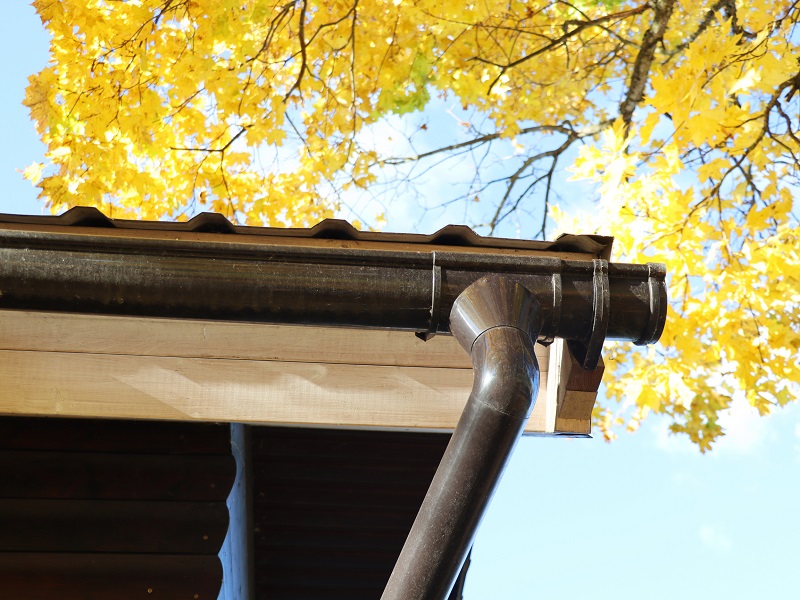
Rain gutter system and roof protection from snow
We’d rather homeowners think in terms of systems than in chores.
Here’s a national framework—five things every home has to manage, regardless of climate, age, or lot size—and what to look at in each before winter arrives.
System #1: Water  |
||
| What to Ask | What to Check | Why It Matters |
| Where does it land, travel, collect, and leave? | Roof and flashing; gutters and downspouts; grading; exterior drains; exterior faucets and hose connections; irrigation shutoff; roof valleys; overflow paths; and window wells, where applicable | Water damage and freezing represented 23% of U.S. homeowners insurance losses incurred in 2023, second only to wind and hail, according to the Insurance Information Institute |
System #2: Air  |
||
| What to Ask | What to Check | Why It Matters |
| Where does conditioned air escape, and outside air get in? | Weather-stripping; door sweeps; attic penetrations; rim joists; attached-garage separation; duct leakage; and any gap wide enough for rodents to exploit as they seek winter shelter | The U.S. Department of Energy estimates that sealing air leaks and adding insulation typically cuts whole-house energy use by 10–20%. The same openings that leak conditioned air are often exactly what a mouse is searching for once temperatures drop. |
System #3: Heat  |
||
| What to Ask | What to Check | Why It Matters |
| What has to safely generate and distribute heat—and safely vent combustion byproducts, where applicable, all winter? | Furnace or heat pump service; filters; chimney and fireplace inspection; exposed pipe protection; exhaust venting | Nearly half of U.S. home heating-equipment fires—46%—occur between December and February, according to the National Fire Protection Association |
System #4: Living Ground  |
||
| What to Ask | What to Check | Why It Matters |
| Is the ground around the house absorbing water, or compacted and shedding it? | Mulch coverage; drainage swales; tree and branch condition; plant bed runoff; compaction; stormwater paths; defensible-space requirements, where applicable | Organic ground cover can moderate soil temperatures, reduce erosion, retain moisture, and contribute organic matter that supports healthier soil structure over time. |
System #5: Warning Systems  |
||
| What to Ask | What to Check | Why It Matters |
| Will the household actually know when a small problem becomes a dangerous one? | Smoke and carbon-monoxide alarm test dates, power source, and replacement age; fire extinguisher charge; main shutoff valve locations | Test smoke and carbon-monoxide alarms monthly. Smoke alarms belong inside every sleeping room, outside each separate sleeping area, and on every level of the home, including the basement. |
Regarding alarms, requirements vary by location, but a few things reliably determine what you need: gas or propane appliances (furnace, water heater, fireplace) generally call for carbon-monoxide alarms, and any home with multiple levels, or a finished basement, needs coverage on each one, not just near the bedrooms. Check local code and manufacturer instructions for exact placement.
None of these items are exotic. What’s easy to miss is that they’re not five separate to-do lists—they’re five systems that share the same joints, seals, and edges. A single fall walkaround that moves through all five systems, paying attention to where they touch, will surface more real problems than five disconnected chores ever will.
If you want the item-by-item version—gutters, chimney inspection, dryer vents, and more—our full fall task list from last year still holds up; this piece is meant to sit above it, as the reasoning for why those tasks matter and where they connect.
Also see:
The Overcleaned Yard
Here’s a misperception we think deserves more attention than it gets: many homeowners treat a “clean” fall yard as bare soil, and a bare yard as evidence of responsible maintenance. It’s actually closer to the opposite.
Research and extension guidance on leaf litter and organic mulch support a lesser-known point: appropriately used organic ground cover can add organic matter, moderate temperature and moisture swings, reduce erosion, and support soil organisms over time. Across most planting beds and beneath trees and shrubs, soil left bare is more exposed to evaporation, raindrop impact, erosion, and compaction. That said, “covered everywhere” isn’t the goal. For instance, small areas of loose, undisturbed bare soil can be important habitat for ground-nesting bees.
There’s a wildlife angle too, and it’s more consequential than most homeowners realize.
About 70% of native bee species nest in the ground, often in loose, undisturbed soil. Fallen leaves and standing stems also provide winter shelter for many butterflies, moths, and overwintering bumble-bee queens. A yard raked bare to the soil in October may look tidy, but it provides far less shelter and habitat for the organisms that depend on leaf litter, stems, and undisturbed ground through winter.
This connects directly to Michael Bernier’s “landscape as infrastructure” framework, which we covered from FutureScape USA 2026: a landscape that’s only evaluated on curb appeal is being asked to do less than its full potential. The same soil that looks better mulched than bare is also the soil managing your stormwater, moderating temperature swings, and hosting the biology that keeps a lawn or garden bed productive without heavy fertilizer inputs.
However, none of this means abandoning yard cleanup. It means being more deliberate about where leaves go. The goal isn’t an unkempt yard, but a landscape with enough “purposeful mess” to do useful ecological work.
Practical Rules for Leaves
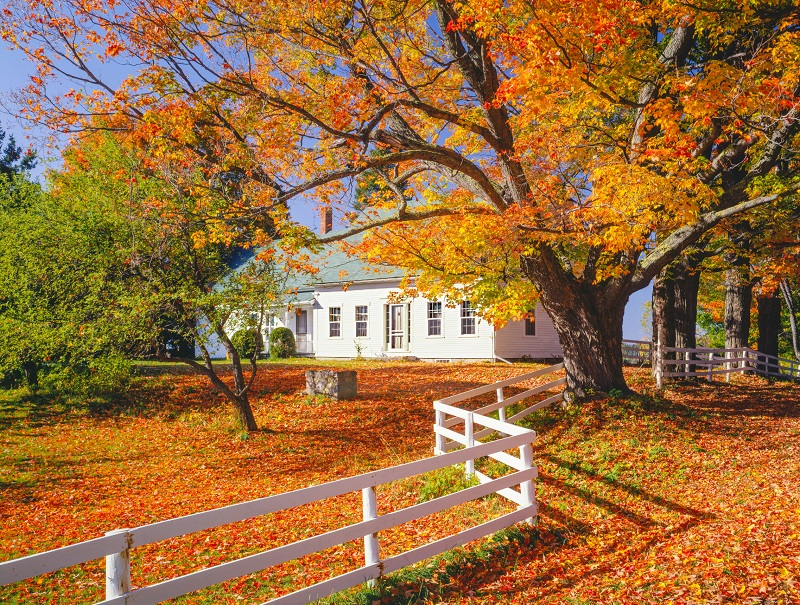
A rural New England house in autumn
Fall maintenance shouldn’t be framed solely as leaf removal. Treating every leaf as debris wastes a free, useful material—and ignores the handful of places leaves genuinely do need to go for safety and drainage reasons. A more useful approach, applicable across most climate zones, looks something like this:
- Clear leaves from gutters, roof valleys, drains, steps, walkways, and window wells—anywhere they can block drainage, create a slip hazard, hold moisture against building materials, or add fire risk near a structure.
- Mulch leaves into the lawn when the layer is light enough that grass remains visibly exposed after mowing; if leaf cover is heavy, remove it in stages and use it in beds or compost instead.
- Shred and use leaves as a light, breathable mulch in planting beds where appropriate, keeping them off tree trunks, plant crowns, and house siding. In insect-friendly areas, leave some leaf litter and patches of loose, undisturbed soil rather than covering every square foot with heavy mulch.
- Compost the excess rather than bagging it for pickup—composted leaves return organic matter, improve water retention, and reduce erosion.
- In high-wildfire-risk regions, this rule bends to defensible-space guidance first. Dry leaf litter near a structure is a legitimate fire concern, and local fire-safety codes should always override the general “leave the leaves” instinct.
The right answer isn’t universal. A wooded lot in the Northeast, a drought-prone lot in the Mountain West, a humid Gulf Coast yard, and a Midwestern suburban lot all call for a different balance—but the underlying principle (clear where leaves create a hazard, keep where they don’t) travels everywhere.
Tools That Help Detect Trouble Earlier
A few modest tools and upgrades can make a fall walkaround more useful—not because they are novel, but because they can help reveal minor failures before they become disruptive ones.
- Cable-style water sensors: These can monitor a longer perimeter—around a water heater, beneath a laundry connection, or along a basement wall—than a single puck-style detector. They are best used where a leak could spread before anyone sees it. They are alerting tools, not shutoff systems. Homeowners should know where the main water valve is and, where leak risk is high, consider an automatic shutoff installed by a qualified professional.
- Long-range, offline-capable sensor networks: For detached garages, basements, second homes, and outage-prone locations, look for leak or temperature sensors that don’t depend entirely on your home’s Wi-Fi. Check how they’re powered, whether they’ll still sound a local alarm on their own, and whether they can alert you at all during an Internet or power outage. Don’t assume a Wi-Fi-only product will notify you when the power or Internet is down.
- Sealed 10-year smoke and CO alarms: Sealed 10-year-battery smoke alarms can eliminate routine battery replacement, but they still require monthly testing and must be replaced at the end of their listed service life. Smoke alarms generally need replacement 10 years after being manufactured. Follow the device’s label and instructions.
- Mulching mower blades or a leaf shredder: These turn a disposal task into a material-management task; smaller leaf pieces break down faster in lawns, planting beds, and compost.
- Properly routed downspout extensions: A properly routed downspout extension can move roof runoff farther from the foundation. The important question is not simply how far it reaches, but whether its discharge point sends water safely away without creating erosion, icing, a trip hazard, neighbor conflict, or a new drainage problem.
Most are simple homeowner-level additions, whereas water shutoff, drainage, electrical, or hard-wired monitoring work may warrant a qualified installer.
A Note about Fall Home Inspections
A fall inspection does not require climbing on the roof or opening a heating appliance. Inspect from the ground where possible, and use binoculars or a phone camera for hard-to-see areas. Contact a qualified professional for roof access, chimney work, electrical issues, combustion appliances, significant drainage changes, persistent moisture, or any repair that requires specialized knowledge, skills, or tools—and above all, anything that can’t be done safely.
What We Think Matters Most
The instinct to treat fall maintenance as a leaf-and-gutter checklist isn’t wrong, exactly—it’s just incomplete. Leaves and gutters are two visible symptoms of a much larger question:
Is this house, in every system that keeps it running, ready for the season that’s coming?
We’d rather homeowners walk their property once each fall asking where water travels, where air escapes, whether heating equipment can operate safely and efficiently, whether the ground is still doing its job, and whether the household would actually know if something went wrong—than hand them one more generic checklist to skim and forget.
That’s the same lens we’ve been applying in our recent coverage: a Forever Home is really just a house designed so its systems can be upgraded without demolition, and a well-designed landscape is infrastructure, not simply decoration. Fall maintenance is the same idea applied to the calendar instead of the blueprint:
The smallest and least expensive moment to notice a system beginning to fail is almost always before the next season forces the issue.
Readiness doesn’t stop at your own address. A walk through the neighborhood before the weather turns often reveals more than a walk around your own house does—a sagging gutter or a stray shingle is sometimes easier to spot from the street than from inside or close to the house it belongs to. It’s also worth checking in on elderly neighbors or parents living farther away, since basic fall prep—clearing gutters, hauling leaves—gets harder for anyone once ice and shorter days arrive; services like TruBlue’s handyman and maintenance plans exist specifically for people who need that extra hand.

Aerial view of a small suburban neighborhood in autumn
The same logic applies to the small stuff sitting in a closet or garage: a space heater that needs a fix, a coat that needs mending. Fall is also the easiest window to get those repaired—errands, walking, and driving all get harder once winter weather sets in—and a local Repair Café is often the fastest, lowest-cost way to get a small fix made before you actually need the thing that’s broken. It’s also a good excuse to declutter: most Repair Cafés run a free-items table, so it’s worth bringing along anything sitting unused—an extra window scraper or snow shovel, a spare rake, winter gloves, an old first-aid or emergency kit—for someone else to take home instead of buying new.
Additional Home Maintenance Articles
- How to Prevent Chimney Fires
- How to Stay Ahead of Unexpected Home Repairs
- 5 Reasons Tree Trimming Is Great for Your Home
- Expert Tips to Lower Your Home’s Heating Bill
- What Homeowners Should Know About Home Insulation
- How to Make Your Roof More Resistant to Extreme Weather
- 4 Simple Ways to Prevent Severe Rodent Infestations
- Assessing Winter Damage: An Extra Helpful Checklist for Homeowners
- How to Prevent Costly Heating Repairs This Season
- Related Topics: Prevention | Home Safety | Winter | Energy Efficiency
| Purgula is reader-supported. When you click on links to other sites from our website, we may earn affiliate commissions, at no cost to you. If you find our content to be helpful, this is an easy way for you to support our mission. Thanks! Learn more. |