
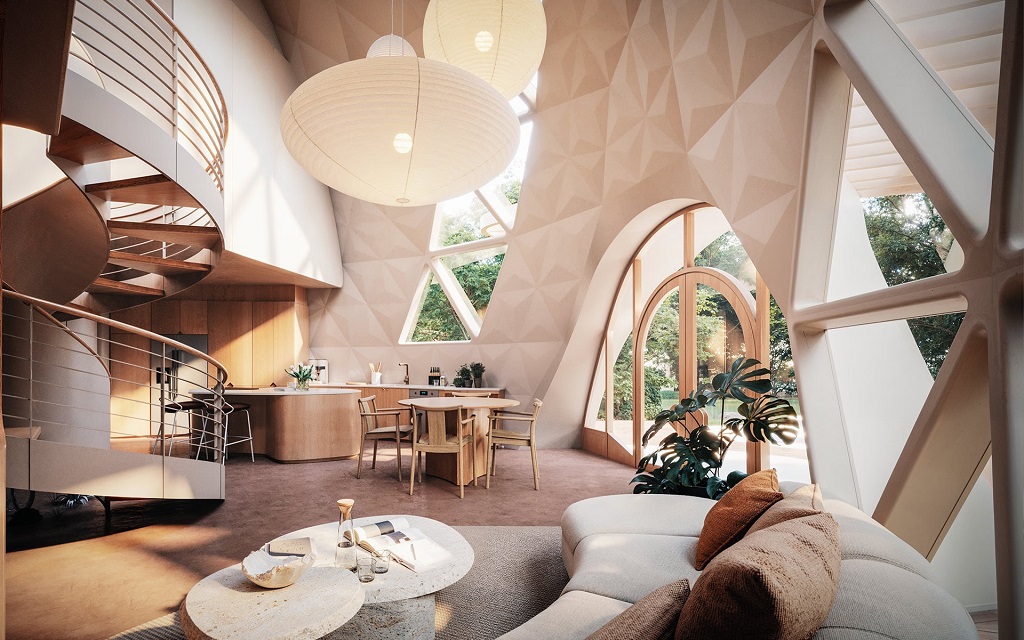
The main image is a rendering of an interior view of Geoship’s Amma Founders Edition, a geodesic dome home built from a proprietary non-toxic bioceramic material.
Updated: August 17, 2026
At PCBC 2026, most construction advocates were arguing, in one way or another, that a house could be smarter—more sensor-driven, more automated, more efficient at performing, as quality homes should. Michel Bayan from Geoship pitched that their flagship geodesic dome-icile, the Amma One Founders Edition, offered something intriguingly different:
the shape of the house itself, combined with the material from which it is constructed, would result in a significantly more resilient, efficient, regenerative, sustainable dwelling better for one’s overall health and well-being.
The company calls its proprietary construction material “bioceramic.” We didn’t know exactly what that meant during the Geoship presentation at PCBC’s Pitchfest, and we’re still trying to confirm the exact composition. We do know that it’s not concrete, not stucco, not anything with an obvious analog in a hardware store aisle.
What caught our immediate attention was Geoship’s claimed hyper-resilience and plethora of biophilic benefits—500-year durability, the curved surfaces, the natural lighting, acoustic calming, and the feeling of comfort from a shell rather than the staid inside of an ordinary rectilinear room. These incredible claims were some of the details we wanted to investigate, learn more about, and confirm, where possible. For instance, what third-party testing and data supports any of these claims?
We also went looking for the inspiration and company behind and under the dome. Their small team—consisting of talent from some of this era’s most elite sources of innovation, such as SpaceX, Tesla, and Apple—is making an unusually large, audacious bet:
The thing which killed geodesic housing the last time around in the late 1970’s-early ‘80’s, could finally be mitigated by a new material and manufacturing process.
What follows is what we’ve learned about Geoship—and our assessment of the company’s ambitious plans.
Table of Contents
- The History of Geodesic Homes
- What Geoship Aims to Solve
- Geoship’s Technology, Explained
- Living in a Geoship
- The Honest Economics
- Our Take on Geoship
- Geodesic Resources
- FAQs
Also see:
The History of Geodesic Homes
Geodesic domes have a longer and stranger history than most people realize. The underlying geometry traces back to German engineer Walther Bauersfeld, who built the first geodesic structure around 1926, well before it became an icon of American housing. It was Buckminster Fuller who patented and popularized the form in United States during the 1950s, and who spent the rest of his life trying to convince the country that the triangle, not the rectangle, was the more honest way to enclose space. Fuller’s geodesic dome became internationally famous after it was chosen as the U.S. Pavilion for Montreal’s Expo ’67—the steel space frame of the structure still stands there today, although its original transparent acrylic skin was destroyed by fire in 1976.

Modern day view of the Montreal Biosphere, renamed in 1968, as the former site of the U.S. Pavilion for Montreal’s Expo ’67 world’s fair.
The domes were, for a while, a genuine cultural moment. But the era that made them famous also planted the reputation problem Geoship is now trying to mitigate several decades later. The dome home briefly caught on in the U.S. during the 1970s and ’80s on the strength of geodesic design, before fading into a fad associated with futurists and hippies.
And it wasn’t just a cultural or aesthetic image problem. The sheer number of triangular seams and joints in a geodesic shell dramatically raises the odds of water intrusion, compared to a conventional roof. Plus, fitting standard rectangular furniture into a curved, non-orthogonal room wastes interior space and creates awkward corners that never quite work the way a normal room does. A 1977 Time Magazine article, titled “Home Sweet Dome,” put it plainly:
domes had earned a bad reputation for leaking, tended to be noisy without interior partitions to muffle sound, and presented layout challenges due to their round walls—problems serious enough that dome dwellers often had to build custom, curve-fitted furniture like tubs, beds, and cabinets just to make the spaces livable.
Then there was the economics. Many prospective geodesic homebuyers have had to walk away because they couldn’t secure mortgage financing. In parallel, insurers have struggled to evaluate a dome home’s value, largely because so few comparable dome sales existed for a conventional lender to reference. That scarcity becomes self-reinforcing: dome homes tend to sit on the market longer, waiting for a buyer specifically excited about an unconventional way of living, rather than selling at the predictable pricing and pacing of traditional residences.
Peter Tobia knows that story better than almost anyone still around to tell it. Now 80, Tobia sold prefabricated geodesic homes during the era’s peak, and was among the voices Time Magazine turned to for its 1977 piece on the dome-home boom. Decades later, he remains genuinely enthusiastic about the form. “The dome form is just phenomenal,” he told us—spherical, no straight lines, “in tune with nature.” One of his dome homes, built with architect William G. Chirgotis, was featured at the NAHB’s International Builders’ Show in Las Vegas around 1979. He insists, contrary to domes’ reputation for wasted interior space, that the shape actually delivers more usable square footage and better airflow than a conventional home.

Architectural drawing of William G. Chirgotis’ Leisure Dome geodesic home, circa 1979
Image courtesy of Peter Tobia
But Tobia is no romantic about what actually killed the movement. Structurally, he says, leakage was the real problem—“everything else was solvable.” The deeper issues were financial and bureaucratic: banks wouldn’t finance them, and buyers worried about resale, since there was no established aftermarket for an unconventional home. When we described Geoship to him—a company he wasn’t familiar with—his first question wasn’t about the material at all. It was about permitting. “How can you get a permit?” he asked. It’s the same question, verbatim, that opened our own list of questions first posed to Geoship.
None of that means that the geometry was a bad idea—domes really do enclose more volume with less surface area than a boxy structure, and that efficiency is part of why the form keeps resurfacing every time climate resilience becomes a design priority. It means the execution—the seams, the waterproofing, the financing and insurance ecosystem—is where the geodesic dream has historically broken down. All of this makes Geoship’s core claim worth taking seriously enough to interrogate:
that a new material, one designed from the ground up to solve the seam and moisture problem, might be the missing piece that iconic geometry alone was never going to provide.
What Geoship Aims to Solve
Purgula’s summary of PCBC 2026 highlighted that homebuyers are increasingly optimizing for how a home performs and feels, not simply how many square feet it has. Geoship’s dome—the cover photo of that article—was one of the clearest examples of this shift. It’s worth being specific about what “performance” means here, because it’s not an abstract concept.

Geoship co-founders Morgan Bierschenk, (Founder and Chief Vision Officer), left, and Bas Kools (Founder and Creative re-Director), right, in front of Geoship’s initial engineering prototype, featuring an 18 foot diameter. For comparison, the current Amma 1 model is built with a 36 foot diameter.
Image courtesy of Geoship
Wood-frame construction, the default for the overwhelming majority of American homes (in 2023, 93% of completed US homes were framed in timber), carries a well-documented set of vulnerabilities, it burns, it’s vulnerable to mold, pests and moisture intrusion, it can perform poorly in high wind and seismic events without significant and costly reinforcement. None of that is controversial—it’s why insurers price wildfire and wind risk the way they do, and why builders in fire- and hurricane-prone regions are increasingly forced to reckon with the latest in materials science and construction methods rather than just code minimums.
Geoship’s pitch is that a bioceramic shell sidesteps that entire category of risk—that “resilient” isn’t a marketing adjective here but a structural claim, tested against fire, wind, seismic, and flood conditions in ways wood-framed, rectilinear construction fundamentally cannot match. That’s a big claim, and it’s precisely the kind of claim our readers—homeowners rebuilding after fire or storm loss, and investors weighing whether this is a real materials breakthrough or simply a creatively marketed one—most need substantiated data rather than taken on faith. It’s also why the third-party testing questions were the first thing on our list:
a resilience claim is only as good as the data behind it.
Although the company claims that they “are developing a new category of housing technology that combines proprietary bioceramic materials structural engineering and advanced manufacturing”, we were not provided any meaningful data or material to validate this statement. When requesting more data on the strength and resilience claims of the key components of its building system, company representatives responded with:
As part of product development and California Factory-Built Housing certification, the company has completed independent third-party testing of key components of its building system, including ASTM testing for non-combustibility, structural loading and water penetration. Amma (the company’s flagship geodesic product) is engineered to meet applicable California Factory-Built Housing requirements and relevant building codes. While Geoship has completed component testing and engineering analysis, we do not represent that a completed home has undergone full-scale destructive testing for every extreme weather scenario.
Though we understand young companies need to disclose proprietary information and data cautiously, the data details on these performance tests will need to get into the hands of material experts, sooner rather than later, to support their ambitious marketing claims.
UPDATE:
Purgula received the following update from Geoship on August 17, 2026 that provides more context on how the California Factory-Built Housing certification will help facilitate the permitting process:
Here’s what our California Factory-Built Housing (FBH) certification through HCD actually does: it shifts the structural, fire, and life-safety plan review for the building system itself away from each individual local building department and puts it in the hands of the state, one time, through a rigorous process that includes engineering plan approval and an ongoing in-plant quality assurance program with independent inspections at the factory. Once a home carries that state insignia, local building officials generally don’t re-review the structural system from scratch, they focus their permitting on the site-specific pieces: foundation, utility connections, and zoning. In practice, that means the hardest, most technical part of the permitting question, “is this building system safe and code-compliant?”, gets answered once at the state level instead of being re-litigated project by project in every town we build in.
That’s also the same model dozens of modular and manufactured housing companies use to operate across state lines today: California was the right place to prove the system first, given how rigorous its FBH program is, and expanding means seeking that same kind of state-level plan and quality-assurance approval elsewhere, using an established path rather than inventing a new one. It’s real, sequential work, but it’s work with precedent, not the kind of open regulatory question that stalled dome homes in the 1970s.

Aerial view of the first Amma installation by Geoship in Northern California
Image courtesy of Geoship
Geoship’s Technology, Explained
Geoship’s bioceramic is its name for a mineral-based, chemically bonded phosphate-ceramic composite that cures at room temperature, unlike the high temperature of a conventional fired clay ceramic. That description has a real materials-science basis to it. Chemically bonded phosphate ceramics are inorganic, room-temperature-setting materials researched for structural, nuclear-waste, medical/dental/prosthetic, fire-protection, and corrosion-protection applications. But that does not independently establish that every Geoship-specific formulation, panel connection, insulation layer, window opening, or finished dwelling performs as claimed.
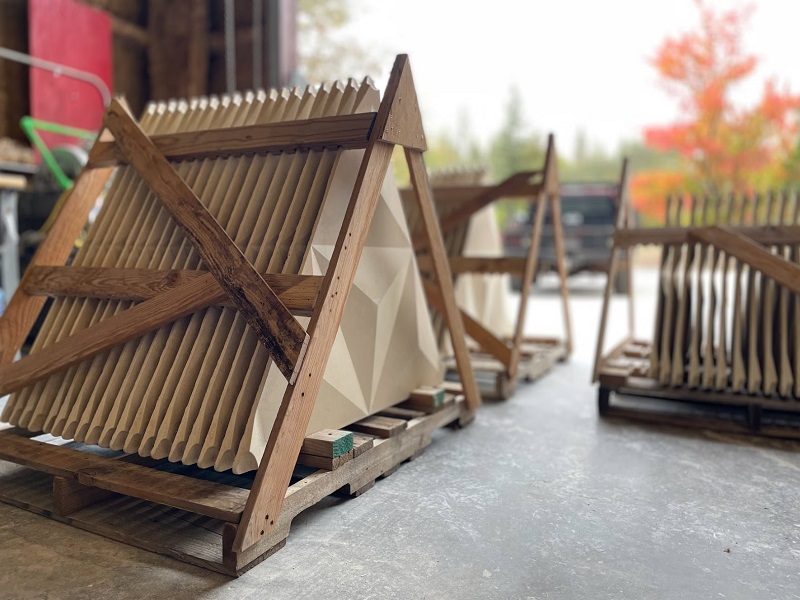
Geoship GeoRock panels ready to be installed
Image courtesy of Geoship
Geoship bioceramic panels are called GeoRock, while their bioceramic-based mortar is called BondRock. Geoship classifies its shell as primarily a magnesium-phosphate compound and describes it as an all-ceramic composite. The company also states that the dome components passed the following tests:
- ASTM E136 non-combustibility testing (no sustained flaming at 750°C)
- ASTM E331 wind-driven-rain testing
- ASTM E330 structural-pressure testing
The following tests or material capabilities have not yet been publicly reported by Geoship:
- No water penetration under the stated E331 exposure
- No damage under +29.1/−24.0 psf E330 loads
Those are potentially meaningful system-component results, but they are company-reported summaries of third-party tests—not, from the material reviewed here, independently available full reports or proof of whole-home survival in wildfire, flood, hurricane, or earthquake conditions.
Although Geoship can point to named ASTM tests and named labs, the open question is how those component tests translate into a permitted, inhabited, repairable home over years of weather, construction variation, and site-specific hazards.
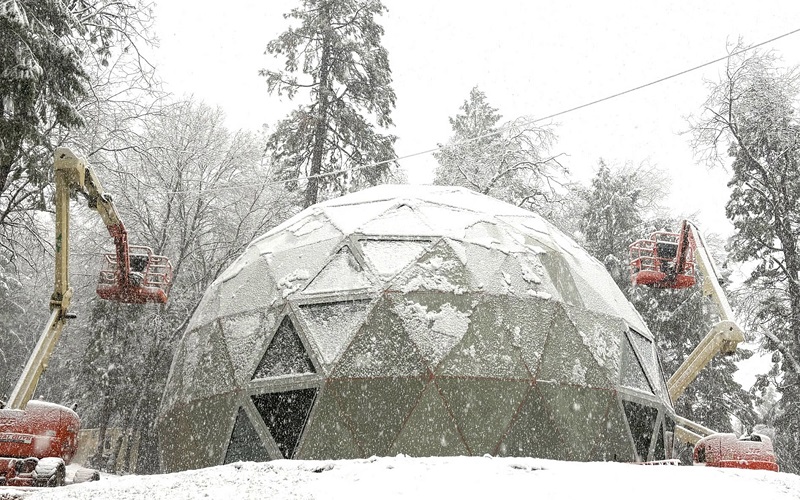
Geoship’s first Amma home being assembled during a snowstorm in Northern California
Image courtesy of Geoship
Ceramics, as a category, are not known for flexibility—they tend to be strong under compression and weak under impact or flex, which is precisely why cracking and reparability were already on our list of questions.
It’s also worth asking a simpler question than the material science: is “bio” the right prefix to use for their proprietary ceramic? The term implies something organic, living, or biologically derived—language that carries real weight with buyers drawn to wellness and sustainability. Paradoxically, Geoship points out that it is the inorganic nature of bioceramic that gives it such strong resilience, as we explained in the FAQs section below:
Because GeoRock contains no organic compounds, it is completely immune to mold, rot, and pests.
Living in a Geoship
Geoship’s pitch isn’t just structural—it’s also experiential. The company markets the feeling of being inside a dome as much as its resilience numbers, and that’s worth taking on its own terms:
what would actually be different, or better, day to day, about living in a dome?
There’s credible evidence that biophilic design features can improve short-term, self-reported psychological responses. But there is no evidence that geodesic geometry itself—or Geoship’s specific material—has been shown to “pacify the human soul,” improve health, create a special electromagnetic environment, or produce a distinct wellness effect.
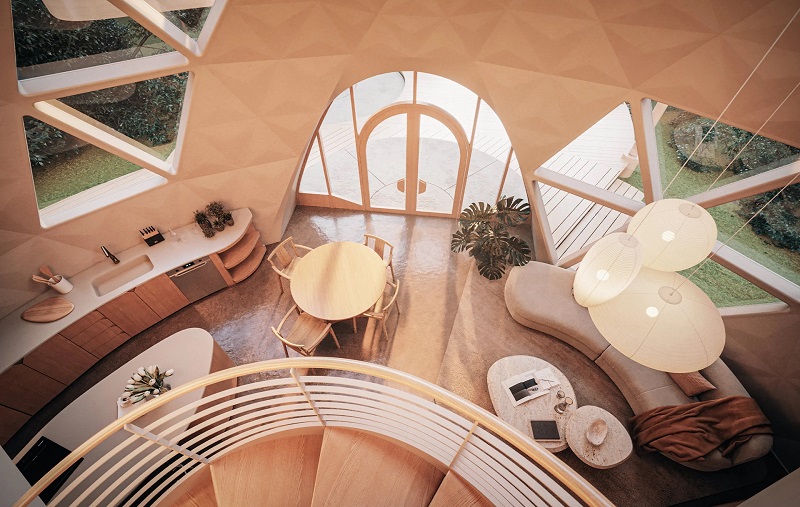
Geoship Amma – overhead rendering of interior view from stairs
Image courtesy of Geoship
A 2025 study of 255 people tested digitally rendered interior scenes with increasing biophilic qualities. After a stress-induction exercise, higher-biophilic scenes were associated with better self-reported stress recovery, attention restoration, and feelings of safety and inspiration. That’s real evidence for daylight, natural materials, and views doing something for how a space feels. But it’s not evidence that a dome, specifically, or Geoship’s bioceramic shell, explicitly, produces that effect—the researchers themselves called for more real-world follow-up. So we’d treat the likely biophilic contributors in a Geoship as:
natural daylight; expansive views; visual complexity; curvature; an open central volume with high ceilings; and contact with exterior landscape via skylights, windows, and glass doors.

Rendering of an interior view of Amma from outside
Image courtesy of Geoship
Curvature and the open central volume are the most obvious suspects for what makes a domed home feel different to stand inside. When designed and constructed properly, the high ceilings of a dome home—paired with skylights, windows and glass doors—can mimic the vast openness of the sky, seemingly dissolving boundaries between interior spaces and the natural world, flooding the interior space with lush daylight and views. But those are plausible design influences, not yet proven ones.
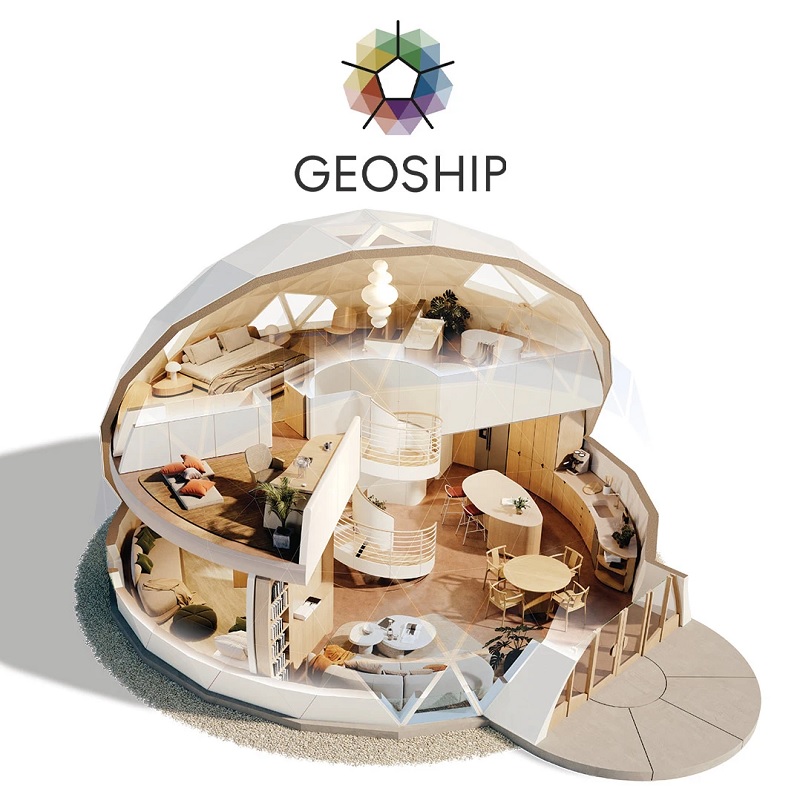
Cross-sectional view of the interior spaces of Geoship’s Amma model
Image courtesy of Geoship
What’s more interesting than Geoship’s marketing language is the list of ordinary, concrete questions that don’t have public answers yet.
Furniture is the obvious one, and it cuts in two directions at once. The domes of the 1970s earned a reputation for wasted corners and furniture that never quite fit a curved room—residents often built custom, curve-fitted pieces just to make the spaces livable. Peter Tobia, who lived through that era, insists the opposite: that a dome actually offers more usable space and better airflow than a boxy home. We don’t know which of those holds true for a Geoship, and it may simply depend on floor plan and furnishing choices a spec sheet can’t capture.
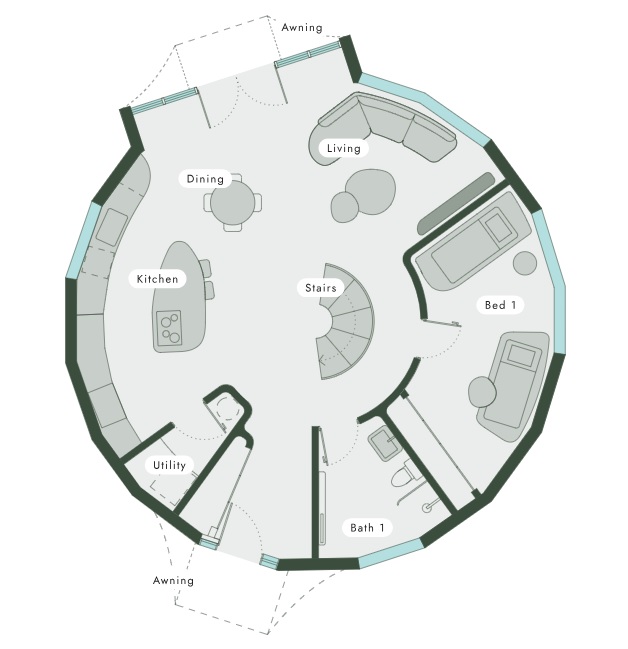
Floorplan of Geoship’s Amma geodesic model
Image courtesy of Geoship
Sound is another issue. While Geoship promises “acoustic calm”, a dome’s hard, curved, largely unbroken interior surfaces raise an obvious question beyond ordinary room echo:
what does it actually sound like inside during a torrential downpour, with no attic or conventional roof assembly to absorb and diffuse the noise?
It’s a small, sensory detail—but exactly the kind of thing a buyer only discovers after moving in, not from a spec sheet.
Then there’s upkeep. If a panel cracks or a seam needs attention years down the line, what does that repair actually look like—for the homeowner, on their own roofline, without a contractor down the street who’s done it before? How does the shell perform through a humid summer, when moisture management is less about a single wind-driven-rain test and more about how a home breathes over years? And how does a curved, continuous interior actually feel to navigate—more open, as Geoship and Tobia both suggest, or simply unfamiliar in a way that takes adjustment?
We don’t think all of these issues need answers before Geoship succeeds. But they’re the questions that determine whether living in a Geoship feels like living in a house that happens to be shaped differently, or something genuinely new to adapt to—and right now, that’s still something only an actual resident could tell you.
The Honest Economics
The current Amma Founders Edition listing is a 1,643-square-foot, two-bedroom, two-bathroom home with an office at $300 per square foot—approximately $492,900 before any items excluded from the quoted scope. The company’s website says the edition launches exclusively in Northern California, with a refundable $500 reservation deposit.
A recent company presentation stated that a fully-loaded, cost to build and deliver today’s Amma, is moving toward a long-term $111/sq. ft. target. When asked what needs to change in order to meet approximately one-third of current day cost the company replied:
On Geoship’s current roadmap, achieving that long-term target depends on increasing manufacturing scale through factory automation, product simplification, supply chain optimization and production efficiencies. The next-generation platform is being engineered with fewer parts, factory-built modules and faster installation to support that objective.
Below are figures directly from Geoship’s own published roadmap, which help clarify the cost-to-build economics. What they reveal is that the affordability case is a manufacturing-scale thesis, not current pricing—the pivotal assumptions being factory throughput, repeatable installation, stable supply of materials, permitting, access to construction finance, and enough completed/resold homes to boost and sustain lender and insurer confidence.
According to Geoship’s June 2025 roadmap post, these earlier projected plans segmented into three phases (NOTE: see updated pricing information at the end of this section):
- Phase 1, “Pilot It” (2025–2027): 10+ homes a year; the Amma Founder Series priced around $500,000, which the company describes as on par with California spec-home pricing.
- Phase 2, “Evolve It” (2028–2031): 100+ homes a year; a target of 10–30% below average new-home cost per square foot.
- Phase 3, “Scale It” (2031 onward): 1,000+ homes a year; a target of 40–60% below average new-home cost per square foot, with a stated goal of bringing mortgage payments under 30% of median household income.

Geoship competitor feature and cost comparison table included in SEC document
Image courtesy of Geoship
In the company’s own words, the biggest constraint to reaching the $111/sq. ft. cost will be scalability. In our opinion, the real obstacles will be permitting, financing options for first-time buyers, as well as insurance friction for this unconventional housing type—all necessary to mitigate nationwide before full consumer demand can be uncapped.
The key economic takeaway on Geoship’s current pricing is the following:
Geoship isn’t currently selling an affordable house. It’s proposing a path toward one.

Regardless of costs, quality materials are essential for Geoship’s resilience value proposition. An interior view of steel framing in Geoship Amma model being installed in Northern California.
Image courtesy of Geoship
UPDATE ON CURRENT GEOSHIP PRICING:
Purgula received the following update from Geoship on August 17, 2026 that provides the latest guidance on their pricing plans:
The $492,900 figure reflects the price of our first completed Amma installation, sold at $300/sq ft. Since completing that home, we’ve evolved our pricing structure, model lineup, and options to offer more flexibility than the single Founders Edition Amma configuration and price point referenced in the June 2025 roadmap post, including the Phase 1 “around $500,000” reference. Those figures no longer reflect our current offering. We’re not yet ready to share the updated pricing structure publicly, but wanted to flag this so the article doesn’t continue to present that post as reflecting current pricing. We’re revisiting our production roadmap more broadly as part of this update, so we’d also ask that the roadmap phases and targets be treated as early projections that are currently under revision rather than current, until we’re ready to share more.
Our Take on Geoship
A Lower-Risk Path Forward
The following suggestion isn’t a purely theoretical idea. In February 2025, following the devastating Eaton Fire in Altadena, we photographed a Tuff Shed still standing next to a home lost in the fire—empty, its contents disheveled but otherwise intact, alongside a section of fencing that also had somehow survived. Presumably, neither structure is fireproof by design.

A Tuff Shed that survived the Eaton Fire on an Altadena lot, photo taken by Purgula in February 2025
Whatever combination of ember distance, wind direction, and luck spared them, the fact remains: modest, unoccupied structures sometimes outlast the homes around them, and nobody planned that experiment—it just happened. We learned of another version of this pattern too, in an LGS-framed ADU we wrote about that also survived the same fire largely intact.
None of that proves anything about bioceramic material specifically. But it does suggest something worth Geoship’s attention:
real-world, high-consequence proof points for resilience claims don’t require a finished, occupied home to be meaningful.
A structure sitting outside, unmonitored, through an actual wildfire season is already a kind of test—the only thing missing, in the examples above, is that nobody built it to be one.
That said, Geoship’s stated ambition spans five distinct, extremely challenging problems, solved simultaneously, in a single product, at commercial volume:
- Health
- Resilience
- Affordability
- Scalability
- Sustainability
It’s worth naming this type of ambitious pattern plainly, because we’ve seen this movie before. Katerra, the most highly funded construction-tech startup in recent times, collapsed in 2021 after trying to reinvent nearly every layer of the building process at once—design, manufacturing, materials, and general contracting—before any single piece had been proven at scale. The lesson from Katerra’s failure isn’t that aspiration is bad:
It’s that ambition pursued on every front simultaneously leaves a company with no fallback, if any one bet is slower or more arduous than expected.
This confidence extends to how Geoship views alternative solutions, too. In a company Instagram video reel, Geoship’s CEO, Micha Mikailian, remarked that some of their competitors’ homes may end up in landfills within 30 years—an unnecessarily disparaging prediction, in our opinion, and a different kind of claim than believing in one’s own mission. It’s an assertion about someone else’s failure, offered with the same confidence as Geoship’s claims about its own success, without the same substantiation. We’d rather see that energy pointed elsewhere: the companies that scale fastest in a nascent category rarely do it by dismissing their neighbors—they do it by finding well-aligned partners, competitors-turned-collaborators, and adjacent industries that help pull the whole category forward.
From what we’ve seen, Geoship’s challenge isn’t simply proving that its material can work. It’s proving that the material, the manufacturing process, the housing product, and the surrounding ecosystem can all work together on a commercial scale. That distinction leads us to a broader concern—and to a possible lower-risk path forward.
We’d modestly propose that Geoship incorporate a parallel, lower-risk development path. It wouldn’t require abandoning the larger vision—just sequencing it differently. Rather than validating fire, seismic, wind, flood, and moisture performance claims primarily through full-occupied homes, Geoship could prove out the bioceramic material’s real-world durability faster, and with far less capital at risk, by deploying simple, unoccupied structures—sheds, studios, storage structures—directly within the harshest climates across the country: salt air on the coasts; Tornado Alley; hurricane country; snow-and-ice regions; high humidity zones; hail zones; desert regions. (A deodesic in Joshua Tree? Right at home!)
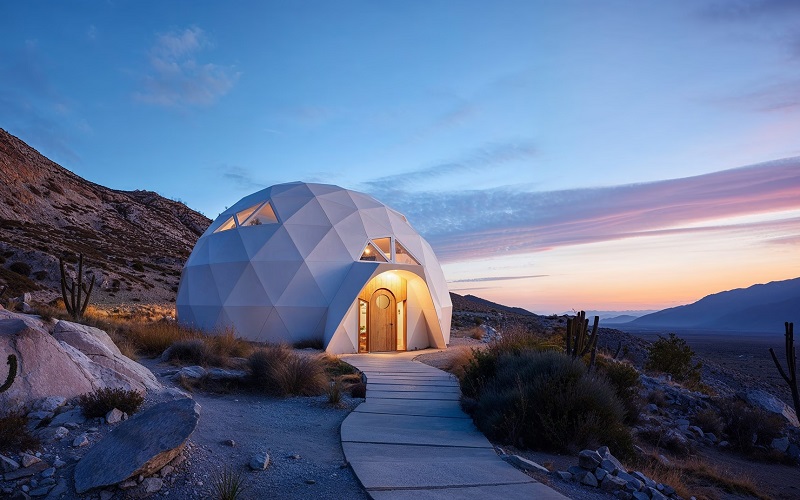
Geoship Amma 1 rendering in a desert climate
Image courtesy of Geoship
None of that would require solving plumbing, HVAC, or full building-envelope complexity. It requires the material and the joinery to survive, in public, where anyone can go check on it. That’s a meaningfully lower bar than an inhabitable home, and precisely because of that, it’s a bar Geoship could clear quickly—turning a “trust our claims” approach into a “here’s a structure that’s been sitting on the Gulf Coast for two years, go take a look at it” validation.
There’s also a viable business argument for taking this kind of reduced risk pathway. An indestructible shed or backyard studio might be a genuinely attractive standalone market—one with a shorter sales cycle, none of the mortgage and insurance friction that complicates a full home purchase, and a much faster path to real revenue and real performance data. Partnering with an existing shed or studio manufacturer, rather than building that channel from scratch, could compress that timeline considerably—Geoship supplies the material, design and manufacturing expertise, an established manufacturer supplies distribution, production capacity, assembly/installation support, and a customer base that already exists.

Already on Geoship’s roadmap: Aerial view rendering of a main home Amma with a smaller geodesic studio in the backyard, plus a carport with solar panels.
Image courtesy of Geoship
That points to a broader idea worth Geoship’s consideration: licensing. Materials science breakthroughs don’t always reach their fullest potential by way of the company that discovers them also becoming a vertically integrated builder, contractor, and mortgage-adjacent housing company all at once. It’s a pattern seen across other industries—the deepest specialists in a novel material often find their most durable business not in owning every downstream application themselves, but in licensing or supplying that material to others who are best-in-class in their own specialized use case.
If bioceramic genuinely performs the way Geoship claims, there may be real value in exploring licensing agreements for other applications and industries—outdoor structures, commercial buildings, disaster-relief housing, industrial enclosures—rather than treating the residential dome as the only vehicle for the material’s success.
There’s also a funding path worth Geoship exploring for this: universities, materials-science labs, or resilience-focused nonprofits may have real interest in covering the cost of installing and monitoring structures like these, in exchange for the real-world performance data they’d generate. The Insurance Institute for Business & Home Safety (IBHS.org) is a natural place to start—an organization whose entire mission is testing how structures hold up against wind, fire, and hail, and whose research directly informs how insurers price risk. A partnership there could be mutually valuable: Geoship gets independent, credible testing it could otherwise take years to self-fund, and IBHS gets a genuinely novel material to study as climate-resilient construction becomes a bigger part of its own research agenda.
Tobia’s question—the same one that opened our list to Geoship—might end up being Geoship’s entire story, condensed to six words. The bioceramic material may well be as remarkable as Geoship claims. The dome, after a half-century in exile, may finally have found a material worthy of its form. But none of that will matter without real progress on permitting, financing, and insurance—the same forces that ended the dream the last time. Geoship’s toughest bet was never the dome. It’s everything surrounding it.
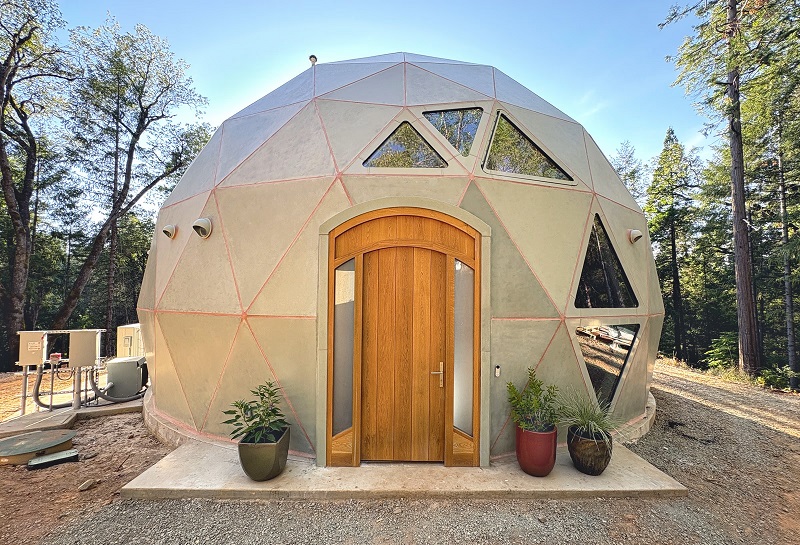
Geoship’s first installation of Amma 1 in Northern California
Image courtesy of Geoship
Geodesic Resources
- Geoship’s GeoJourney Video Series – behind-the-scenes coverage of the company’s progress
- Geoship’s Story and Timeline
- Geoship on Instagram
- Geoship’s YouTube Channel
- Home Sweet Dome (Time Magazine, March 13, 1977)
- House Geodesic (New York Times, May 25, 1975)
- Buckminster Fuller Institute
FAQs
The following answers summarize Geoship’s descriptions and claims about its products. They should not be interpreted as Purgula’s independent validation of those claims. Where independent testing or evidence was not available to us, we have identified that limitation in the article above.
What is GeoRock and what is it used for?
According to Geoship, GeoRock is a proprietary, mineral-based bioceramic building material developed as an alternative to traditional materials such as concrete. The company describes it as a room-temperature-setting material adapted from mineral-based bioceramics used in medical and dental applications. Geoship says the material mixes non-toxic minerals with water to crystallize and harden at room temperature, a process the company compares to the way nature forms coral and seashells rather than relying on energy-intensive kilns.
Geoship further describes GeoRock as a family of four specialized formulations engineered for different components of its building system, including:
- Structural Skeleton
- Exterior Skin
- Lightweight Interior Elements
- Adhesive Joints
The company says these materials can replace hundreds of traditional building components.
Geoship also claims that, because GeoRock contains no organic compounds, it is immune to mold, rot, and pests. The company further describes the material as highly resilient, citing carbon-negative lifecycle characteristics, resistance to earthquakes, floods, and impacts, non-combustible fire protection up to 1,382°F, and a projected lifespan of more than 500 years.
NOTE: These performance, durability, environmental, and lifespan claims are Geoship’s claims; Purgula has not independently validated all of them.
What is BondRock and what is it used for?
According to Geoship, BondRock is a specialized bioceramic adhesive and joint material used to connect and seal the seams between the company’s exterior skin panels and its structural bone hubs and struts. Geoship further states that BondRock is formulated by replacing a portion of the material’s water content with a biocompatible natural organic solution, creating molecular crosslinking that allows the material to expand and contract with changing temperatures without cracking.
The company describes the resulting connection as an exceptional, waterproof seal that is stronger than aerospace-grade epoxies. Geoship adds that the BondRock joints are designed to allow the individual components of the dome to function as a unified structural system engineered to withstand earthquakes and extreme weather.
NOTE: These performance and durability claims are Geoship’s claims; Purgula has not independently validated them.
Additional Housing & Construction Articles
- Why Your Next Home Should Be Built Like a Computer
- The Future of Homebuilding Arrives in Pacific Palisades
- The Forever Home Myth: Why Adaptability is More Important than Endless Love
- Redefining Luxury: Resilience, Legacy, and the Future of the Modern Home
- LGS: A Proven Opportunity for More Resilient Homes
- Designing Against Loneliness: A Look at The Granary in Milton, Delaware
- 5 Innovative Ways 55+ Communities Are Reinventing Wellness
- Related Topics: Resilience | Construction | Home Wellness | Design | Proptech
| Purgula is reader-supported. When you click on links to other sites from our website, we may earn affiliate commissions, at no cost to you. If you find our content to be helpful, this is an easy way for you to support our mission. Thanks! Learn more. |