

The main image is a rendering of Geoship’s Amma Founders Edition, a geodesic dome home built from a proprietary non-toxic bioceramic material.
We didn’t attend PCBC 2026 to parrot what was presented. We went to see what was revealed—and what wasn’t.
Homebuyers are increasingly looking beyond how large a home is and prioritizing how well it performs and feels.
This is not an ephemeral design trend. It’s a change in the definition of housing value itself. At PCBC 2026, industry leaders arrived at this conclusion from seemingly unrelated directions, without necessarily naming the common thread connecting their perspectives.
We’ve been tracking this shift for a few years. Back in 2023, covering PCBC for the first time, we noted that an increasing number of new-home buyers were prioritizing quality, functionality, and low-maintenance living over more square footage. We also observed that a larger home or bigger yard mattered less than finding a home with more functional space.
Three years later, that observation looks less like an emerging preference and more like a fundamental shift in how buyers define value.
Here’s what we took away from PCBC 2026—and where we think the residential construction industry is headed next. We’ll also highlight two technologies and amenities that were largely absent from the collective discussion but, we believe, deserve more attention.
Table of Contents
- Housing’s New Definition of Value
- Designing for the Next Generation
- Technologies Worth Watching
- Companies We’ll Be Following
- What We Think Matters Most
Also see:
- A National Competition Rethinks Housing with Collaborative R&D
- Passive House Principles for Homeowners
- Look Back at PCBC 2025: The State of Innovation in the New Home Construction Industry
- More Recommended Housing & Construction Articles
- Related Topics: Resilience | Construction | Home Wellness | Design | Proptech
Housing’s New Definition of Value
Let’s start with the economists, as they set the terms and framework that most everyone implicitly argues about. Christopher Thornberg of Beacon Economics opened one of PCBC’s most-discussed sessions with a line worth carrying forward on its own:
There is a housing supply problem, not an affordability problem.
Thornberg proceeded to share data that indicated household and business finances remain strong and that the drags are structural—slowing population growth and, increasingly, political uncertainty—rather than a story of financially strained consumers. The gap, he argued, is between:
how people feel about housing and what the fundamentals actually show.
California housing numbers back up these assertions. New-home prices in San Diego are up 60.6% over the past six years, even as resale inventory stays flat—a filtering problem, and now we can put a number on it, thanks to Danielle Hale from Realtor.com, who presented after Thornberg:
80.3% of mortgaged homeowners nationally are locked into a rate below 6%, which is exactly why existing owners aren’t moving and supply gets clogged at every level.
That affordability squeeze isn’t evenly distributed, either—it’s concentrated almost entirely in people who’ve actually had to move. Among mortgaged homeowners who haven’t moved recently, the share paying 35% or more of income on housing barely shifted over the past decade: 22.9% in 2014, 22.2% in 2024. Among homeowners who moved in the past 12 months, that same share jumped from 19.8% to 31.5%. The lock-in effect isn’t just about the aggregate supply gap—it’s actively protecting existing owners from the cost pressure that new buyers are absorbing in full.
That supply gap is widest exactly in terms of what most new buyers need: starter homes. Listings under $350,000 remain roughly 300,000 short of pre-pandemic levels—373,102 available as of June 2026, versus 671,081 in June 2019—even after a partial recovery from 2022’s lows. Every stat in this section about smaller, more efficient homes assumes those homes exist to buy; this is the reminder that, at the entry-level price point, they mostly don’t yet.
Ken Perlman of John Burns Research and Consulting filled in the mechanics: developers have largely stopped buying land outright (73% of public builders’ land is now optioned rather than owned, as land banking now accounts for 41% of how builders approach land), a risk-management response to a market where single-family permits are down an average of 9% year-over-year. Realtor.com’s Danielle Hale offered a more optimistic counterweight—the typical mortgage payment’s share of median income is on track to dip below 30% for the first time since 2022—suggesting a slow, uneven rebalancing rather than a crisis: better nationally, still tight in California.
None of that is new information on its own.
What’s new is where the cost is actually showing up for existing homeowners.
Green Builder Media’s Consumer Resiliency Survey (COGNITION Smart Data) sharpens this perspective considerably. Homeowners are already acting, having made or are considering the following upgrades:
- Upgraded Roofing: 44.4%
- Backup Power or Battery Storage: 38.7%
- Firewise Landscaping: 33.0%
- Solar: 29.5%
- Storm Proof/Impact Rated Windows: 23.8%
But when asked what’s motivating those upgrades, insurance is surprisingly far down the list:
- Reducing long-term costs: 52.5%
- Protecting personal safety: 44.8%
- Preventing damage from extreme weather: 41.8%
- Lowering insurance costs: 16.1%
This data implies:
Homeowners are responding to underlying risks, not rising premiums.
Insurance is a symptom in this data, not the driver—which is exactly why Kin, a digital-first insurer built specifically around disaster-prone states, is betting that better underwriting for resilient homes can close that gap (more on Kin below).

Findings from COGNITION Smart Data reveals that resiliency upgrades have not turned into reduced insurance premiums for many homeowners.
Image courtesy of Green Builder Media.
This is where two frameworks—developed at unrelated organizations, but with leads who share backgrounds in venture capital—arrive at nearly identical conclusions. Green Builder Media CEO Sara Gutterman has spent the past year pushing Value Per Square Foot (VPSF), a proposed replacement for the traditional price-per-square-foot metric that accounts for long-term operating costs, resilience, health, water efficiency, and community benefit—not just sticker price. As she stated during her PCBC presentation:
Affordable doesn’t mean cheaper, it means more stable, more efficient, and less risky over time.
Meanwhile, the Housing Innovation Alliance’s Housing Innovation Challenge—a national university-industry R&D competition we covered in detail this summer—evaluates its ten finalist homes through a nearly identical lens: the H.O.M.E. framework (Home Production Cost; Occupancy Cost; Maintenance and Operation Cost; and Equity), built out by Chris Langford of Home Technology Ventures. Two organizations, working on separate tracks, both concluded that a single number—price per square foot—can’t encapsulate what a home actually costs or delivers over its lifetime. Worth noting: this convergence may not be pure coincidence—a systems view of long-term cost and risk is closer to how an investor evaluates an asset than how a buyer typically shops for one. Either way, it is strong evidence that “value” is being genuinely redefined, not just rebranded.
Buyers themselves are getting more specific about what the redefinition of home value means.
When Green Builder Media asked homeowners which features should be standard in all new homes, fire-resistant materials topped the list at 54.9%, ahead of backup power systems (50.4%) and high-performance insulation (44.7%). A separate question—what’s a genuine deal breaker when shopping for a home—put natural daylight, non-toxic materials, and fresh air ventilation at the top. Combine these two findings and you get a clearer, more useful version of “buyers want X, Y, and Z” and if you don’t offer it, an increasing number of buyers won’t even consider the home. That’s a different, harder claim than a preference ranking—it is buyers pre-declaring their own veto power.
The clearest evidence supporting our 2026 PCBC thesis of “performance over square footage”, comes from a Green Builder Media affordability survey that asked homeowners directly what features matter most in a home designed to reduce long-term costs. An efficient, optimized layout ranked second at 56.9%—ahead of durable materials, smart technology, even location—and a smaller size to reduce upfront cost came in third at 49.5%.
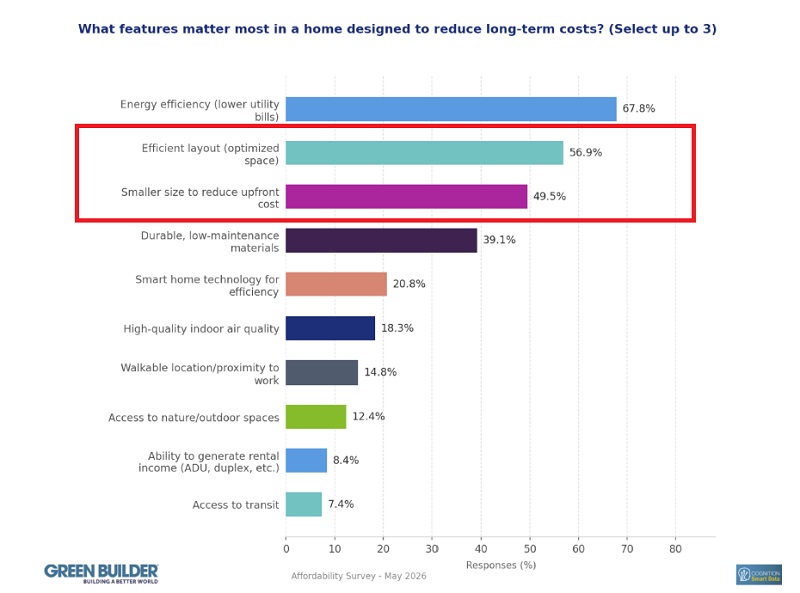
Features that matter most to homeowners to Reduce Long Term Costs by Green Builder Media using COGNITION Smart Data
Image courtesy of Green Builder Media. Red highlight box added by Purgula.
That’s not us inferring a size-to-value shift from floorplan examples—that’s homeowners naming smaller, better-designed homes as a cost strategy when asked directly.
The reasoning behind these choices is shifting too, not just the choices themselves.
Take solar: in July 2024, “save money” was the dominant reason people gave for going solar (32%), with “increase self-sufficiency” a distant second (25%). By July 2026, those numbers had nearly flipped—self-sufficiency jumped to 49%, while “save money” fell to 17%. That’s not a snapshot of current preference; it’s two years of measured movement in how homeowners talk about the same decision, and it tracks with everything else in this section:
Buyers are increasingly framing home investments around control and resilience, not just cost.

Reasons to Go Solar chart presented by Green Builder Media using their COGNITION Smart Data
Image courtesy of Green Builder Media. Highlight markups added by Purgula.
The savings case for building this way isn’t theoretical, either. Realtor.com found that new-construction homes cost $25,335 less to operate over ten years than existing homes, nationwide—with real regional spread (Massachusetts buyers save nearly $39,000 over a decade; a handful of Southern states show new construction carrying no price premium at all over resale). Stated plainly:
The efficient, right-sized, better-built home this section keeps describing isn’t just a values statement. It’s a specific, quantified financial one.
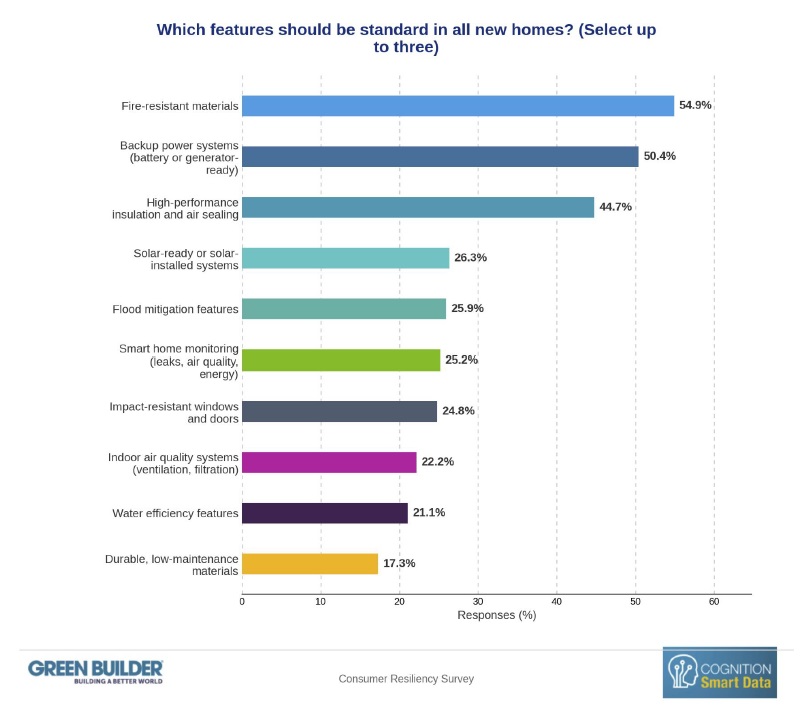
Standard Features that Should be in All New Homes, findings from COGNITION Smart Data
Image courtesy of Green Builder Media
Meanwhile, wellness continues to play an integral part of a home’s core amenities. Across several differently framed COGNITION Smart Data questions—what people appreciate on a daily basis; what they wish their current home had; and what’s non-negotiable when shopping—one feature won or nearly won every time: natural daylight, with non-toxic materials, air quality, and water quality forming a consistent second tier. This is the same instinct Gutterman’s own “Successful Communication Strategies” framework for homebuilders points to directly:
Stop selling what a home has, and start selling what it does and how it improves a life.
One wellness dimension was conspicuously absent from PCBC’s own discussions, though: acoustic comfort—easy to overlook, but increasingly essential not only in condo, multifamily, and multigenerational settings, but in detached single-family homes as well, where privacy now matters just as much—for remote work, for quiet decompression, and for simply being able to hear yourself think.
Designing for the Next Generation
If the economists and analysts explained why the definition of value is shifting, the “Right-Sizing Floorplans” panel showed what it looks like on paper and in real life.
Lincoln at NUVO Parkside in Ontario, California is a 1,100-square-foot, two-bedroom-plus-loft plan—on a lot as tight as 31’×41′, at 16.3 homes per acre. Designed by Bassenian Lagoni and built by Lennar, this model feels far larger than its footprint, thanks to the deliberate use of light, doing the work square footage used to do, especially in the upstairs workspace area.
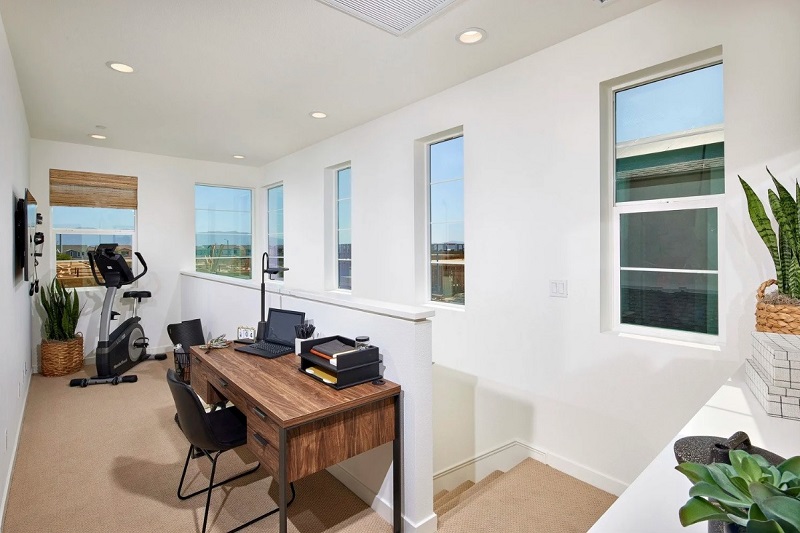
Loft with ample natural lighting in the Lincoln model at NUVO Parkside
Image courtesy of Bassenian Lagoni Architects
Models in the Petra community of San Juan Capistrano, CA, built by Landsea Homes (now Risewell Homes) feature short driveways to maximize space-constrained Orange County land and shift square footage into larger indoor living areas. This compact layout also shortens setbacks to create a more walkable, pedestrian-friendly neighborhood aesthetic close to downtown transit, while placing emphasis on communal green spaces.

Rendering of a blue Petra model with short driveway
Image courtesy of Risewell Homes
S&A Homes has stopped avoiding the word “affordable” in its own marketing. By addressing affordability directly rather than masking it behind corporate euphemisms, S&A Homes reflects a broader industry pivot toward transparency in an era of higher interest rates and increasing homeownership costs. This marketing shift is supported by “right-sized” floorplans and lot-optimization strategies, demonstrating that budget-efficient designs are not a compromise on quality.
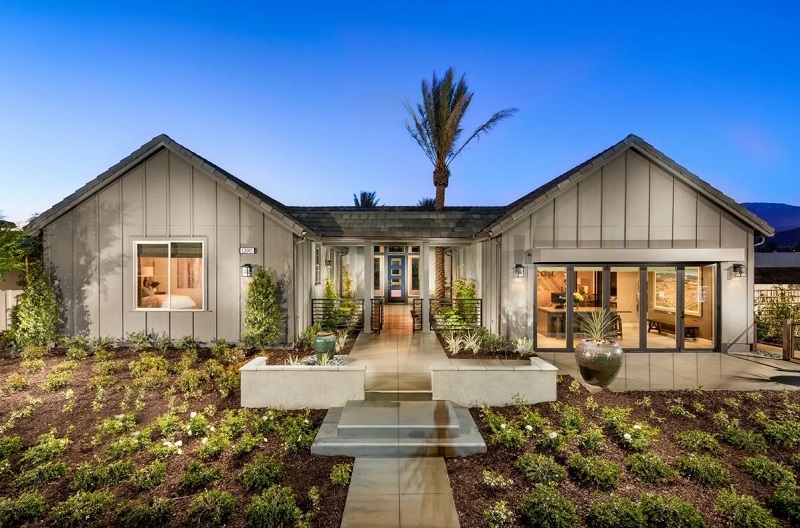
Front view of the Beacon model at Sundance, a stylish home designed in an H-plan
Image courtesy of Bassenian Lagoni Architects
The bigger shift continues to be connecting interior spaces with outdoors seamlessly, while creating “unexpected moments” in the process. At Beacon at Sundance, a genuine spatial sequence—front entry, then windows onto an internal courtyard, then access to a covered back patio—treats the courtyard as a journey through the home rather than a bolted-on amenity.

View of a central courtyard in the Beacon model at Sundance
Image courtesy of Bassenian Lagoni Architects
At Edgewood, a Las Vegas community by Tri Pointe Homes, one exquisite outdoor space sits off the primary bedroom instead: a private retreat, distinct in purpose from Beacon’s more public, entertaining-oriented courtyard. A slide from one session made the emotional logic behind both explicit—a slider in the great room, its own line read, “translates to freedom, more moments, more memories”; a courtyard for gathering translates to “not having to sacrifice a love of nature for a smaller footprint.”

Tri Pointe Homes Edgewood Las Vegas covered outdoor patio off of upstairs master suite
Image courtesy of Tri Pointe Homes
Builders, in other words, have started designing to a stated emotional brief, not just a floorplan.
Buyers are also paying, deliberately, for the detail that makes a home feel tailored rather than generic. A combined 31 of 32 buyers from their Carlisle Peak and Lakeview Ridge communities in Las Vegas upgraded to a floating staircase when given the option. Tri Pointe Homes surveys buyers a year after move-in specifically to see which bold choices held up. Early feedback shows homeowners favoring “the specific” and “the unusual” (e.g. a striking accent color up front, an angled wall creating drama) over safe and neutral choices.
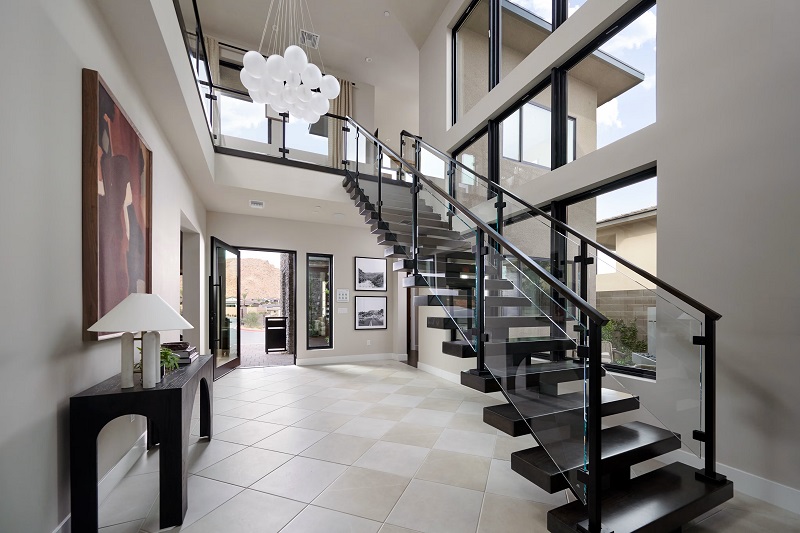
Tri Pointe Homes Lakeview Ridge floating stairs in Residence 3
Image courtesy of Tri Pointe Homes
The panel also mentioned that buyers of Atlas Custom Homes actively compete over distinctive features, wanting a home that reads as “theirs” rather than a copy of the model next door.
Set against the demographic wave that Perlman flagged—the 75+ population projected to grow 45% over the next decade—the “Responsive Home” concept—e.g. a young, first-time buyer rents out an attached ADU, then years later converts the same footprint into multigenerational living—reads less like a design trend and more like an early, structural response to who’s about to need housing next.
Technologies Worth Watching
Pitchfest 2026, produced by the Housing Innovation Alliance, was centered around three themes—AI Workflows, Labor Automation, and Resiliency—giving six finalists an opportunity to pitch on stage. AUAR (covered in full below) took the top prize, a $100,000 investment from Home Technology Ventures, for their on-site robotic microfactories that build housing components—currently wood-panel systems, with light-gauge steel framing also on their radar—designed explicitly to slot into a builder’s existing workflow rather than replace it. (Contrast this approach to Katerra’s, who one speaker described their strategy as “trying to reinvent everything”.)
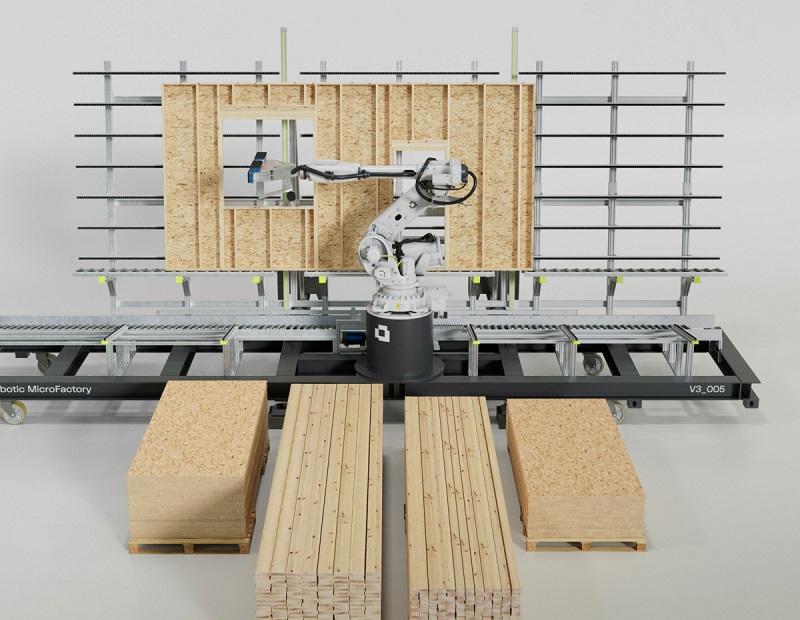
AUAR Robotic Microfactory
Image courtesy of AUAR
Sonic Fire Tech, pitching acoustic-based fire suppression (infrasound against fires that water can’t touch, like oil fires), won Audience Favorite. The other four: TradeTrax (real-time jobsite intelligence for cycle times), OpenHouse (AI-powered predictive analytics for sales and operations), Verustruct (3D-printed construction with embedded MEP systems), and Geoship (covered in full below). The framing that opened the broader session is worth repeating on its own: homebuilding sits inside a roughly $17 trillion-a-year “cost of being housed,” and an estimated 30% of people have at some point considered living in a vehicle. Whatever else came out of Pitchfest, that’s the scale of the problem all six were pitching against.
One notable absence, though—and we mean this in an optimistic, forward-looking spirit, not as a knock: no session at PCBC 2026 was dedicated to Digital Twins. Several speakers described exactly the problem these 3D/virtual databases can solve—several admitting that builders and architects don’t really understand how the homes they complete actually perform once occupied. Everyone identified the problem; almost nobody discussed the solution.
For simplicity’s sake, we break Digital Twins into two concepts:
- A virtual 3D database of a constructed home—starting at preconstruction and finishing at completion with a handoff to the homeowner, who then possesses every vital piece of information about their home: drawings, materials, appliances, warranty details, and an insurance-ready inventory.
- A real-time performance and maintenance database that tracks how a home is actually performing—energy efficiency, prescriptive maintenance alerts and records, water usage, indoor air quality, and more.
We’d be surprised if next year’s program doesn’t close that educational gap; the moment is too overdue to ignore. As we’ve covered, digital twins are already set to be a core feature of HIC’s approach, tracking home performance through the entire ownership phase.
We’ve been watching this particular gap close for three years. In 2023, at our first PCBC, we covered Digs as a “digital home binder”—a basic digital twin tracking a home’s warranties, service records, and materials, passed intact to the next owner. This July, Digs partnered with builder Matt Risinger and The Build Show Network, one of residential construction’s most-watched education platforms. If innovative builders like Risinger are just now adopting solutions like Digs, it’s a reasonable indication that digital home records are still far from mainstream.
What’s changed since 2023 isn’t the idea; it’s who will force this capability into the mainstream. We believe it won’t be builders, but buyers. Digs refers to their product as “CarMax for Homes,” and the logic holds: a buyer comparing two identical homes, one with a complete digital database and one without, isn’t weighing similar products. They’re choosing between a known, up-to-date entity and a black box. We suspect plenty of buyers, at any price, won’t assume that risk. Digs learned early that homeowners were unexpectedly thrilled just to receive a “digital binder” of their newly built home.
That binder, while valuable, is just phase one of what’s possible. The next generation of digital twins will serve as the engine of ongoing maintenance and performance—and for builders, architects, and suppliers to actually improve on what they build, they’ll need access to those living records. Mirroring ad-supported mobile apps, homeowners will likely need an incentive to share this data. We’re not sure yet what those incentives will look like, but the opportunity is large enough that we’re optimistic a fair balance will be struck.
Companies We’ll Be Following
Geoship
Geoship was the most talked-about materials story on the floor at PCBC: geodesic dome homes built from a proprietary non-toxic bioceramic material, claiming a 500-year structural lifespan, encompassing strong fire and earthquake resilience. This benefit lines up perfectly with Green Builder Media’s top “should be standard” feature (fire-resistant materials at 54.9%). The company’s pre-order pipeline was stated as being roughly $750 million at PCBC, up from a publicly reported $500 million earlier this year. Geoship was also a Pitchfest finalist this year.

Rendering of internal view of Geoship’s Amma Founders Edition dome
Image courtesy fo Geoship
Wellpointe
Wellpointe is a California operator converting existing single-family homes into small, licensed residential care facilities for the elderly—assisted living reimagined as a real home, not an institution. The regulatory hinge is a single number: California treats a facility serving six or fewer residents as ordinary residential use, no special permitting required, versus a much slower commercial path at seven or more. That threshold is what lets a six-resident home read as a good neighbor—no signage, no parking lot—rather than the institutional facilities most people picture. The demand case is stark (the 80+ population is projected to roughly 2.25x between 2020 and 2040, according to JBREC), and Wellpointe is already operating at real scale: 4 brands (Fresno Guest Homes, Cottages at the Colony, Irvine Cottages, Granny’s Place), 67 locations, 400+ resident units, and backed by institutional debt capital.
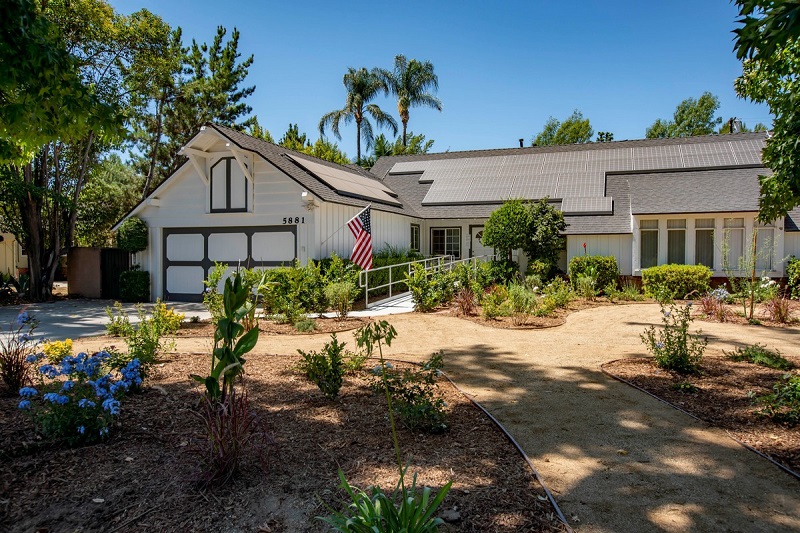
Front view of a converted assisted living home at the Cottages at the Colony, Valley Glen
Image courtesy of Cottages at the Colony
Worth flagging plainly: Wellpointe’s own model is rental-based, a bit outside Purgula’s usual homeownership focus. But we’d like to plant a speculative idea here anyway—could a similar model someday let an aging homeowner sell their house to be converted this way and remain in it as a resident, staying in the neighborhood they’ve always known? Or let a homeowner live in a prefab ADU on their own property while the main house converts? Neither exists today, as far as we know. But the underlying appeal that Wellpointe is selling to neighborhoods—that a well-run, six-resident home is a better neighbor than a poorly managed rental property—isn’t hard to imagine homeowners eventually wanting an option of this kind for themselves.
Kin
Kin is an online-only home insurer built specifically around disaster-prone states. Its presence at PCBC is a real-world counterpoint to the insurance data presented above—homeowners are hardening their homes to reduce long-term costs and prevent weather damage, not primarily to lower premiums, and Kin is effectively betting that better underwriting for resilient homes can close that gap.
MeterNet
MeterNet is a utility sub-metering and billing company for multifamily communities, helping properties bill water and utility usage at the unit level instead of splitting costs evenly. Quieter than the others on this list, but it sits in the same water-conservation territory as our past graywater coverage—part of the same broader shift toward treating water as something to be measured and managed, not assumed. It also speaks to something we’ve noticed firsthand: in our own city, aging utility meters are frequently unreliable, with usage sometimes estimated rather than measured—a frustration we’ve often seen on neighborhood forums. Technology like MeterNet’s is a direct answer to what we view as a growing, nagging distrust of utility companies.
AUAR
As this year’s Pitchfest winner, AUAR (pronounced “our”) is worth a fuller mention here: on-site robotic microfactories building wood-panel housing components, with light-gauge steel framing reportedly under consideration, designed to integrate with a builder’s existing workflow rather than ask them to change how they operate. This efficient, integration-first philosophy seems to be exactly what won the room.
One more idea worth flagging, even without a firsthand pitch to draw on: Prophetic, an AI tool aimed at evaluating and selecting land for development. Prophetic is an enterprise-grade, B2B software tool designed specifically for large-scale residential developers, national homebuilders, land brokers, and professional investors to source, analyze, and manage multi-parcel land pipelines. While not applicable for individuals looking to build a custom home, their solution underscores the importance of using AI for complicated planning decisions involving the purchase of land, such as navigating zoning regulations and property rights.
That general concept—AI-enhanced land vetting—is one we’d like to see more accessible to individual homeowners, not just developers. Though we didn’t encounter a direct equivalent for consumers at this year’s PCBC, a company doing something in that spirit—and worth a mention—is Buildora IQ, which offers address-level feasibility and floor-plan tools aimed partly at individual property owners rather than large-scale pipelines. We haven’t vetted them firsthand, so treat this as a pointer rather than an endorsement. But the underlying opportunity is real. For instance, enterprising first-time homebuyers can pair affordable, AI-vetted land with a scalable prefab ADU as a starter home—an approach particularly appealing to remote workers with more location flexibility than previous generations of buyers have had.
What We Think Matters Most
Pulling all of this together—two unrelated frameworks landing on the same definition of value, buyers pre-declaring their own deal breakers, an industry that identified its own performance-data problem without naming the technology already solving it—one thing becomes clear. The biggest takeaway from PCBC 2026 wasn’t that builders are changing. It’s that buyers already have. Builders, frameworks, and even the conference itself are simply catching up.
We said in 2023 that buyers were already choosing function over sheer size. Three years later, that instinct has a name, a metric, and—increasingly—a receipt.
Additional Housing & Construction Articles
- Why Your Next Home Should Be Built Like a Computer
- The Future of Homebuilding Arrives in Pacific Palisades
- The Forever Home Myth: Why Adaptability is More Important than Endless Love
- Redefining Luxury: Resilience, Legacy, and the Future of the Modern Home
- LGS: A Proven Opportunity for More Resilient Homes
- Designing Against Loneliness: A Look at The Granary in Milton, Delaware
- 5 Innovative Ways 55+ Communities Are Reinventing Wellness
- Related Topics: Resilience | Construction | Home Wellness | Design | Proptech
| Purgula is reader-supported. When you click on links to other sites from our website, we may earn affiliate commissions, at no cost to you. If you find our content to be helpful, this is an easy way for you to support our mission. Thanks! Learn more. |